
Young DeFi Platforms Channel Nearly $100M Back to Token Holders Within a Month
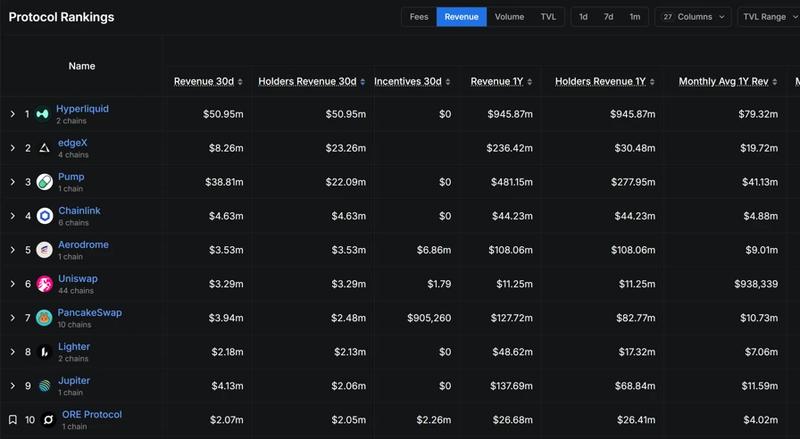
In a span of 30 days, three emerging DeFi platforms—Hyperliquid, EdgeX, and Pump.fun—channeled $96.3 million back to their token holders, signaling a fundamental transformation in cryptocurrency as the industry pivots from growth-centric metrics to revenue-driven valuations.

A trio of relatively new decentralized finance platforms—Hyperliquid, EdgeX, and Pump.fun—has collectively channeled $96.3 million to their token holders during the last 30 days, marking a notable transformation as the industry increasingly prioritizes real revenue generation.
Leading this distribution effort was Hyperliquid, which produced $50.95 million in revenue during this timeframe, with every dollar flowing directly to token holders and nothing allocated toward incentive programs, based on DefiLlama's tracking data. In second place, Pump.fun delivered $22.09 million to its holders from a total revenue pool of $38.81 million. EdgeX rounded out the top three by distributing $23.26 million to holders despite recording only $8.26 million in protocol revenue, indicating the platform may be utilizing accumulated reserves or supplementary revenue channels to compensate its holders.
When projected on an annual scale, Hyperliquid has produced $945.87 million in revenue throughout the last year, with all proceeds returned to holders, whereas Pump.fun registers $481.15 million and EdgeX records $236.42 million.
Looking at other prominent protocols, Chainlink distributed $4.63 million to holders, Aerodrome delivered $3.53 million, and Uniswap provided $3.29 million across 44 chains. PancakeSwap produced $3.94 million in total revenue but allocated $2.48 million to holders while dedicating $905,260 toward incentive programs.
Cryptocurrency Industry Pivots Toward Revenue Metrics
These figures emerge during a period when revenue generation has become the predominant measurement of success in the cryptocurrency space, with token holders demanding that protocols demonstrate value through tangible earnings instead of relying on transaction volumes or network expansion statistics.
"Nobody cares that your chain does 10x the TPS anymore," stated Robbie Klages, co-founder of The Rollup, referring to a blockchain's measure of transactions per second. "The market is 'show me the money right now.' Treat it like a business not a network growth thesis," he added.
A separate X user commented that this transition from storytelling to actual earnings is "permanent now," cautioning that protocols that cannot demonstrate genuine revenue will face valuations similar to pre-revenue startups during a rate hike environment, a comparison to the severe devaluations experienced by speculative investments when capital becomes more costly.
Decentralized Finance Evolves Into Infrastructure for Onchain Economy
Andre Cronje, founder of the popular DeFi protocol Yearn.Finance, observed that DeFi in 2026 resembles less of a speculative playground and more of operational financial infrastructure. He highlighted that stablecoins have expanded into a $320 billion market led by Tether and Circle, decentralized exchanges are processing over $160 billion in monthly spot volume and perpetual DEXs are handling $540 billion monthly.
Cronje further noted that lending protocols, including Aave, Morpho and Maple Finance, are sitting on $28 billion in active loans, while real-world assets are increasingly being used as onchain collateral. "DeFi is no longer just competing for APY. It is becoming the backend for the onchain economy," he wrote on X.