
Tokenized Traditional Assets on Crypto Platforms Surge to $6.6B, Marking Fivefold Expansion: Analysis
Research from CoinGecko reveals growing appetite for tokenized stocks and commodities across major centralized platforms, with perpetual futures contracts accounting for the majority of trading volume.

Mounting pressure from conventional brokerage firms and decentralized trading platforms is driving cryptocurrency exchanges to diversify their offerings beyond digital currencies into tokenized equities, raw materials and precious metals, according to CoinGecko.
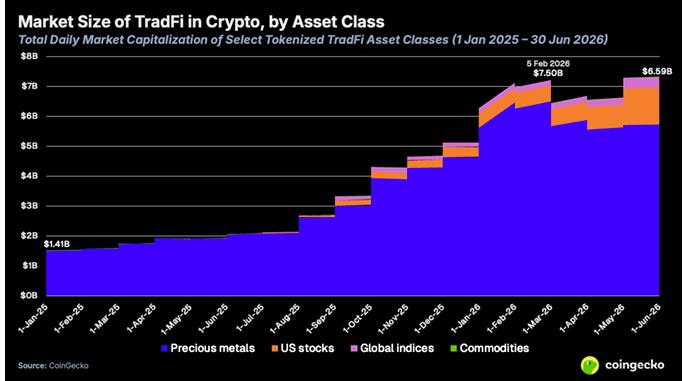
An analysis published by the cryptocurrency data aggregator on Wednesday revealed that the total market capitalization of tokenized traditional financial instruments, encompassing precious metals, United States equities, commodities, international indexes and foreign exchange, climbed to $6.6 billion in June 2026 from $1.4 billion in January 2025. The research examines trading activity on Binance, OKX, Bybit, Bitget, Gate and MEXC.
The sector's early expansion was predominantly driven by tokenized precious metals before diversifying into United States stock markets. By the middle of 2026, perpetual futures tied to US stocks had surpassed precious metals in terms of both transaction volume and open interest, propelled by trader enthusiasm for semiconductor equities and expected initial public offerings, according to the report.
Perpetual futures contracts represent the overwhelming majority of transaction activity, whereas spot trading venues remain relatively limited in size. The report indicates that derivatives products dominate the landscape because market participants favor leveraged instruments and trading platforms can introduce perpetual contracts without the need to issue or maintain custody of the actual tokenized assets.
This expansion is occurring as centralized trading platforms seek opportunities beyond cryptocurrency transactions to acquire and maintain their user bases. CoinGecko noted that competitive pressures are mounting from both decentralized exchanges, which have captured portions of market share, and conventional brokerage firms that are broadening their cryptocurrency product portfolios.
Robinhood stands among the traditional brokerage platforms that have substantially increased their cryptocurrency and digital asset product lines, highlighting the increasing convergence between conventional financial services and blockchain-based trading platforms.
Institutional demand fuels tokenization push
Institutional appetite for tokenized financial instruments continues to gain momentum. A June report by Standard Chartered projected that tokenization could help expand decentralized finance into a $2.7 trillion market by 2030 through the adoption of real-world assets. Separately, Bernstein analysts estimated the broader tokenization market could reach $4 trillion by the end of the decade as financial institutions increasingly embrace blockchain-based assets.
Like the convergence between crypto exchanges and traditional brokerages highlighted by CoinGecko, institutional adoption of tokenization underscores how fast the lines between traditional finance and blockchain infrastructure are blurring.
As Cointelegraph recently reported, BitGo and OTC Markets Group have partnered to expand access to tokenized securities for more than 150 broker-dealers. Separately, Tradable teamed with the Stellar network to bring up to $1 billion in private credit assets onchain, illustrating how banks, brokerages and crypto firms are increasingly building on the same blockchain infrastructure.