
First Amendment Protects Cryptocurrency Code as 'Functional' Expression, Coin Center Claims
According to Coin Center, cryptocurrency software qualifies as constitutionally protected expression under the First Amendment, with developers only entering the realm of regulatable activity when they maintain control over user funds and perform transactions on behalf of users.

Cryptocurrency advocacy organization Coin Center has elaborated on its position that computer code constitutes free speech and deserves constitutional protection under the First Amendment of the United States Constitution, as ambiguity persists regarding potential liability for cryptocurrency developers based on the applications of their creations.
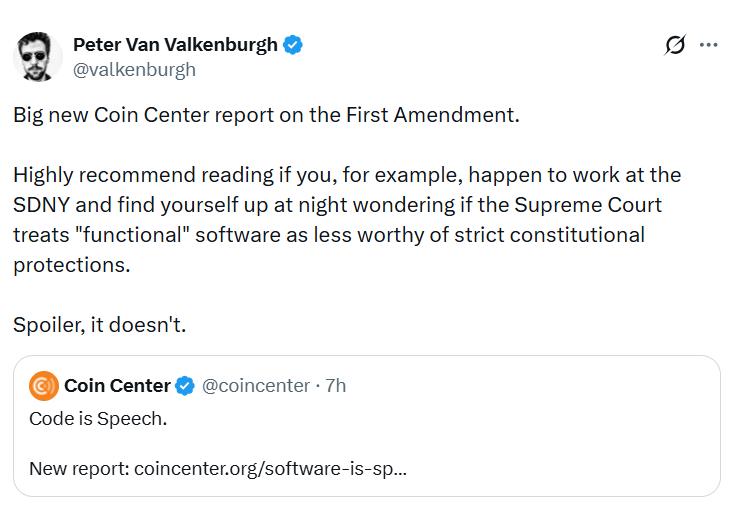
Through a report released on Monday, Executive Director Peter Van Valkenburgh and Director of Research Lizandro Pieper of Coin Center stated that creating and distributing cryptocurrency software code parallels writing a literary work or sharing a culinary recipe.
The two researchers contended that the First Amendment, which safeguards citizens' rights to free speech and expression, provides robust constitutional protections for developers whose activities are limited to publishing and maintaining software programs.
"They are speakers and inventors, not agents, custodians, or fiduciaries. Extending pre-registration or licensing requirements to this speech activity drops the historical logic of financial oversight and imposes a classic prior restraint on activities that are primarily speech and expression—which is almost always unconstitutional," they added.
Developers working in the cryptocurrency space have been pursuing legal safeguards to protect themselves from potential criminal prosecution related to the software tools they develop. The previous year witnessed multiple prominent criminal convictions of cryptocurrency developers stemming from the utilization of their software, notably including the prosecution of Roman Storm, a developer associated with Tornado Cash.
Regulation applies when devs interact directly with users
Van Valkenburgh and Pieper explained that the document aims to establish a clear framework enabling courts and regulatory bodies to differentiate between constitutionally protected software publication activities and the professional conduct of developers.
The researchers maintained that a developer transitions into territory subject to regulation when they assume control over users' assets, perform transactions on users' behalf, or make determinations for users.
"Lower court confusion over the distinction between conduct and speech naturally found in software publishing has fueled the development of what might be called a functional code theory of diminished First Amendment protection," they said.
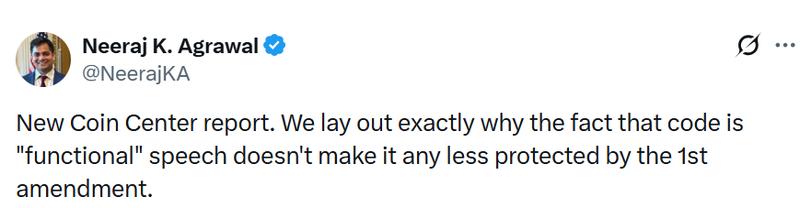
"Some courts have suggested that because software can be executed to produce real-world effects, it resembles conduct rather than speech," they added.
"We argue that such activities are pure speech and that the Supreme Court's existing jurisprudence insists on this interpretation even if some lower courts have gone astray."
The authors referenced the 1985 Supreme Court decision in Lowe v. SEC, where the highest court determined that a publisher who neither maintains custody of client assets nor takes actions on a client's behalf receives free speech protections and does not qualify as engaging in a regulated profession.
Crypto developers can't be used as scapegoats
In certain instances, cryptocurrency software has rendered specific traditional intermediaries obsolete, as self-custody wallets and peer-to-peer transaction capabilities have eliminated the necessity for a centralized authority to facilitate or hold funds.
Historically, financial institutions that act as intermediaries on behalf of users face government regulation and are obligated to obtain appropriate licenses.
Van Valkenburgh and Pieper acknowledged that while constructing regulatory frameworks for emerging technology presents challenges, designating software developers as intermediaries purely for "administrative convenience" represents an inappropriate solution.
"Crypto software does not necessitate the invention of new legal doctrines or novel carveouts. It requires the faithful application of settled First Amendment principles to a new technological context," they added.
"In the age of computers, where software is the primary means for expressing ideas and organizing economic life, those principles matter more, not less. Writing and publishing code is speech. And in a free society, speech cannot be licensed into silence."
Storm received a conviction in the prior year on charges related to conspiracy to operate an unlicensed money-transmitting business, though his legal team has been developing a motion for dismissal utilizing the Supreme Court precedent Cox Communications Inc. v. Sony Music Entertainment, asserting he lacked intent to engage in the alleged criminal activities.
The individuals who co-founded Samourai Wallet, a privacy-oriented Bitcoin wallet service, were similarly convicted on identical charges and received prison sentences ranging from four to five years.