
Coinbase Shows Bitcoin Price Discount: Will $76K Support Be Tested Again?
The sustained support at $79,000 for Bitcoin demonstrates that Coinbase's pricing discount results from stablecoin fluctuations, not weakening institutional interest.


Key takeaways:
- Coinbase's Bitcoin pricing discount appears to originate from stablecoin capital flight instead of genuine institutional selling activity.
- Strategy maintains its Bitcoin accumulation strategy while prices remain stable despite small exchange-to-exchange pricing variations.
On Thursday, Bitcoin (BTC) demonstrated strong price action by maintaining support above the $79,000 threshold. Nevertheless, concerns are emerging among certain market participants that bullish momentum may be weakening, as Bitcoin prices on Coinbase reflect a discount compared to stablecoin trading pairs available on global cryptocurrency platforms.
Stablecoin capital outflows appear to be driving Coinbase discount
Though this metric remains a subject of ongoing discussion among analysts, it could potentially indicate reduced buying pressure from institutional players, although the underlying dynamics are probably more nuanced.
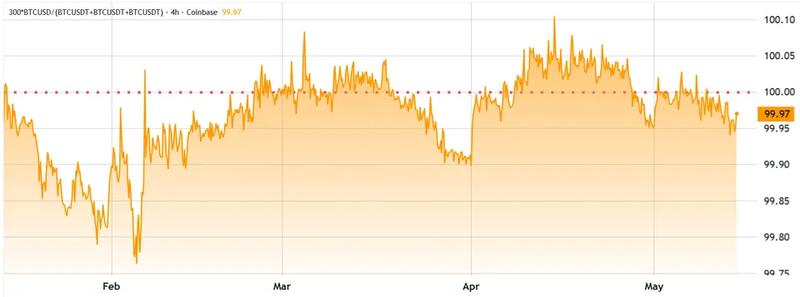
Throughout the previous week, BTC/USD pricing on Coinbase has sustained a 0.03% discount when compared with Binance, OKX, and Bybit platforms. This pricing differential marks a significant departure from the 0.04% premium that was observable in April. This transformation in market dynamics occurred concurrently with Strategy (MSTR US) acquiring 51,364 BTC throughout a three-week period.
While a relationship can be observed between institutional trading behavior and the Coinbase premium indicator, stablecoin market demand simultaneously influences this measurement. Substantial trading activity where participants convert cryptocurrency holdings back into traditional fiat currency can result in stablecoins experiencing minor devaluation relative to the dollar.
As a result, these digital assets don't consistently maintain exact parity, creating potential distortions in the apparent premium or discount observed on exchanges that use USD-denominated pairs.
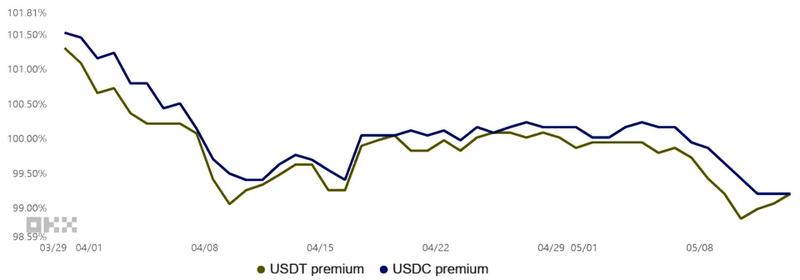
When denominated in China's Yuan, USD stablecoins presently exhibit a 0.6% discount relative to the official foreign exchange rate. This market information indicates increased desire among participants to convert cryptocurrency holdings into fiat, and represents the probable primary factor explaining the Bitcoin discount observed on Coinbase relative to pricing based on stablecoins.
Bitcoin deposits to Coinbase insufficient to indicate significant selling pressure
In essence, stablecoin valuations continue to fluctuate irrespective of whether they're denominated in dollars or Yuan.
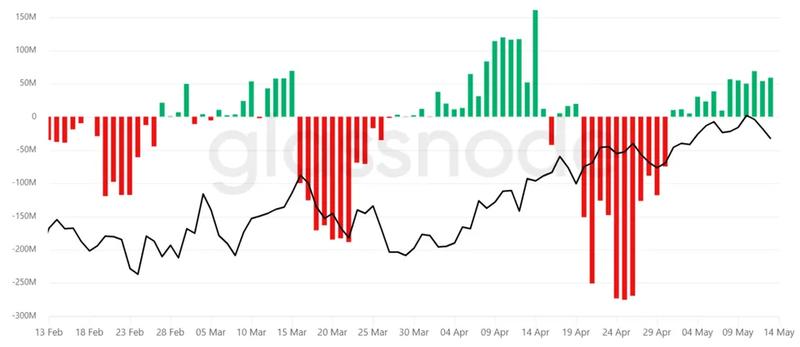
Analysis of net Bitcoin transfer activity on the Coinbase platform reveals average net incoming deposits totaling $58 million daily. This amount represents a relatively minor sum and doesn't account for the pricing divergence observed across different trading venues. By contrast, average daily net Bitcoin outflows reached a peak of $275 million in April, despite which the Coinbase premium remained unable to exceed 0.05% throughout that timeframe.
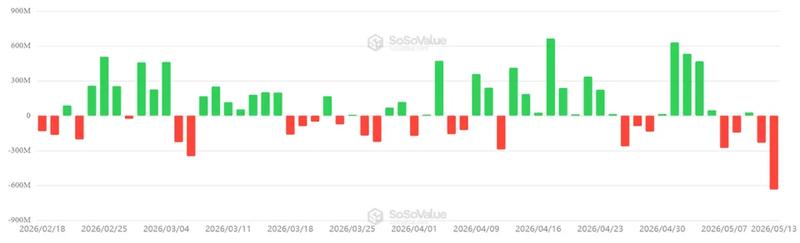
Capital withdrawals from US-listed Bitcoin exchange-traded funds (ETFs) have most likely played a role in these net incoming deposits observed at Coinbase. The $1.26 billion in aggregate net outflows documented since May 7 corresponds with the negative premium observed in stablecoins when measured against the Chinese Yuan. In addition, Bitcoin's consistent inability to surpass the $82,000 resistance threshold has weakened market confidence, creating challenges in identifying the singular primary driver of the variable Coinbase premium indicator.
A 5% price pullback in Bitcoin from the $82,840 high point reached on May 6 shouldn't generate significant concern, particularly given Strategy's ongoing expansion of its holdings through continuous stock issuances. Even more significantly, the Bitcoin/USD pricing discount observed on Coinbase doesn't serve as a dependable gauge of institutional market participation. Additionally, analysis of Coinbase exchange transfer volumes shows no unusual patterns or evidence of widespread panic liquidations.
The resilience Bitcoin demonstrated above $81,000 on Thursday clearly indicates that pricing disparities across different exchanges lack sufficient influence to determine broader price trajectory. In conclusion, the probability of support being retested at $76,000 in the immediate timeframe remains minimal notwithstanding these technical pricing anomalies.