
Taiwan Enacts Comprehensive Cryptocurrency and Stablecoin Regulatory Framework
In a landmark move, Taiwan's parliament has approved the country's inaugural cryptocurrency and stablecoin regulatory framework, designed to position the nation within the worldwide digital asset ecosystem.

On Tuesday, legislators in Taiwan approved legislation that creates a comprehensive regulatory structure for cryptocurrency, encompassing licensing requirements and stablecoin governance provisions.
According to the Financial Supervisory Commission (FSC), Taiwan's financial regulatory authority, the Legislative Yuan enacted legislation mandating that every virtual asset service provider, or VASP, must secure regulatory authorization before commencing operations.
Under the newly enacted legislation, stablecoins that are issued within Taiwan must receive authorization from both the central bank and the FSC, while those who issue them are required to keep adequate reserves with a trustee and submit to periodic audits.
This legislation marks Taiwan's inaugural effort to regulate cryptocurrency and stablecoins, aligning the country with regional counterparts including Japan, Singapore and Hong Kong, which have previously enacted regulatory frameworks for the sector as they seek to draw the industry to their markets.
According to the FSC, the legislation enhances protections for traders' interests, and the authorization of stablecoins will facilitate Taiwan's integration into the international marketplace and establish its position in the worldwide crypto market.
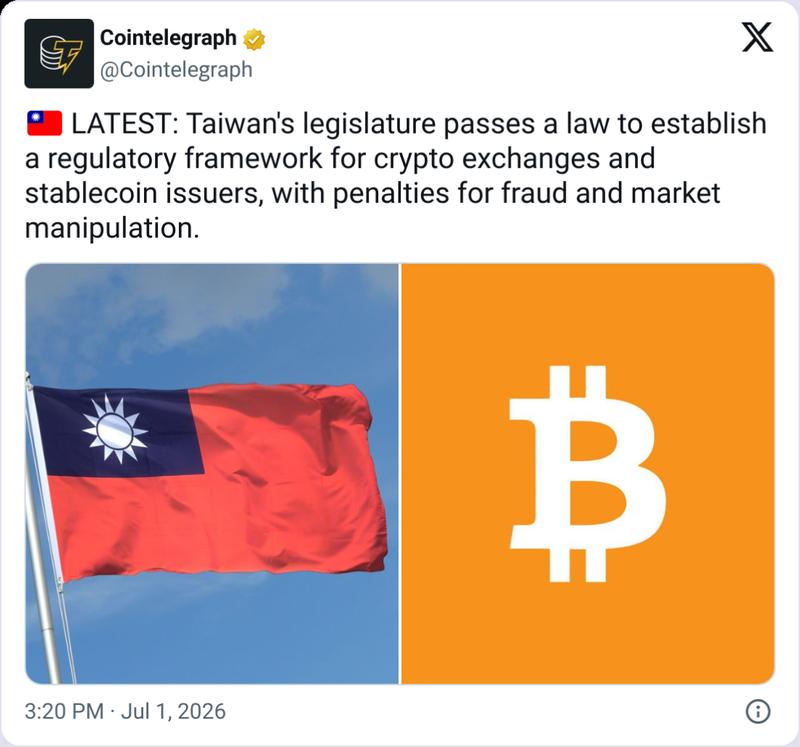
The regulatory framework established by Taiwan identifies seven categories of VASPs, which include exchanges, trading platforms, custodians and lenders, all of which will need to comply with requirements for internal control and audits, cybersecurity systems, crypto listing and delisting rules, customer asset segregation and financial reporting.
The regulatory framework prohibits crypto-based fraud and price manipulation, imposing prison sentences of between three and 10 years on violators along with fines that range from approximately 10 million New Taiwan dollars ($300,000) to 200 million New Taiwan dollars ($6.3 million).
Individuals found to be operating a VASP or issuing a stablecoin without obtaining proper licensing face prison sentences of up to seven years along with fines reaching 100 million New Taiwan dollars ($3.1 million), according to Tuesday's report from CNA, Taiwan's national news agency.
The date when the bill will be implemented remains to be decided, and the legislation will only become effective following its publication by the executive branch of the government.
According to the FSC, VASPs that have completed their anti-money laundering registration prior to the bill's implementation, along with institutions providing related services under the agency's purview, must submit applications for licensing within a 12-month period following the bill's implementation.
Lawmakers also approved a resolution requesting the FSC to develop a proposal within one year that outlines the pathway for the crypto industry to offer derivative crypto commodity services, as reported by CNA, with the objective of enabling diversified investments and enhancing the overall health of the sector.