
Minnesota and Rhode Island become epicenters of prediction market legal conflicts
Legal disputes intensify as Kalshi initiates lawsuit against Minnesota, and CFTC takes action against Rhode Island, with escalating conflicts between state regulators and federal authorities potentially destined for Supreme Court review.

Companies operating prediction market platforms and the US Commodity Futures Trading Commission (CFTC) are pressing forward with legal challenges against authorities at the state level, with Rhode Island and Minnesota emerging as the newest focal points of contention.
Minnesota Governor Tim Walz put his signature on legislation last week that modified existing statutes to ban the advertising, creation, operation, or facilitation of prediction market platforms in any capacity. The action triggered a response from CFTC Chair Michael Selig, who initiated federal court proceedings within 24 hours, accusing Minnesota and state officials of implementing what he characterized as the "first outright ban" targeting prediction markets.
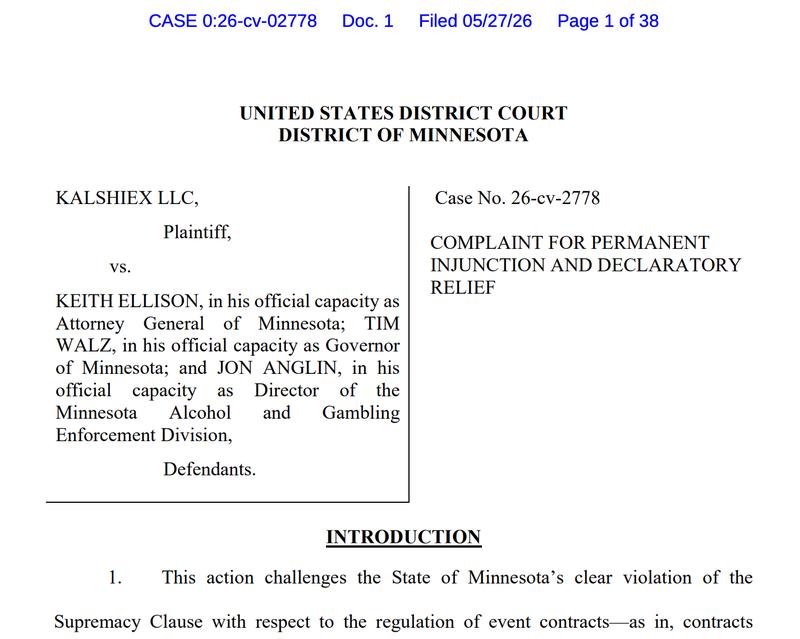
This development paved the way for Kalshi to take legal action on Wednesday, mounting a constitutional challenge against Minnesota's new legislation. The platform operator reinforced contentions previously advanced by Selig, asserting that under the Commodity Exchange Act, the CFTC possessed "exclusive authority" over prediction markets, and citing the Supremacy Clause of the US Constitution, maintained that federal legislation superseded state-level regulations.
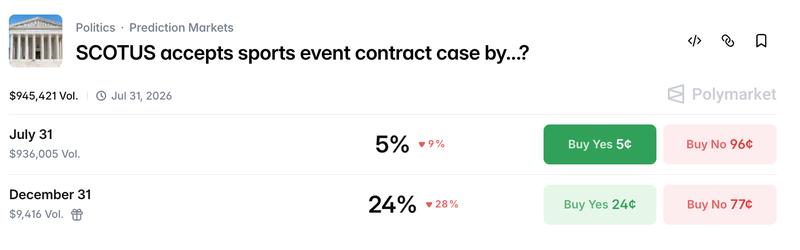
At the heart of both Kalshi's and Selig's legal arguments lies the assertion that event contracts available on prediction market platforms constitute "swaps" that are traded on contract markets with federal designation and therefore fall under CFTC jurisdiction instead of state regulatory control. While certain courts have dismissed this line of reasoning, other judicial bodies have ruled in favor of Kalshi and the CFTC, creating the conditions for a possible Supreme Court of the United States review.
The CFTC revealed on Thursday that it had submitted a joint filing alongside Kalshi targeting Rhode Island state officials. The intervention motion reinforced the agency's earlier assertions regarding its regulatory authority over prediction markets, which originated from Rhode Island Attorney General Peter Neronha initiating legal proceedings against Kalshi and Polymarket, seeking a judicial determination that the platforms' sports-focused "event contracts" constituted gambling wagers.
Donald Trump weighs in, despite family ties to prediction markets
US President Donald Trump utilized social media on Wednesday to voice his position, asserting it was "critically important" for the CFTC to maintain exclusive regulatory jurisdiction over prediction markets. His son, Donald Trump Jr., serves in an advisory capacity to both Kalshi and Polymarket and has financial stakes in the latter through his venture capital firm, 1789 Capital.
"We want to remain at the top," said Trump, making reference to prediction markets while directing criticism toward state officials responsible for some of the legal actions targeting Kalshi and Polymarket.
Both platforms have faced examination from members of the US Congress stemming from apprehensions that elected officials might be participating in insider trading activities. Last week, the chair of the House of Representatives' Oversight and Government Reform Committee issued requests for the CEOs of Kalshi and Polymarket to provide responses to inquiries regarding how their companies address insider trading concerns.