
MiCA Enforcement Era Begins as EU Crypto Transition Period Concludes
Following the conclusion of MiCA's transition period, the European Union has begun enforcing regulations against crypto firms lacking proper authorization, mandating operational shutdowns and threatening significant financial penalties.

A fresh enforcement era has begun for the cryptocurrency sector in the European Union following the conclusion of the transitional period under the Markets in Crypto-Assets (MiCA) framework.
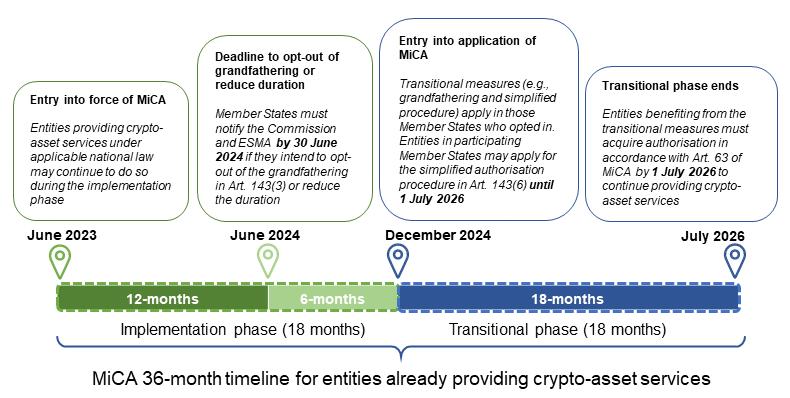
With the transitional period now concluded, cryptocurrency firms operating without proper MiCA authorization are prohibited from legally providing services to clients within the EU and must cease their operations or risk facing substantial fines reaching into the millions of euros alongside additional regulatory enforcement measures.
Legal professionals and industry leaders speaking with Cointelegraph indicated that the upcoming hurdle involves guaranteeing that regulators at the national level implement the unified rulebook of the bloc in a consistent manner, despite anticipated differences in how supervision is conducted among different member states.
This transition represents the initial significant enforcement examination for MiCA as regulatory bodies commence implementing the European Union's regulatory framework for cryptocurrencies.
MiCA compliance costs versus fines
While achieving compliance with MiCA regulations may require expenditures ranging from hundreds of thousands to several million euros, industry specialists emphasize that conducting business without the necessary authorization presents substantially higher financial and regulatory hazards.
According to Nicola Massella, partner at Legal & Resilience, the implementation expenses for MiCA compliance among numerous cryptocurrency firms range between 350,000 euros ($400,000) and 600,000 euros ($690,000), whereas Edwin Mata, CEO of Brickken, indicated that expenses can escalate to 2 million euros ($2.3 million) based on factors such as a firm's operational scale, service offerings and preparedness for compliance requirements.
Regarding financial penalties, Eckehard Stolz, managing director of Amina EU, explained that MiCA's penalty framework begins at 5 million euros or 5% of yearly turnover for certain infractions.
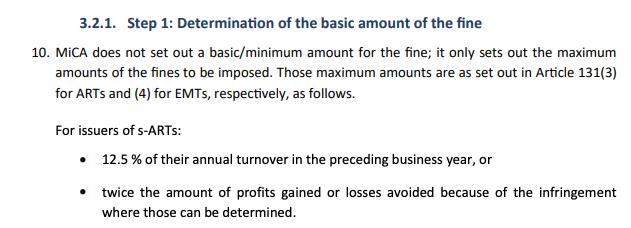
Massella further noted that on June 26, the European Banking Authority (EBA) put forward recommendations to enhance penalties within specific regulatory frameworks, including potential fines reaching as high as 12.5% of yearly turnover for certain violations related to stablecoins.
Who enforces MiCA?
Although MiCA establishes a unified regulatory framework across the EU, the responsibility for daily supervisory activities rests with national competent authorities (NCAs), which handle the authorization, supervision and enforcement of regulations governing cryptocurrency firms.
The European Securities and Markets Authority (ESMA) performs a coordinating function for supervision throughout member states and maintains the official registry of licensed crypto-asset service providers, while the EBA assumes direct oversight responsibility for major stablecoin issuers.
At the EU level, ESMA plays an important coordination and supervisory-convergence role, especially to avoid regulatory arbitrage between member states.
Ivo Grlica, founder of GrlicaLaw and G LAB Advisors
"National regulators are only the first line of MiCA enforcement, but the legal consequences can spread into national courts and criminal-law systems if the underlying conduct causes harm," he added.
Enforcement unlikely to be uniform at first
Uniform enforcement of MiCA regulations is improbable during the initial implementation phase due to variations among NCAs regarding available resources, regulatory experience and supervisory focus areas.
"ESMA made clear it expects NCAs to act against unauthorized providers from July 1," Stolz said, adding that how aggressively each regulator moves "will depend on local resourcing and priorities."
According to Peter Bidewell, vice president of institutional product adoption at Parfin, the varying supervisory methodologies among regulators might generate possibilities for regulatory arbitrage, despite MiCA's objective of creating harmonized cryptocurrency regulations throughout the European Union.
Grlica indicated his expectation that enforcement will evolve toward greater systematization as time progresses, with regulators identifying providers operating without authorization and exchanging intelligence among member states, thereby making it progressively more challenging for firms with records of non-compliance to secure MiCA authorization at a later date.
Multiple regulatory authorities throughout the EU, including those in the Czech Republic, Bulgaria, Luxembourg and Italy, have published official communications reminding cryptocurrency businesses that MiCA's transitional period has concluded and advising service providers lacking authorization to commence winding down their business activities.
In a statement to Cointelegraph, the Czech National Bank explained that the nation's Financial Market Digitization Act provides it with the legal authority to levy sanctions for violations related to MiCA, including conducting operations without proper authorization, unlawful offerings of tokens and failure to cooperate with regulatory supervisors. Under this legislation, the central bank possesses the power to impose fines on firms delivering crypto services without authorization of up to 118.5 million Czech koruna (approximately $5.6 million), 5% of yearly turnover if that amount is higher, or double the unlawful benefit gained, selecting whichever sum is largest.
Cointelegraph reached out to France's Autorité des marchés financiers (AMF), the Netherlands' Authority for the Financial Markets (AFM) and Germany's Federal Financial Supervisory Authority (BaFin) to inquire about their enforcement strategies for MiCA regulations following the conclusion of the transition deadline. At the time of publication, none of these authorities had provided responses.