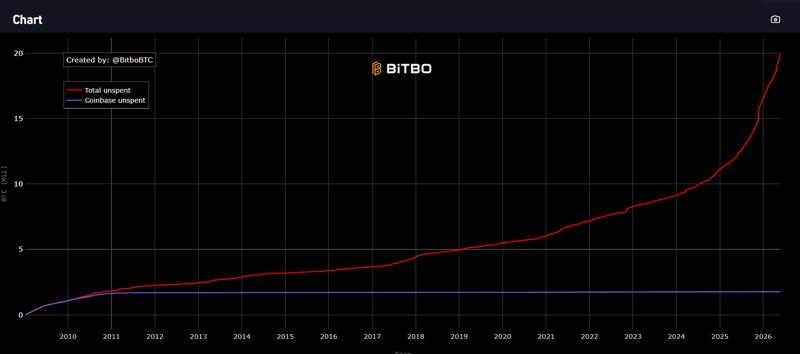
Bitcoin Property Rights Battle Emerges in New York Court Over Inactive Wallets
Legal action in New York targets 39,069 inactive Bitcoin wallets, sparking debate about cryptocurrency ownership, cryptographic keys and abandoned property regulations.

Legal proceedings initiated in New York by Noah Doe alongside two limited liability companies based in Wyoming—ABC Company and XYZ Company—are requesting judicial determination of ownership rights to 39,069 inactive Bitcoin addresses, sparking significant legal debate regarding how dormant cryptocurrency should be treated under existing property legislation.
The legal action, submitted on May 1, contends that the cryptocurrency associated with the enumerated addresses constitutes property that has been legally abandoned, which the plaintiffs discovered and subsequently reported to the New York Police Department before filing a claim pursuant to New York's regulations governing lost property.
According to the plaintiffs' assertions, the inactive Bitcoin wallets represent property that has been legally "abandoned," encompassing wallets associated with Bitcoin's earliest miners and addresses connected to Bitcoin's pseudonymous creator Satoshi Nakamoto, alongside additional lost cryptocurrency and wallets linked to unidentified parties. The plaintiffs maintain these should be treated as recoverable assets, comparable to conventional banking accounts.
The legal challenge presents crucial questions regarding how the justice system should handle Bitcoin wallets that have remained inactive for extended periods, including tokens from the Satoshi era that haven't seen movement in more than ten years. Though the legal foundation supporting the lawsuit appears dubious, uncertainty remains regarding how the plaintiff could actually retrieve the lost Bitcoin in the absence of possessing the cryptographic private keys necessary to access these wallets.
Nevertheless, even in a scenario where judicial authorities ruled favorably for the plaintiff, such a decision would amount to nothing more than a symbolic gesture lacking technical enforceability, given that the Bitcoin network lacks any system to "reassign funds without a private key," according to Noveleader, lead research analyst at investment research firm Castle Labs, in comments provided to Cointelegraph, who further stated:
"The one narrow exception would be if any of these coins are moved to a regulated custodian or exchange, at which point a court could compel that intermediary to act."
The research analyst contended that a substantial percentage of these coins likely belong to holders who have passed away, individuals who have lost access to their keys or simply long-term investors who haven't executed transactions, emphasizing that none of these scenarios legally qualify as abandonment.
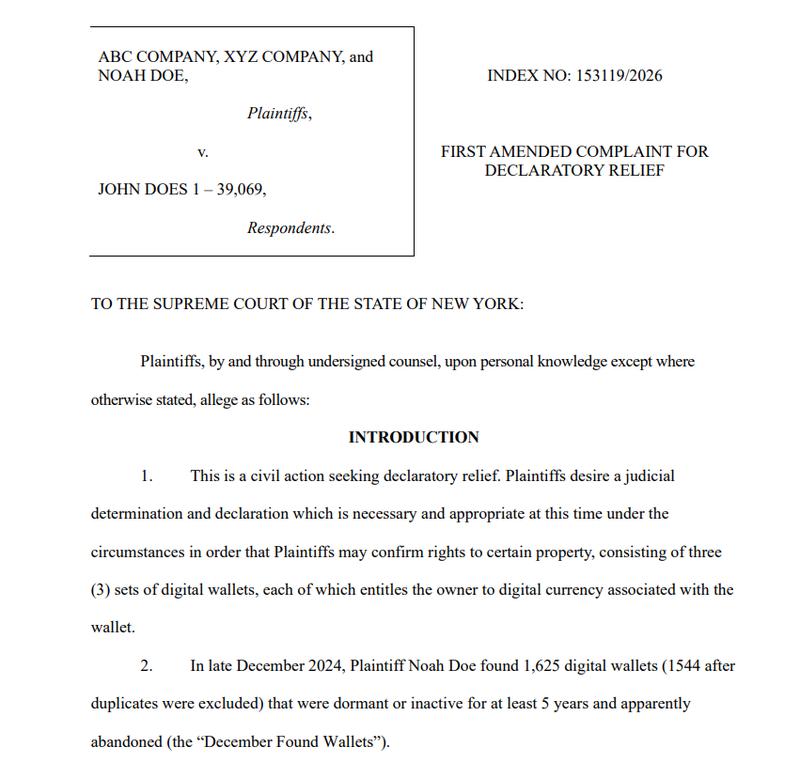
Legal action targets Satoshi's holdings, Mt. Gox attacker's Bitcoin cache
The extensive 901-page legal filing enumerates 39,069 Bitcoin wallet addresses in total, among them wallet address "12c6D" linked to Satoshi Nakamoto and address "1Feex" connected to the individual who hacked the Mt. Gox exchange.
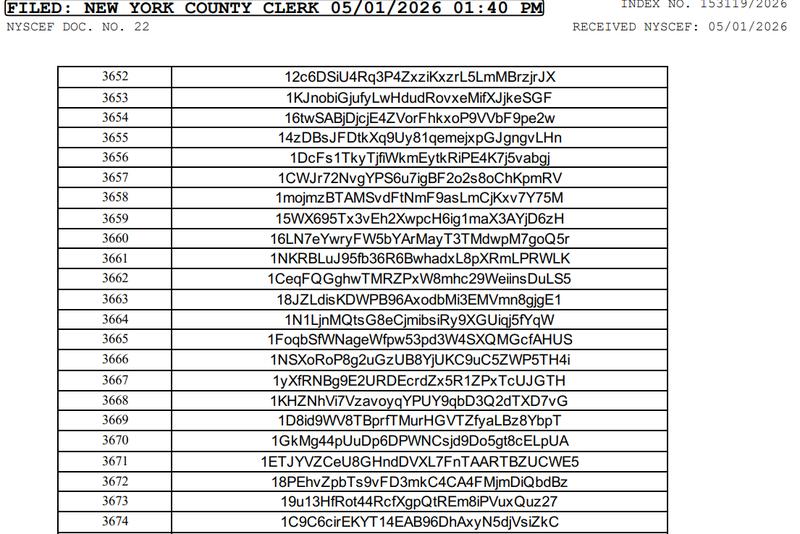
The wallet addresses enumerated in the filing contain approximately 3.7 million BTC, with a current valuation around $285 billion, based on analysis from Sani, who founded Bitcoin onchain analytics platform Timechain Index.
The platform's founder additionally observed that the majority of these vintage Satoshi-era tokens currently exist in Pay-to-Public-Key (P2PK) output formats, whereas the plaintiffs exclusively delivered legal notifications to the corresponding hashed public key utilizing Pay-to-Public-Key-Hash (P2PKH) formats, which frequently contain no assets.
This technical discrepancy could potentially weaken the assertion that adequate notice regarding abandonment was provided to the wallet holder, given that plaintiffs directed the legal notifications to the vacant P2PKH addresses, whereas the genuine BTC holdings remain in unnotified P2PK scripts.
The lead research analyst from Castle Labs concurred with this assessment, noting that the notification attempt was "structurally defective" due to being directed to address formats that the targeted wallets no longer utilize. Transmitting a minor transaction through the OP_RETURN function would prove "similarly ineffective" since it only functions with active recipients who are monitoring their wallets.
The more than 39,000 wallets referenced in the legal filing contain Bitcoin classified as dormant, or lost, indicating that they have not experienced any onchain circulation for several years.