
European Central Bank objects to stablecoin expansion plans over systemic risk concerns
EU finance ministers received a cautionary message from the European Central Bank regarding plans to scale up euro-denominated stablecoin operations, with concerns centered on potential disruption to banking systems and monetary policy effectiveness.

On Friday, the European Central Bank issued warnings to finance ministers across the European Union regarding proposals aimed at expanding the issuance of euro-backed stablecoins, expressing concerns that such expansion could undermine traditional bank lending mechanisms and introduce complications to monetary policy implementation, as reported by Reuters citing three informed sources.
These objections emerged as a direct response to a policy document drafted by Bruegel, a think tank headquartered in Brussels. The organization's researchers delivered their recommendations during the two-day informal gathering of the Economic and Financial Affairs Council held in Nicosia, Cyprus. Their proposal advocated for relaxing the liquidity obligations imposed on stablecoin issuers while exploring the possibility of providing them with access to ECB funding facilities. The authors contended that such steps would be essential for enabling the euro stablecoin sector to achieve competitive parity with stablecoins backed by the US dollar.
Despite European users representing 38% of worldwide stablecoin transaction activity, stablecoins denominated in euros comprise a mere 0.3% of the total stablecoin supply in circulation, the policy document revealed. Circle's EURC (EURC), which holds the position as the most significant euro-denominated stablecoin, occupies only the 12th position in global rankings, based on data from CoinMarketCap.
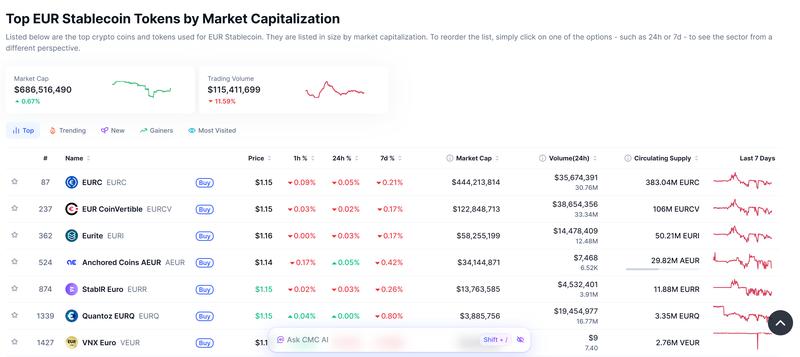
The central question being deliberated during the Nicosia gathering was whether European policymakers possess sufficient motivation to bridge this disparity by offering central bank-level support mechanisms to stablecoin issuers. Based on current indications, the ECB's response to this proposition appears to be negative.
Euro stablecoins could destabilize banks
Christine Lagarde, serving as ECB President, spearheaded the opposition to these proposals, cautioning that the process of issuing stablecoins undermines the stability of bank deposits through the transfer of purchasers' funds into the accounts of stablecoin issuers, Reuters sources reported. When implemented at significant scale, authorities are concerned this dynamic would hasten the process of disintermediation, elevate the costs associated with bank funding operations, and diminish the ECB's capacity to effectively regulate interest rate levels.
Multiple central banking officials participating in the meeting also voiced explicit skepticism regarding the Bruegel recommendation that would establish the ECB as a lender of last resort for companies operating in the stablecoin space, a privileged status that is presently exclusive to institutions with formal banking regulations, the report indicated.
During remarks delivered at the Banco de España LatAm Economic Forum held in Spain in early April, Lagarde acknowledged that euro-denominated stablecoins might stimulate increased demand for safe assets originating from the euro area, yet emphasized that the disadvantages, encompassing threats to financial system stability, pressures related to redemption processes, and diminished effectiveness of monetary policy transmission mechanisms, surpass any potential advantages.
Rather than endorsing stablecoins, Lagarde advocated for tokenized financial infrastructure that remains anchored by central bank-issued money as the optimal direction for Europe, referencing the Eurosystem's Pontes project designed for wholesale settlement operations and the Appia roadmap focused on creating interoperable tokenized finance systems.
EU central bankers shrug off digital dollarization fears
The researchers from Bruegel issued warnings that the comparatively more stringent regulatory framework in the EU relative to the United States created risks of hastening digital dollarization trends, potentially driving economic activity beyond the bloc's borders. Nevertheless, central banking officials assembled at the meeting predominantly rejected this apprehension, with multiple participants instead advocating for the implementation of limitations on European redemptions affecting both US-issued and EU-issued stablecoins as a protective measure against reserve depletion scenarios, according to the Reuters account.
This ongoing discussion unfolds as the European Union conducts its review of the Markets in Crypto-Assets (MiCA) regulation, which mandates that stablecoin issuers maintain substantial reserves held in liquid asset forms, representing a stark contrast to the more permissive regulatory approach embodied in the US GENIUS Act.