
Binance Refutes WSJ Claims of $850M in Transactions Connected to Iran
Richard Teng, CEO of Binance, has rejected allegations from a recent Wall Street Journal article that $850 million in Iran-related transactions passed through the platform to the IRGC.

Richard Teng, the Chief Executive Officer of Binance, has contested a recent Wall Street Journal investigative piece that alleges the cryptocurrency exchange facilitated $850 million worth of transactions connected to a sanctioned Iranian financier, with funds ultimately reaching Iran's Islamic Revolutionary Guard Corps.
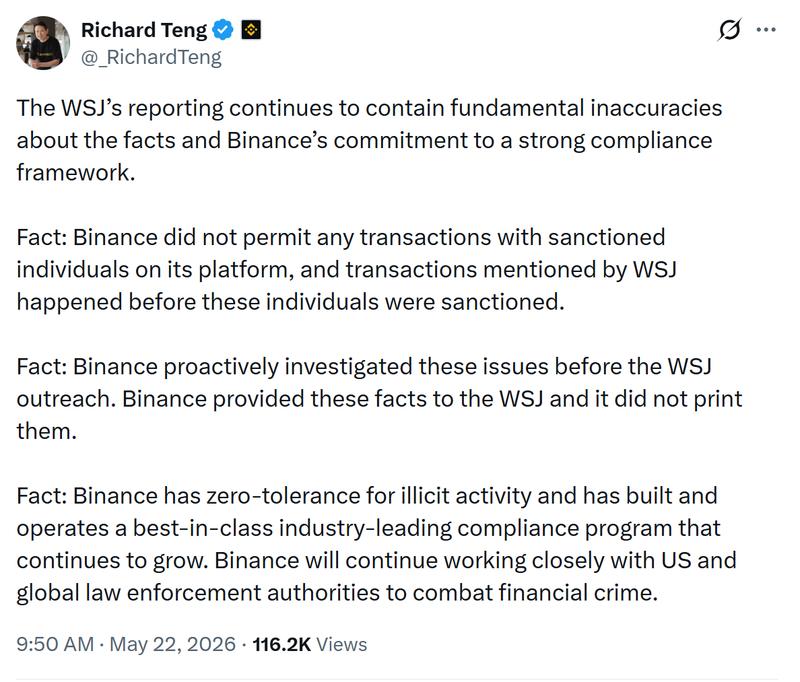
Through a post shared on X this past Friday, Teng characterized the Journal's reporting as "fundamentally inaccurate," asserting that the exchange has never allowed transactions involving sanctioned parties and that any suspicious activity identified took place prior to the individuals being added to US sanctions lists. Teng further stated that Binance had already launched its own investigation into these matters before the Journal reached out to the company, and that critical facts the exchange provided were omitted from the published article.
The investigative piece from the Journal, which went live on Thursday, named Babak Zanjani, who faced renewed US sanctions in January, as the key player behind a covert cryptocurrency payment system that channeled $850 million through various Binance accounts during a two-year period. According to the report, Zanjani's business entity Zedcex, alongside accounts registered to his sister, his romantic partner and a company director, all showed activity from identical devices.
According to the Journal's findings, Binance's internal compliance monitoring systems raised red flags on the Zedcex account following the detection of access points originating from Tehran in late 2024. Despite this, the account continued operating for more than a year, generating over a dozen additional internal warnings. The Journal reports that Binance's own compliance investigators put forward recommendations to close the accounts and notify relevant authorities, yet the accounts purportedly continued to remain operational.
WSJ alleges Binance permitted Iranian transactions post-settlement
In 2023, Binance entered a guilty plea to violations related to anti-money laundering protocols and sanctions enforcement, resulting in a historic $4.3 billion penalty and a commitment to completely revamp its compliance infrastructure. Nevertheless, the Journal's reporting suggests that the purported flow of Iranian funds recommenced not long afterward.
Back in March, the Journal published another report indicating that the Justice Department has launched an investigation into Iran's alleged use of the Binance platform to circumvent sanctions following that guilty plea. In response to that March report, Binance initiated a defamation lawsuit against the news organization, pursuing both monetary damages and a jury trial. The cryptocurrency exchange has denied having any awareness of a DOJ investigation, informing Cointelegraph that it maintains ongoing cooperation with both regulators and law enforcement authorities.
In addition to Zanjani's network of transactions, the Journal's latest report asserted that Iran's central banking institution transferred $107 million in cryptocurrency into Binance accounts throughout 2025, while a foreign law-enforcement organization traced approximately $260 million in direct transaction activity between Binance accounts and Iranian individuals involved in terrorist financing during the 2024 and 2025 timeframe.
Binance has zero-tolerance for illicit activity and has built and operates a best-in-class industry-leading compliance program that continues to grow.
Richard Teng on X
Binance rejects allegations of terminating internal Iran investigation
This past February, an additional Journal article claimed that Binance had terminated an internal compliance investigation examining approximately $1 billion that had moved through the exchange to networks with connections to Iranian proxy organizations. Binance refuted claims of shutting down any compliance-related investigation, maintaining that its internal examination remained active and revealed a complex, multi-jurisdictional pattern of financial transactions spanning Asia, the Middle East and additional regions.
The cryptocurrency exchange additionally released a blog post responding to what it described as inaccurate allegations, and in a separate action, provided a response to a Senate inquiry in March, refuting claims that it enabled transactions to entities based in Iran.