Glassnode: Bitcoin Price Faces Critical $87.7K Barrier as Late 2025 Buyers Create Resistance
Investors who purchased Bitcoin during the closing months of 2025 are contributing to sustained BTC price resistance above the $87,000 threshold, according to fresh research published by Glassnode.

Analysis shows that Bitcoin (BTC) holders currently experiencing unrealized losses are limiting upward price movement at the $87,700 level, even as exchange-traded fund inflows bolster support around the $80,000 mark.
Key points:
- Those who acquired Bitcoin during the final portion of 2025 have a collective cost basis hovering around $87,700, creating a resistance zone according to Glassnode's analysis.
- Multiple resistance points cluster just above $87,000, encompassing the 2026 opening price at $87,490 and the 20-month moving average positioned at $87,165.
- Support for Bitcoin price at the $80,000 level gains strength as bidding liquidity concentrates around this key psychological threshold.
Late 2025 Bitcoin purchasers contribute to $87,000 resistance cluster
Fresh analysis from blockchain analytics firm Glassnode demonstrates that the break-even threshold for a specific group of recent Bitcoin investors is presently functioning as a resistance barrier.
Throughout the current year, two distinct cohorts of holders have prevented BTC/USD from advancing beyond their respective acquisition cost foundations once challenged.
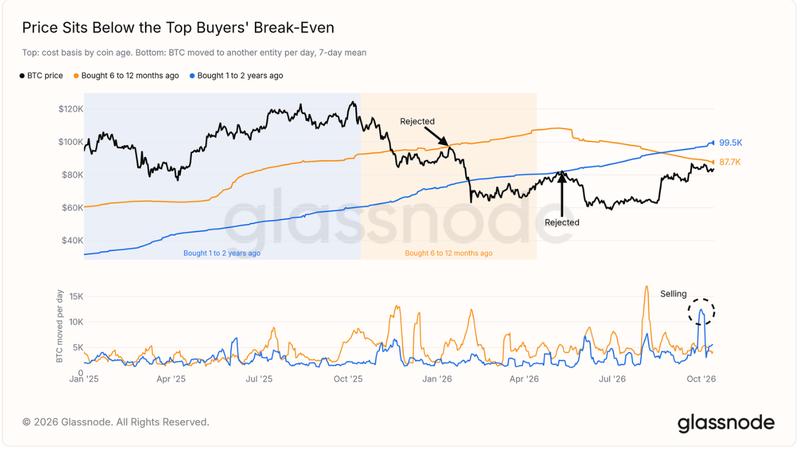
During November 2025, the market price dropped below the cost basis of holders who had entered positions between six and 12 months earlier, which stood at $94,000 during that period. As price made an effort to surpass the trendline at $97,100 during January 2026, this level transformed into resistance, prompting a reversal that pushed prices downward.
An analogous resistance pattern emerges from the cost basis of holders who purchased BTC within a one-to-two-year timeframe. This particular group entered aggregate losses during February of the present year when price fell beneath their cost basis of $76,900. During May, this cost basis stopped an upward price recovery just beyond $82,000.
In each instance, investors holding underwater positions and seeking to exit at their breakeven points created substantial sell-side pressure that incoming demand failed to overcome. In their commentary, Glassnode highlighted the magnitude of BTC price pullbacks following rejections at either cost basis level.
Bitcoin rose to the 6-12 month cost basis in January and then fell by more than a third. It met the 1-2 year cost basis in May and fell by about a quarter. The 1-2 year holders also stepped up their selling into the rally at the start of October.
The cost foundations for the six-to-12-month holder group and one-to-two-year holder group currently sit at $87,700 and $99,500, in that order.
The region situated above $87,000 additionally encompasses the opening price for 2026 at $87,490 alongside the 20-month simple moving average (SMA) for BTC/USD at $87,165, a threshold that has historically signaled the approach of fresh all-time highs once successfully converted into support.
Exchange-traded fund cost basis establishes fresh BTC price support zone
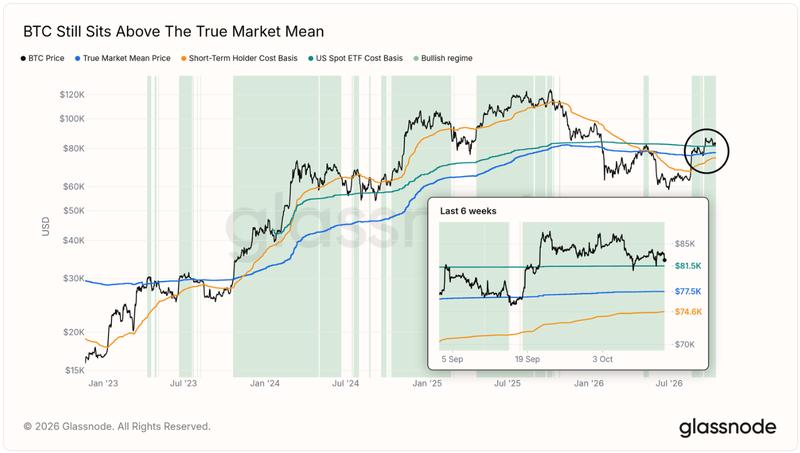
Beneath the current spot market price, the cost basis associated with United States spot Bitcoin exchange-traded funds (ETFs) represents one of multiple noteworthy support thresholds concentrated around the $80,000 area.
According to Glassnode's calculations, the spot ETF cost basis stands at $81,500, whereas Bitcoin's true market mean — representing the cost basis for all BTC purchased through secondary market transactions — is positioned at $77,500. Beneath this threshold, the break-even level of Bitcoin's short-term holder cohort — defined as wallet entities maintaining a specific quantity of BTC for a maximum of six months without executing sales — is located at $74,600.
Serving as a significant psychological benchmark, the $80,000 level has emerged as an attraction point for bid liquidity throughout exchange order books.
The block sits just under the US Spot ETF Cost Basis, so the zone between $80K and $81.5K is where order-book and on-chain support overlap. A break below it would bring the liquidation cluster just under $80K, and then the True Market Mean near $78K, into play.
Glassnode