
France's Senate Passes Legislation Enabling Cross-Border Crypto Tax Information Exchange
French lawmakers in the Senate have approved legislation that will enable international tax authorities to automatically share information about cryptocurrency assets, though the measure still requires full legislative approval.

France's Senate has given the green light to legislation that would enable tax officials to share cryptocurrency transaction information automatically with international counterparts.
Following its first reading approval on Tuesday, the legislation was forwarded to the National Assembly, designated as Bill no. 3421, where it will undergo further review.
The proposed legislation encompasses provisions for a new agreement focused on cryptocurrency tax data sharing, along with revisions to a pre-existing arrangement concerning financial account data exchange.
The cryptocurrency-focused agreement draws its foundation from the Crypto-Asset Reporting Framework (CARF), an initiative created by the Organisation for Economic Co-operation and Development (OECD). CARF establishes uniform reporting standards that enable participating nations to gather and systematically exchange data related to cryptocurrency transactions.
Crypto reporting requirements were previously established in France via the 2025 Finance Act, which put into practice the cryptocurrency reporting modifications to the European Union's Directive on Administrative Cooperation, commonly referred to as DAC8. Under these regulations, cryptocurrency service providers must disclose customer identification details and transaction records to tax officials, who subsequently distribute this data to tax authorities in the EU nations where users maintain residency.
Additional cryptocurrency taxation modifications are currently under consideration by French legislators as part of the 2027 budget discussions. On Oct. 16, the National Assembly approved an amendment that would subject profits from conversions into specific fiat-pegged stablecoins to taxation beginning Jan. 1, 2027. This provision has not yet been enacted into law.
Budget discussions focusing on the revenue component resumed on Tuesday among lawmakers, with the final vote planned for Nov. 3.
EU's planned crypto tax repository raises data security, wrench attack concerns
The tax disclosure requirements mandated by DAC8 have sparked concerns regarding data protection, given that the framework necessitates the exchange of personally identifiable information—such as full names, residential addresses, taxpayer identification numbers, and trading volumes—across EU tax administration agencies, according to Faustine Fleuret, global head of public affairs at lending protocol Morpho, in her conversation with Cointelegraph.
"In a country where crypto holders have been physically targeted, a leaked list of who trades what, and for how much, is not only a privacy issue but first and foremost a safety issue."
A centralized database for cryptocurrency reporting data is scheduled to be established by the European Commission before the conclusion of 2026. Tax agencies from every member nation would gain access to records pertaining to their respective tax residents.
According to Fleuret, consolidating such sensitive information in one location could establish a "single point of failure" that would put private cryptocurrency transaction records at heightened risk.
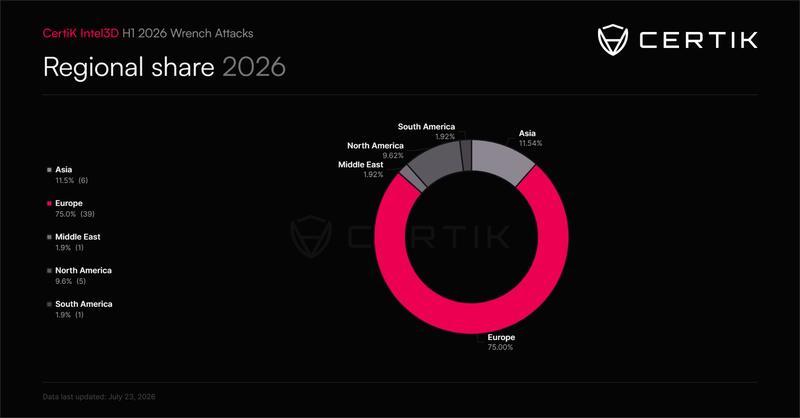
Fleuret's concerns come amid a troubling surge in physical assaults against cryptocurrency holders, commonly termed wrench attacks. Throughout the initial six months of 2026, France was the location of 33 out of 52 confirmed wrench attacks documented globally, based on data compiled by blockchain security company CertiK.
One notable March incident involved a French couple in their late 50s who fell victim to criminals impersonating law enforcement officers, losing approximately $1 million worth of Bitcoin in the robbery.