
Saylor Hints at Upcoming Bitcoin Acquisition While Strategy Shareholders Vote on Dividend Schedule Changes
Executive leadership at Strategy used social platforms on Sunday to promote the company's Bitcoin accumulation approach as stockholders prepare to finalize voting on a measure introducing semi-monthly preferred share dividend distributions.

Those following Strategy closely received what they anticipated on Sunday when executive chairman Michael Saylor utilized social media platforms to hint at forthcoming announcements regarding modifications to the firm's Bitcoin portfolio, just hours before shareholders complete their voting on a proxy proposal that would transition the company to distributing dividends on STRC preferred shares on a twice-monthly basis.
The message Saylor shared on X.com read, "A good time to add more dots," accompanied by a bubble chart that documents Strategy's Bitcoin (BTC) acquisition activity spanning nearly six years. The visualization, originating from the Iceland-based StrategyTracker.com platform, has repeatedly appeared in Saylor's social media posts during the period immediately preceding announcements of additional purchases by the world's largest publicly listed Bitcoin corporate holder.
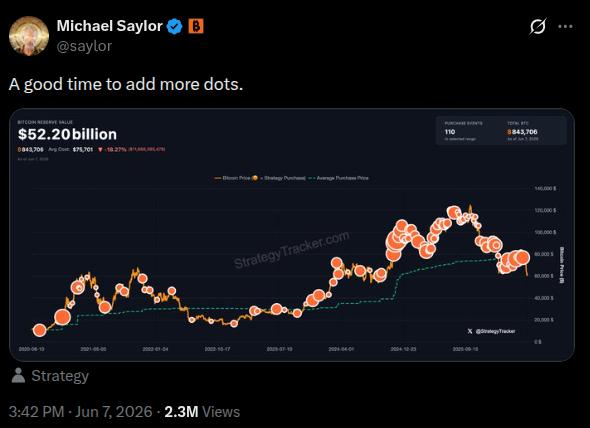
Strategy's CEO Phong Le redistributed Saylor's tweet while adding his own commentary, stating, "Our corporate @Strategy is to increase net Bitcoin and Bitcoin per share over time. Rumors otherwise are just rumors."
If purchases are indeed revealed in the upcoming days, they will probably demonstrate that the Bitcoin treasury company acquired its assets at prices meeting or falling beneath the average acquisition cost of its prior BTC purchases. The average cost basis for Strategy's present holdings totaling 843,706 Bitcoin stands at $75,701 per unit. Meanwhile, the cryptocurrency with the largest market capitalization has experienced a 16.6%% decline in value over the preceding seven-day period, with trading occurring around $62,153 as of publication time, based on information from CoinMarketCap data.
During the previous week, Strategy made public that it had conducted a repurchase of certain corporate debt instruments, creating a temporary suspension in its Bitcoin accumulation activities. This development caused concern throughout the market as participants worried that the organization might face pressure to sell portions of its BTC reserves to provide funding for the debt buyback operations.
Down to wire on STRC dividend change proxy vote
Shareholders of Strategy face a decision regarding approval of modifications to dividend distribution schedules on STRC, transitioning from monthly to semi-monthly payments. According to the company's statements, implementation of this change would result in decreased reinvestment lag periods, improved liquidity conditions, enhanced market efficiency metrics and greater price stability characteristics.
During last week's Synergy26 conference designed for registered investment advisors, Saylor explained, "We think that it should decrease the volatility, should cut the volatility by some decent factor. It should increase the Sharpe ratio. It provides more entry and exit points. There's 24,000 companies that pay a quarterly dividend. 176 pay monthly. We'll be paying twice a month. And so that's, it's an interesting thing. It all will start in June. In July."
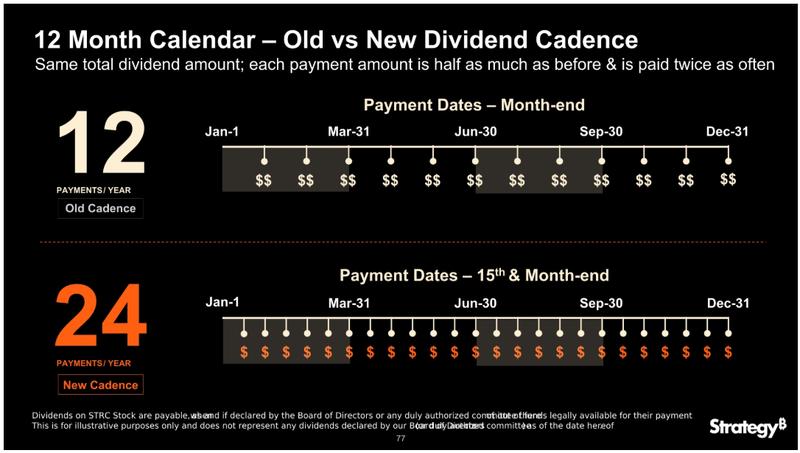
For the STRC semi-monthly dividend amendment to achieve passage, it requires approval from 50% of the total 85 million outstanding shares recorded as of April 17, 2026, based on company documentation.
The outcome will presumably be determined during Monday's scheduled Strategy shareholder meeting. Cointelegraph submitted a request via email to proxy solicitation firm Alliance Advisors seeking data regarding the quantity of shareholders who had submitted votes through June 7. No response was immediately forthcoming.
Individual retail investors have demonstrated relatively modest engagement levels when it comes to participating in proxy vote submissions. Research findings published in November by The Harvard Law School Forum on Corporate Governance presented data indicating that retail investors have maintained a consistent voting rate of approximately 29% of their shareholdings throughout the most recent five proxy voting seasons. In contrast, institutional shareholders have participated at roughly 77% voting levels.