
Russia Introduces Stricter Cryptocurrency Regulations Requiring Licensed Platform Use
A new crypto legislation package has been greenlit in Russia, mandating the use of licensed platforms for trading while implementing an annual limit of $3,700 for individual investors.

A series of draft bills have received approval from Russia's government that will require all cryptocurrency trading within the country to be conducted via licensed intermediaries while imposing strict limitations on individual investor participation.
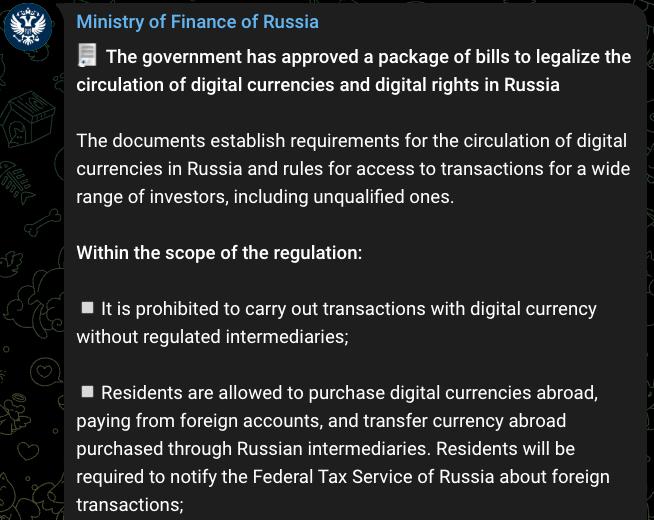
According to an announcement made Monday by the Finance Ministry, government officials have given their approval to a comprehensive package of legislative proposals focused on legalizing the circulation of digital currencies and digital rights throughout the Russian Federation.
"Under the new regulatory framework, transactions involving digital currency without regulated intermediaries are prohibited," the ministry said. The legislative package is designed to strengthen government supervision of digital assets while maintaining restricted access for non-qualified investors and expanded access for qualified investors.
The regulatory framework imposes substantial restrictions on retail investors, permitting the purchase of what the Bank of Russia will designate as the "most liquid digital currencies." According to the proposed rules, retail investors are required to successfully complete a test and face restrictions limiting their annual purchases to a maximum of 300,000 rubles ($3,700) through any single intermediary.
The draft legislation would continue to permit Russian citizens to purchase cryptocurrency through foreign platforms using accounts held overseas, as long as these transactions are disclosed to tax authorities, indicating that Moscow's strategy focuses on bringing crypto trading under domestic control rather than imposing an outright prohibition.
Crypto operators face licensing requirements
The package that received approval encompasses bills addressing digital currencies and digital rights, amendments to various Russian legislative acts, as well as modifications to the country's administrative offenses code.
The regulatory framework creates a licensing system for entities engaged in cryptocurrency operations, including digital exchanges and custodial services, while permitting banks and brokers to engage in such activities under specific regulatory requirements.
"As for banks and brokers, they will be able to carry out such activities provided they comply with specific prudential requirements," the announcement notes.
The legislative package additionally establishes administrative liability provisions for violations committed by organizations participating in exchange activity, representing part of a comprehensive effort to monitor and penalize unlicensed crypto intermediation operations.
Critics say rules could backfire on oversight goals
Although the government's objective is to bring structure and formality to the sector, critics argue that the regulations may produce unintended consequences by driving trading activity into unregulated spaces.
"At a time when the rest of the world is moving toward liberalizing access to equity markets through tokenization, we are, for some reason, doing the opposite by pushing crypto into a framework of securities market regulation," Exved founder Sergey Mendeleev told Cointelegraph.
"In the end, it will be like with casinos — people won't play less, but everything will move out of state control into online and underground venues," he said.