Robinhood acquires ownership positions in Crypto.com and OG.com through prediction trading partnership
The online brokerage will leverage OG.com's infrastructure regulated by the CFTC to process event contracts as part of its prediction markets expansion strategy.

As part of a comprehensive multi-year partnership to utilize OG.com's regulated infrastructure for event contracts, Robinhood has acquired equity positions in both Crypto.com and its recently separated prediction market platform OG.com.
The partnership arrangement calls for Robinhood to channel retail event contracts through the derivatives exchange and clearinghouse operated by OG.com, which maintains regulatory approval from the Commodity Futures Trading Commission (CFTC). The service became available to qualifying US customers starting Tuesday.
Based on the announcement made Tuesday, the digital brokerage firm will obtain initial equity positions in both Crypto.com and OG.com. These stakes are valued at the same pricing established through a previous investment by Citadel Securities in these platforms. Neither party revealed specific details regarding the magnitude or monetary value of Robinhood's equity positions.
This partnership arrives on the heels of OG.com's separation from Crypto.com, which established a $5 billion valuation for the company. The announcement comes fewer than eight weeks after media reports indicated Robinhood was engaged in discussions with Crypto.com regarding an expansion of its prediction markets capabilities.
OG.com is set to function as an autonomous entity separate from the cryptocurrency exchange. CEO Kris Marszalek indicated the platform intends to broaden its offerings beyond prediction markets to include futures and perpetual contracts.
Recent development builds on prediction market partnerships
In March 2025, Robinhood introduced its prediction markets hub through a partnership with Kalshi, a CFTC-regulated exchange, and subsequently broadened its prediction market infrastructure capabilities.
The segment has experienced substantial growth. During the second quarter, event contracts produced $156 million in revenue for Robinhood, representing an increase of over tenfold compared to the same period one year prior. This figure exceeded both its $129 million in transaction revenue from equities and $100 million derived from cryptocurrency trading.
According to estimates from Bernstein analysts published in July, Robinhood's total revenue, incorporating prediction markets, has the potential to reach $1.7 billion by 2028.
However, prediction market operators are increasingly confronting legal challenges from state governments attempting to enforce their gambling regulations on sports event contracts.
A Nevada judge in April prolonged a prohibition that prevents Kalshi from providing event contracts within the state unless it obtains a gaming license. The judge determined that these products are essentially indistinguishable from conventional betting operations. The decision dismissed Kalshi's contention that the contracts constitute swaps falling exclusively under CFTC jurisdiction.
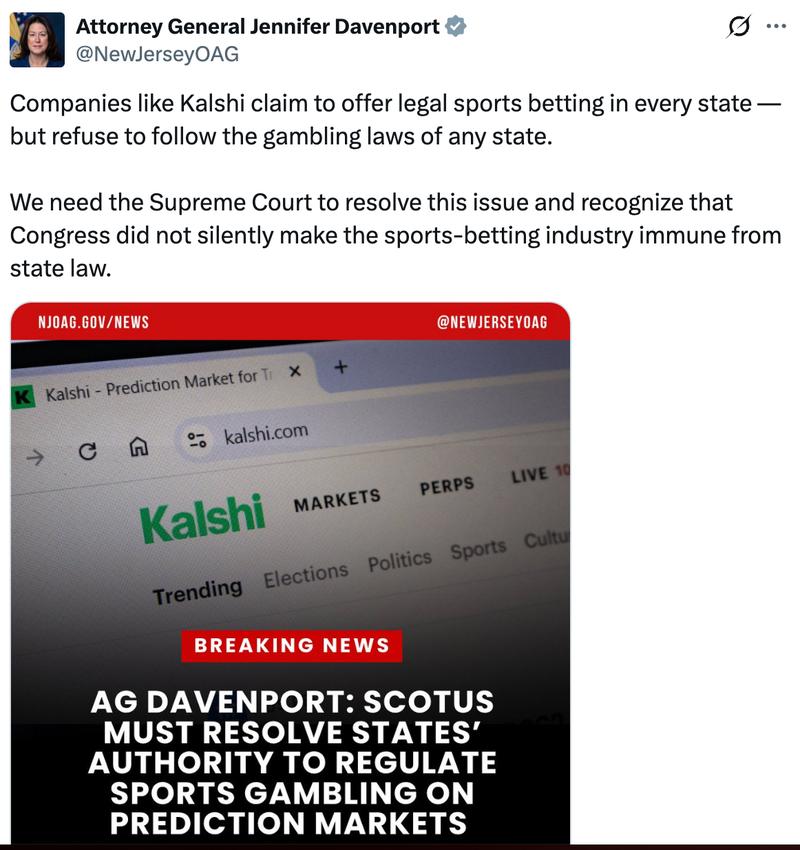
The legal conflicts intensified last week when New Jersey filed a petition with the US Supreme Court requesting clarification on whether individual states possess the authority to regulate sports contracts available on CFTC-regulated prediction markets.
In a statement announcing the petition, New Jersey Attorney General Jennifer Davenport stated that companies like Kalshi assert they provide legal sports betting on a nationwide basis while declining to adhere to state gambling regulations. She urged the Supreme Court to settle the jurisdictional conflict.