
New York Politician Unveils 'AI Dividend' Plan to Combat Worker Displacement
A New York lawmaker's AI dividend initiative would derive funding from taxation on artificial intelligence usage and ownership shares in AI firms, distributing payments to American citizens when automation significantly replaces human workers.

An assemblymember from New York state who is also running for Congress has introduced an artificial intelligence dividend initiative designed to help US citizens cope with anticipated employment losses resulting from artificial intelligence technological advancement.
During a Sunday post on the social media platform X, New York representative Alex Bores detailed a comprehensive strategy aimed at equipping the United States and its population for what he describes as the "potential large-scale displacement of human labor by artificial intelligence."
"Today, I'm proud to announce the AI Dividend, my plan to prepare for the AI economy with direct payments to Americans funded by tax reform that simultaneously incentivizes hiring humans instead of AI," he said.
The initiative from Bores emerges during a period of mounting anxiety regarding artificial intelligence's potential to trigger widespread job losses across multiple sectors. A recent analysis published by Goldman Sachs indicates that the implementation of AI technology has been responsible for eliminating approximately 16,000 positions each month throughout the previous year.
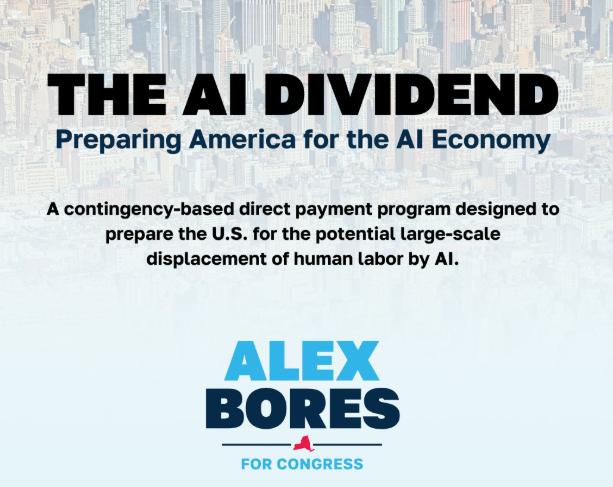
The initiative would receive its funding through multiple channels including implementing a levy on artificial intelligence utilization, acquiring ownership positions in prominent AI corporations, and reforming tax policies related to the "treatment of labor and capital."
At present, Bores is promoting this policy initiative as a central component of his congressional campaign, and whether the program can gain traction may ultimately hinge on how successful his electoral bid proves to be.
In addition to distributing dividend payments to American citizens, the collected revenue would also be allocated toward financing "workforce transition, training and education" programs and creating the necessary oversight and safety infrastructure.
"At its core, the AI Dividend is simple: if AI dramatically increases productivity and concentrates wealth, the American people have a stake in those gains," the dividend plan read.
"The AI Dividend is a direct payment program that kicks in when and if AI meaningfully displaces American workers. It is not a punishment for innovation — it is an insurance policy."
Major American technology corporations including Amazon, Meta, Intel and Microsoft have either completed the termination of thousands of employee positions or have been reported to be planning such reductions, attributing these decisions to operational efficiencies generated through AI implementation.
Nevertheless, Morgan Stanley, an international investment banking institution, published research on April 14 examining artificial intelligence's effect on workforce displacement, observing that the influence on employment markets has remained "modest so far."
The Morgan Stanley analysis contended that there exists minimal evidence supporting claims of extensive employment elimination and emphasized that, based on historical patterns, emerging technological innovations tend to facilitate employment growth across time, despite causing displacement in certain positions. The firm did, however, recognize that artificial intelligence might break from this established historical pattern.