
Merck Partners with Hashgraph Group on Hedera Blockchain Product Passport Solution for EU Regulations
A blockchain-powered platform built on Hedera integrates product verification and traceability features to help companies meet emerging European Union requirements for sustainability and supply-chain transparency.

Merck and The Hashgraph Group have combined the German technology manufacturer's product verification solution with TrackTrace, a digital product passport platform built on Hedera that was unveiled in February, as companies prepare to meet new European Union requirements for supply-chain transparency and product traceability.
Through this partnership, Merck's M-Trust technology incorporates security markers directly into products and their packaging, which can be authenticated using a handheld scanning device. The authentication information is subsequently logged on The Hashgraph Group's TrackTrace platform, establishing a digital trail that connects to a product's Digital Product Passport.
According to the companies, this integration merges tangible product verification with blockchain-powered traceability, enabling organizations to authenticate both a product's genuineness and the documentation tied to it.
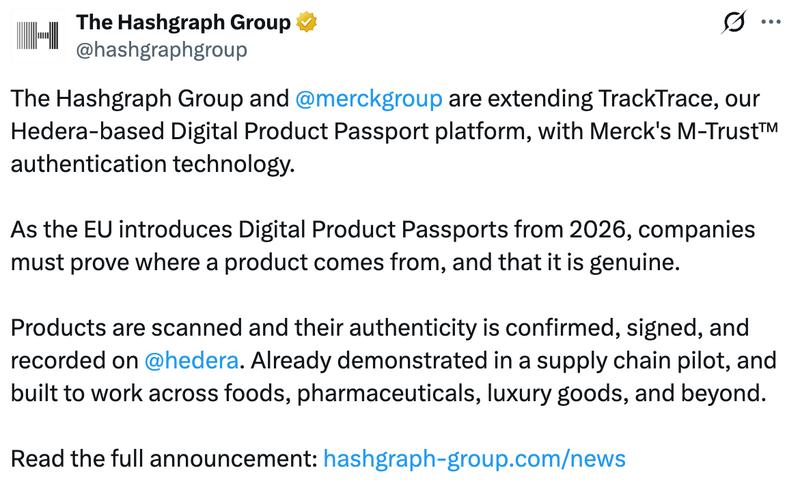
The solution is designed to address two developing EU regulatory frameworks: Digital Product Passports mandated by the Ecodesign for Sustainable Products Regulation and traceability obligations outlined in the EU Deforestation Regulation.
Merck operates as a science and technology enterprise with focus areas in healthcare, life sciences and electronics, while The Hashgraph Group, headquartered in Switzerland, creates enterprise blockchain and AI solutions within the Hedera ecosystem.
The companies report that the technology has been validated through a supply-chain pilot program that has not been publicly disclosed. Applications for the technology could span food, pharmaceutical, luxury goods and electronics supply chains, where organizations are experiencing heightened pressure regarding sourcing practices and product authentication.
EU sustainability rules create market for product traceability
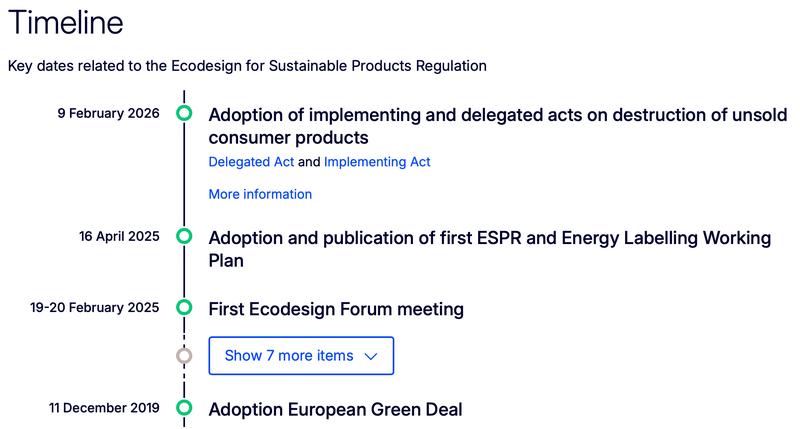
This partnership emerges as businesses get ready for upcoming Digital Product Passport obligations under the European Union's Ecodesign for Sustainable Products Regulation (ESPR), which became effective in July 2024.
The regulation encompasses nearly all physical products marketed in the EU and represents a component of the European Green Deal, a comprehensive initiative designed to enhance resource efficiency, promote the circular economy and boost transparency regarding product environmental impacts.
Enthusiasm for blockchain-powered trade and supply-chain systems reaches beyond the EU. In March, officials in Hong Kong and Shanghai reached an agreement to explore a blockchain-enabled cross-border platform through the Hong Kong Monetary Authority's Project Ensemble initiative, which investigates tokenized market infrastructure and digital financial rails.
The initiative will evaluate how trade documentation and commercial information can be incorporated into trade finance applications, aiming to optimize cross-border commerce and associated financial services.