
Large Bitcoin Holders Reduce Selling Activity as $60K Price Level Takes Center Stage
Major Bitcoin holders have scaled back their selling activity while exchange deposits plummet dramatically, putting the spotlight on the critical trend line support around $59,000.

During the early hours of Asian trading on Tuesday, Bitcoin (BTC) surged to reach an intraday peak of $68,300, coinciding with a notable reduction in selling activity by whales. The derivatives market also witnessed a cooling of selling pressure, pointing to what a recent analysis describes as a bearish stance that is "becoming less aggressive."
Key takeaways:
- Significant deposits of BTC to Binance by large holders have experienced a substantial decline, indicating diminished selling pressure.
- Market analysts tracking Bitcoin regard the 200-week simple moving average positioned at $59,430 as a crucial support level for BTC's price trajectory.
Major Bitcoin holders decrease their selling activity
Exchange flow data from CryptoQuant revealed a notable "shift in behavior" among major market participants, with whale deposits of Bitcoin declining significantly across leading trading platforms.
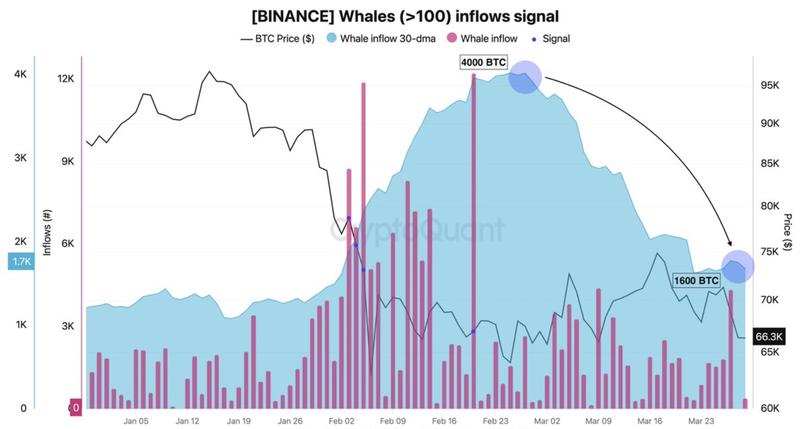
Data visualization below demonstrates that during Bitcoin's descent toward $60,000 in the opening days of February, whale activity on Binance intensified considerably, with deposits reaching as high as 11,800 BTC transferred to the platform within a single 24-hour period.
Consequently, the monthly moving average (30-day MA) for BTC exchange deposits climbed higher, approaching nearly 4,000 BTC flowing daily into Binance by February's conclusion, which "reflecting a more pronounced distribution phase from large holders," according to CryptoQuant analyst Darkfost in a Tuesday post on X.
Following that period, the "situation appears to have cooled down significantly," with the 30-day MA currently hovering around 1,600 BTC transferred daily to Binance," the analyst noted, further stating:
"This decrease in whale deposits could indicate a short-term slowdown in selling pressure, with large players seemingly adopting a wait-and-see approach in this still uncertain market environment."
These metrics align with recent data demonstrating that Bitcoin whales and sharks have been in accumulation mode throughout the past two months, establishing a pattern that may potentially catalyze an eventual price breakout from the current trading range.
This dramatic reduction in whale deposits occurred in tandem with Bitcoin's net position change across exchanges plummeting by 89,710 BTC on March 26, representing the most significant spike observed since December 2024, based on data from Glassnode.
The net position change metric, which tracks the 30 day fluctuation of supply maintained in exchange wallets, stands at -68,650 BTC as of Tuesday at the time of this writing.
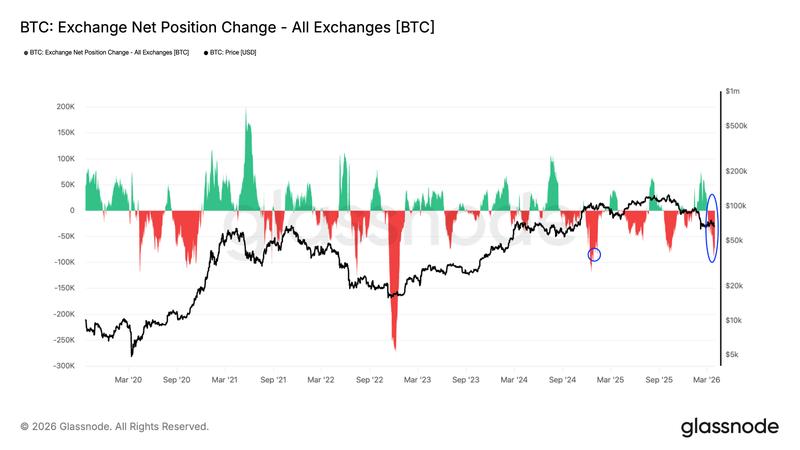
Outflows of this magnitude generally signal robust accumulation activity by major holders, consequently diminishing immediate selling pressure in the market.
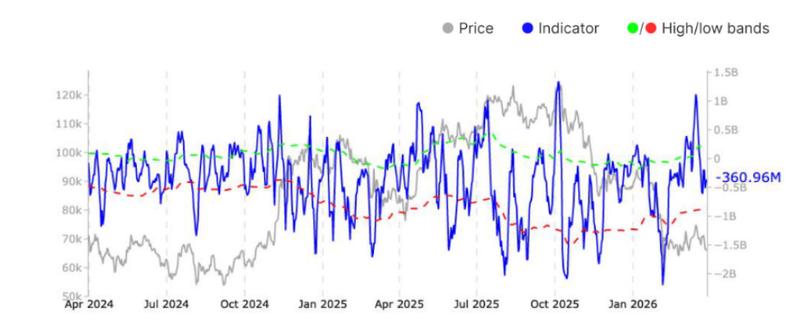
Furthermore, the perpetual cumulative volume delta (CVD) has experienced a 38.1% increase throughout the past week, rising to -$361 million from -$583 million, "indicating a decrease in sell-side pressure," according to Glassnode's most recent Market Impulse report, which added:
"While it remains negative, the move suggests bearish positioning is becoming less aggressive, and buyer participation is starting to recover."
The 200-week trend line emerges as critical support for BTC price action
Market analysts examining Bitcoin maintain consensus that downside risk persists, with multiple indicators pointing toward BTC entering the "later stages" of its bear market cycle.
Market participants have now redirected their attention toward the 200-week simple moving average (SMA) positioned at $59,430, which currently functions as the final line of defense for Bitcoin's price structure.
Maintaining a position above this critical support level has historically preceded substantial price recoveries for BTC, as evidenced following the 2018 bear market cycle and the 2020 Covid-19 market crash.
Conversely, a breakdown below this support zone would initiate another downward movement for BTC before establishing a price bottom, similar to what transpired during the 2022 macro-driven drawdown.
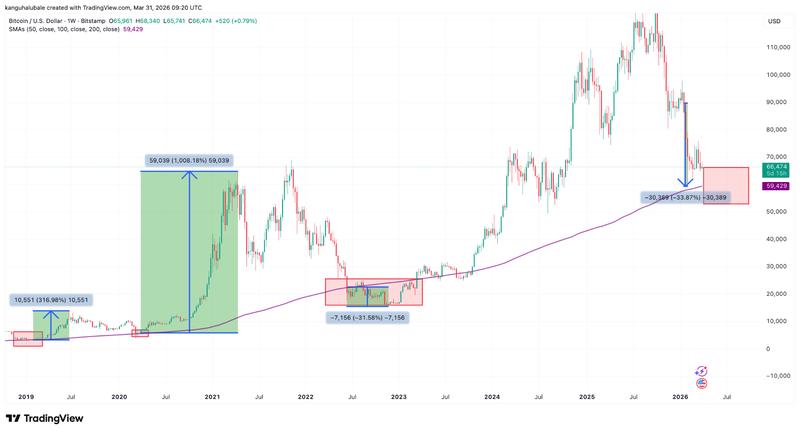
"Bitcoin is still above the 200-week moving average ($59,000)," market analyst Crypto Patel stated in a recent post on X, further explaining:
"The same level that confirmed every bull cycle in history. As long as $BTC holds this line, every dip is a gift."
Another analyst, Anup Dhungana, indicated that the "200-week MA at $59K is now the primary support to watch," following Bitcoin's confirmation of a bear flag breakdown pattern.
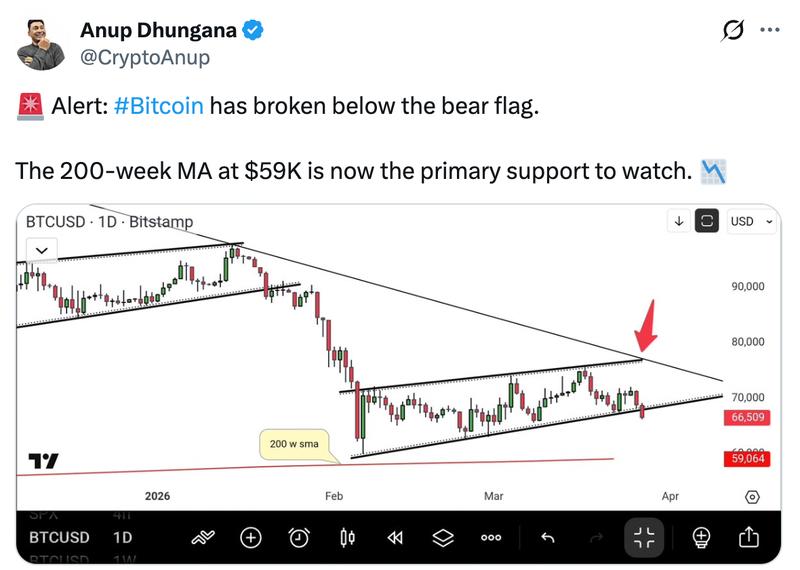
According to previous Cointelegraph coverage, Bitcoin's next significant support zone is now located at $60,000-$62,000, and a failure to hold this level could trigger a more substantial correction extending toward $41,000, which represents the measured target derived from a bear flag pattern visible on the daily chart.