
Hyperliquid establishes DeFi advocacy group during 'pivotal moment' for American regulations
The newly formed Hyperliquid Policy Center will push for favorable legislation on Capitol Hill, with special focus on perpetual derivatives platforms and decentralized blockchain systems.

Digital asset platform Hyperliquid has established a fresh lobbying group designed to advocate for regulatory reforms concerning decentralized finance within the halls of Congress.
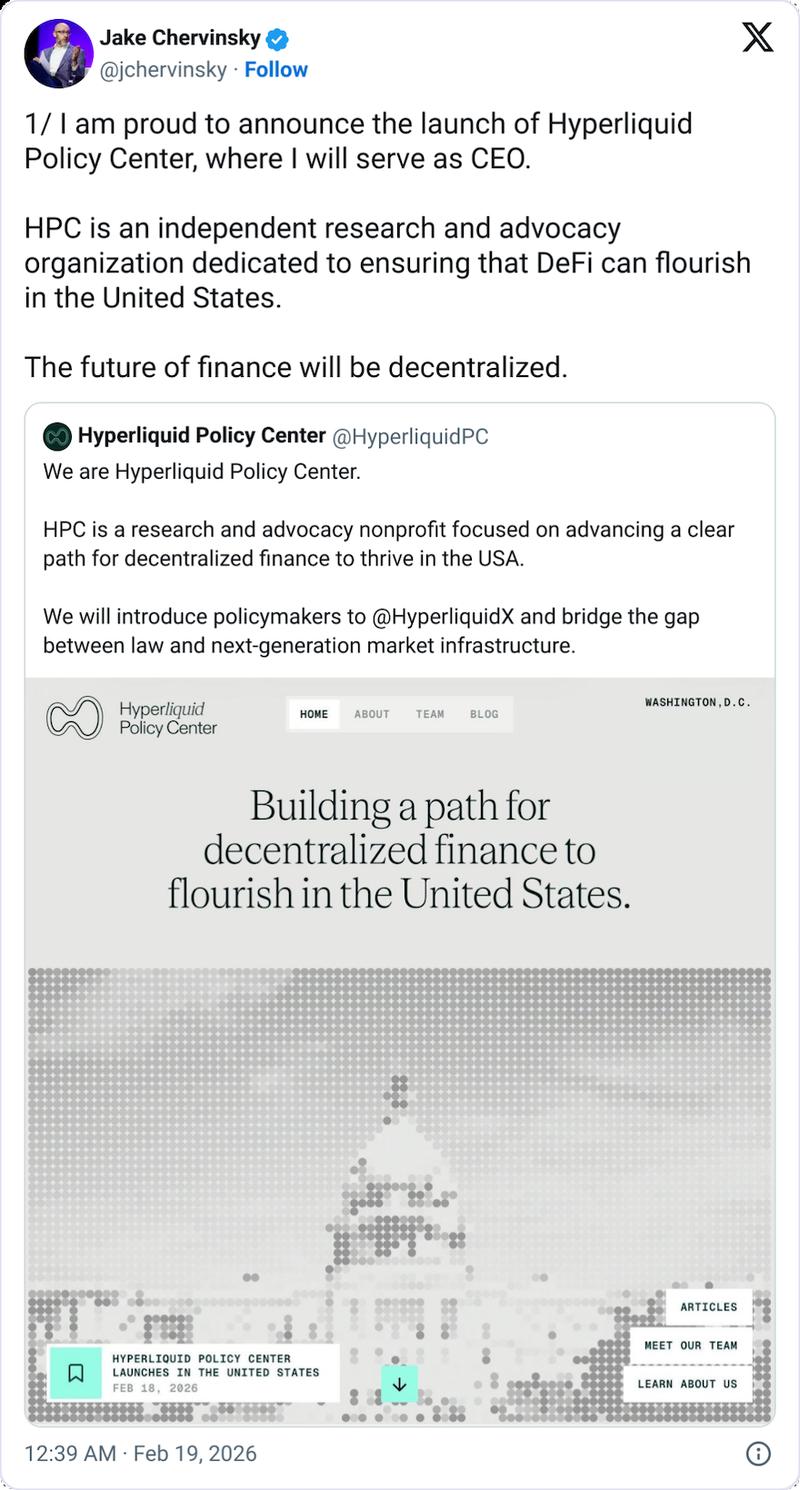
On Wednesday, the Hyperliquid Policy Center announced its official launch in the nation's capital, Washington, DC, appointing Jake Chervinsky as its founder and chief executive officer. Chervinsky brings extensive experience as a crypto legal expert, having previously served as legal chief at Variant, a cryptocurrency venture capital fund, and as the former head of policy at the Blockchain Association, a prominent crypto advocacy organization.
According to the organization's announcement, it aims to promote "a clear, regulated path for decentralized finance to thrive in the United States" and will advocate for policy initiatives "with a specialty in perpetual derivatives and blockchain-based financial infrastructure."
As a layer-1 blockchain platform and perpetual futures trading venue, Hyperliquid has experienced a dramatic surge in user adoption recently, driven by traders gravitating toward commodities markets during a widespread market decline. The platform has also been working to broaden its offerings into the prediction markets sector.
To support the policy center's establishment, the Hyper Foundation, an autonomous entity that supports Hyperliquid, will allocate 1 million Hyperliquid (HYPE) tokens for initial funding.
"Critical time" for policy, says Hyperliquid CEO
According to Chervinsky, an increasing number of conventional financial institutions are deploying blockchain-powered products and services due to the technology's inherent "efficiency, transparency, and resilience that legacy systems cannot match."
This technology is poised to become the base layer of the global financial system. Now the United States must choose: we can either adopt new rules that allow this innovation to thrive here at home, or we can wait and watch as other nations seize the opportunity.
In a statement posted on X, Hyperliquid co-founder and CEO Jeff Yan characterized the current environment as a "critical time in policy discussions" across the United States, noting that the platform had previously "lacked a unified voice in important policy discussions until now."
There is a tangible and urgent possibility of upgrading the tech stack of the existing financial system. Global financial regulation will be shaped in the United States, and we must work to ensure that these new policies thoughtfully embrace the potential of the new financial system.
Lawmakers in Congress are currently attempting to advance legislation that would establish how market regulatory bodies oversee cryptocurrency markets, though the proposed bill remains gridlocked in the Senate. The holdup stems from disagreements among legislators and competing interests from the cryptocurrency and banking lobbying sectors over specific language relating to stablecoin regulations.
In its announcement, the Hyperliquid Policy Center revealed that its initial leadership team would include Salah Ghazzal as the newly-named policy director, who previously led policy efforts at Variant, along with Brad Bourque serving as policy counsel. Bourque joins from his previous position as an associate at Sullivan & Cromwell, a prominent law firm that gained notoriety for its connections to FTX, the now-defunct fraudulent cryptocurrency exchange.