
Fed researchers propose using Kalshi prediction market data for monetary policy decisions
According to Federal Reserve researchers, Kalshi's ability to capture "rich intraday dynamics" provides real-time measurement of market expectations during significant financial events and policy announcements.

A trio of Federal Reserve researchers have made the case that the prediction market platform Kalshi offers superior real-time measurement of macroeconomic expectations compared to current methods, suggesting it deserves integration into Federal Reserve policy deliberations.
Published on Feb. 12, the research paper titled "Kalshi and the Rise of Macro Markets" was authored by Anthony Diercks, a principal economist at the Federal Reserve Board, along with Jared Dean Katz, a research assistant at the Federal Reserve, and Jonathan Wright, a research associate from Johns Hopkins University.
The study compared Kalshi's market data against conventional survey methods and market-implied forecasts, analyzing how perceptions regarding future economic conditions shift following macroeconomic data releases and policy communications from government officials.
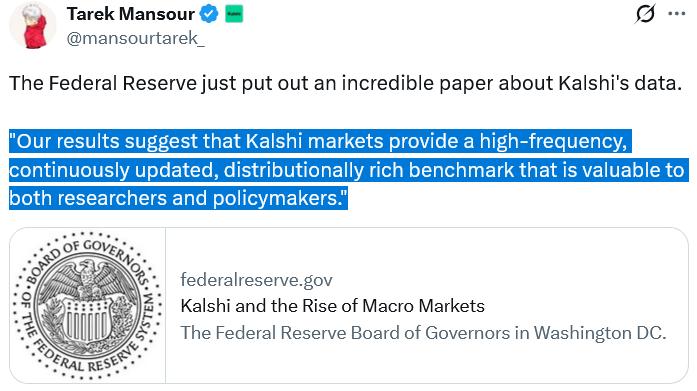
According to the researchers, "Managing expectations is central to modern macroeconomic policy. Yet the tools that are often relied upon—surveys and financial derivatives—have many drawbacks," emphasizing that Kalshi has the capability to capture market "beliefs directly and in real time."
"Kalshi markets provide a high-frequency, continuously updated, distributionally rich benchmark that is valuable to both researchers and policymakers."
The Kalshi platform enables traders to place wagers across various markets connected to Federal Reserve decisions, encompassing consumer price index inflation and payroll data, alongside additional macroeconomic indicators like gross domestic product growth and gas prices.
According to the Federal Reserve researchers, Kalshi's market data should be utilized to generate a risk-neutral probability density function, which illustrates the complete spectrum of potential Fed interest rate decision outcomes and their respective likelihoods.
"Overall, we argue that Kalshi should be used to provide risk-neutral [probability density functions] concerning FOMC decisions at specific meetings" while asserting that the existing benchmark is "too far removed from the monetary policy interest rate decision."
That said, research papers published by Federal Reserve staff are merely "preliminary materials circulated to stimulate discussion" and do not directly influence the central bank's policy-making process.
Throughout the previous year, prediction markets emerged as one of the cryptocurrency sector's most popular applications and have maintained more than $10 billion in monthly trading volume consistently. Both Kalshi and its rival platform Polymarket have pursued aggressive retail user marketing campaigns in recent months, even as certain state regulatory authorities attempt to impose restrictions on the prediction market industry.
Kalshi is more reactive than existing expectations tools
According to the Federal Reserve's analysis, a key benefit of using Kalshi for assessing macroeconomic expectations lies in its "rich intraday dynamics."
The researchers observed that "These probabilities respond sharply and sensibly to major developments," citing a specific instance where the implied probability for a July rate cut climbed to 25% after public statements from Federal Reserve Governors Christopher Waller and Michelle Bowman, only to decline subsequently when a more robust-than-anticipated June employment report was released.
The researchers further noted that "Kalshi provides the fastest-updating distributions currently available for many key macroeconomic indicators."