
Crypto Market Structure Legislation's Newest Draft Sparks Concern Before Senate Committee Review
Legislators are advocating for the inclusion of ethics-related language in the legislation, with cross-party collaboration being essential for the CLARITY Act's success in a full Senate vote.


The most recent publication of the Digital Asset Market Clarity Act (CLARITY) within the US Senate Banking Committee has generated notable concern from industry observers prior to Thursday's planned markup session, particularly regarding housing-related inclusions and the absence of language addressing ethical considerations.
Three Republican senators made public the legislative text on Monday that committee members will utilize when evaluating whether to move forward with the cryptocurrency market structure proposal in the banking committee. This follows earlier draft versions that were made available in July and September 2025, which expanded upon conversations between cryptocurrency sector participants and banking industry representatives concerning the topic of stablecoin yield generation.
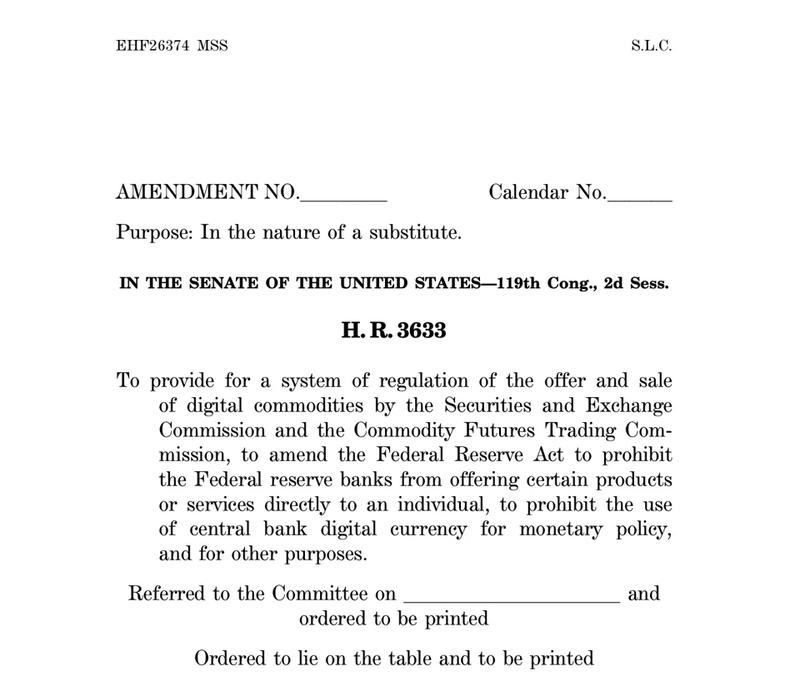
Nevertheless, this newest iteration contains language that appears disconnected from the core focus of cryptocurrency market structure regulation. Within the final pages of the proposed law appeared a housing-focused provision known as the Build Now Act, which, based on a detailed section-by-section breakdown of the legislative text, seeks to establish "a pilot program to incentivize housing development of all kinds in certain Community Development Block Grant participating jurisdictions."
Based on statements from Senators Tim Scott, Cynthia Lummis, and Thom Tillis, the legislation represents "continued negotiations with Democratic colleagues," indicating cross-party agreement heading into Thursday's markup session. Nevertheless, several Democratic senators, including Kirsten Gillibrand, have stated they will withhold support for the market structure legislation during a floor vote unless explicit language addressing ethics is incorporated to prevent potential conflicts of interest.
"We have worked too hard on this bill to give up now," Senator Angela Alsobrooks, who sits on the banking committee and announced the stablecoin yield compromise with Tillis, told Cointelegraph. "My hope is to get to a bipartisan markup on Thursday with a compromise on ethics."
The CLARITY Act is anticipated to transfer greater regulatory authority to the Commodity Futures Trading Commission (CFTC) for supervising and regulating digital assets, representing a departure from responsibilities traditionally managed by the Securities and Exchange Commission (SEC).
The Senate Agriculture Committee successfully passed its iteration of the legislation during a January markup session, though the bill must still clear the banking committee, receive approval from the full Senate, and undergo reconciliation with the House of Representatives before it can potentially receive presidential signature and become law.
What's in the bill?
CLARITY expressly forbids the payment of interest or yield generation on payment stablecoins, though it creates an exception for "rewards or incentives based on bona fide activities or bona fide transactions that are not economically or functionally equivalent to the payment of interest or yield on an interest-bearing bank deposit."
The legislation also incorporated text from the Blockchain Regulatory Certainty Act, a proposal designed to shield developers from money transmitter regulatory requirements. The advocacy organization DeFi Education Fund expressed in a Monday X post that it was "encouraged by the direction of recent negotiations" surrounding the legislation, specifically highlighting the protections afforded to software developers.
The bill's authors chose not to incorporate any ethics-related provisions addressing Democratic concerns regarding US President Donald Trump's cryptocurrency business interests, including his memecoin and his family's World Liberty Financial enterprise.
"This bill puts investors, our national security and our entire financial system at risk – and it will turbocharge Donald Trump's crypto corruption," said Massachusetts Senator Elizabeth Warren in response to the bill. "In just one year in office, the President and his family have raked in at least $1.4 billion in gains from crypto deals alone, and yet this bill stunningly includes zero provisions to prevent that."
The Senate Agriculture Committee approved the legislation through a party-line vote to advance it in January, though the bill would need 60 votes to successfully pass the Senate even if an identical party-line outcome occurs in the banking committee during Thursday's markup. During consideration of stablecoin payments legislation, the GENIUS Act, in the Senate in June 2025, numerous Democrats crossed party lines to join with Republicans in passing the measure through a 68-30 bipartisan vote.