
Corporate cryptocurrency trading returns to South Korea after 9-year prohibition: Understanding the regulatory shift
After nearly a decade, South Korean corporations gain regulated access to cryptocurrency markets with controlled investment thresholds and restrictions on digital asset types. The move aligns with wider regulatory reforms encompassing stablecoin frameworks and crypto ETF possibilities.

Key takeaways
- A nearly decade-long prohibition on corporate cryptocurrency trading in South Korea is coming to an end, with listed companies and professional investment entities gaining market access through a controlled regulatory structure.
- Businesses will face stringent controls on their crypto participation, including a 5% cap on annual equity capital allocation and restriction to the 20 largest cryptocurrencies available on domestic regulated platforms.
- The introduction of institutional players could progressively strengthen liquidity and market organization, though stringent limitations suggest substantial corporate treasury capital influx remains unlikely near-term.
- When measured against regulatory approaches in the US, the EU, Japan and Hong Kong, South Korea's framework represents a more conservative methodology that grants access while constraining exposure to mitigate systemic and corporate reputation hazards.
Following nearly nine years of exclusion, corporate entities in South Korea are preparing to rejoin the nation's cryptocurrency marketplace. The country's Financial Services Commission (FSC) has unveiled new regulatory protocols that permit listed corporations and professional investment companies to recommence digital asset trading, bringing the 2017 ban to a close.
The initiative represents a component of the administration's comprehensive "2026 Economic Growth Strategy," designed to position South Korea as a leading digital economy by enacting stablecoin regulatory frameworks and creating pathways for spot cryptocurrency exchange-traded funds (ETFs).
This analysis delves into the circumstances that prompted South Korea's corporate trading prohibition, examines the opportunities created by the updated regulatory framework, and assesses how these changes will reshape the country's digital asset marketplace. The piece also reviews the regulatory challenges facing South Korean authorities and benchmarks the nation's corporate crypto trading framework against international standards.
Why corporate crypto trading was banned in South Korea
South Korea imposed a ban on institutional cryptocurrency participation in 2017 amid explosive retail market speculation. Financial regulators identified significant concerns regarding money laundering vulnerabilities, potential market manipulation schemes, and broader financial system stability threats. The government chose to block corporations and professional investors from market participation, while permitting retail trading subject to rigorous compliance protocols.
This regulatory approach fundamentally influenced the development of South Korea's cryptocurrency ecosystem. Retail traders came to dominate market activity, while domestic institutional players found themselves largely shut out from a burgeoning asset category. Over time, this regulatory environment also channeled investment capital offshore, as South Korean investors and enterprises sought cryptocurrency exposure through international exchanges and foreign-based investment vehicles.
Meanwhile, mature markets including the US steadily integrated institutional capital into cryptocurrency through regulated futures contracts, professional custody infrastructure, and eventually, spot ETFs. By 2024, institutional market participants accounted for the majority of trading activity on numerous prominent global cryptocurrency platforms.
Did you know? In 2018, South Korean banks issued special "real-name account" partnerships with exchanges, making them legally responsible for monitoring crypto transactions tied to customer identities.
What South Korea's new corporate crypto rules allow
Under fresh directives from the Financial Services Commission (FSC), roughly 3,500 entities will receive authorization to engage in cryptocurrency trading. This cohort includes publicly listed corporations as well as properly registered professional investment organizations.
Initially, corporate cryptocurrency allocations will face a ceiling of 5% of annual equity capital. This threshold aims to prevent organizations from subjecting their financial statements to excessive risk levels, while providing regulators opportunity to assess the wider consequences of institutional market participation on systemic stability.
Eligible investments are restricted exclusively to the top 20 cryptocurrencies ranked by market capitalization. These digital assets must be accessible through South Korea's five major regulated cryptocurrency exchanges. This structure directs corporate investment toward prominent, highly liquid cryptocurrencies such as Bitcoin (BTC) and Ether (ETH), while excluding the overwhelming majority of lower-capitalization or particularly volatile digital tokens.
The regulatory treatment of stablecoins including Tether's USDt (USDT) within South Korea's legal framework remains under deliberation. Government officials have suggested that stablecoins may be subject to a separate evaluation procedure. Supplementary legislation could be forthcoming related to payment infrastructure and financial market systems.
Cryptocurrency exchanges will be required to establish protections for institutional order flow, incorporating features like phased trade execution and limits on individual transaction sizes. These regulatory mandates are designed to minimize sharp price movements and prevent large orders from destabilizing shallow order books.
Did you know? Korea's National Pension Service, one of the world's largest public pension funds, has invested in blockchain-related companies but has so far avoided holding cryptocurrencies directly.
How this fits into South Korea's broader crypto strategy
South Korea's corporate cryptocurrency trading regulations should not be viewed as a standalone policy adjustment. Rather, they constitute one element of an extensive regulatory transformation that encompasses the forthcoming Digital Asset Basic Act, which the National Assembly is slated to introduce during the opening months of 2026.
This legislative proposal seeks to unify South Korea's currently fragmented cryptocurrency regulations. The legislation will encompass critical domains including exchange supervision, token issuance protocols, custody requirements, market behavior standards, and investor safeguards. Officials are evaluating potential frameworks for Korean won-pegged stablecoins and regulated spot cryptocurrency ETFs. These developments will further embed digital assets within conventional financial market infrastructure.
These policy moves indicate a transition away from reactive, crisis-motivated prohibitions toward organized market engagement under formal regulatory oversight.
How corporate access will be transforming South Korea's crypto market
South Korea's determination to permit controlled corporate engagement with cryptocurrency markets marks a constructive advancement toward enhanced institutional integration. This regulatory evolution, combined with forthcoming comprehensive regulations, is positioned to reconfigure the nation's digital asset environment gradually.
Institutional liquidity and market structure
Permitting corporate market participation will fundamentally alter the composition of Korea's cryptocurrency trading ecosystem. Institutional market participants typically operate with extended investment horizons, portfolio diversification approaches, and sophisticated risk management frameworks. Their market entry may boost liquidity depth, compress bid-ask spreads, and diminish the influence of short-horizon retail trading behavior.
Nevertheless, the 5% allocation constraint limits the quantum of capital that can migrate into cryptocurrency from corporate balance sheets in the immediate term. Consequently, observable market effects may materialize incrementally rather than instantaneously.
Treasury strategies and business innovation
Across other regulatory jurisdictions, numerous companies have adopted digital asset treasury management approaches. These firms utilize Bitcoin or comparable assets as extended-duration balance sheet positions. For example, Japan's Metaplanet has attracted global attention through its systematic expansion of Bitcoin reserves to enhance shareholder value.
Market participants within South Korea contend that rigid investment thresholds may inhibit the development of innovative business approaches. Detractors suggest that corporations should possess autonomy to establish their own risk tolerance levels within conventional corporate governance and transparency frameworks, rather than confronting cryptocurrency-specific allocation constraints.
Domestic financial products
Institutional cryptocurrency market engagement will facilitate the development of novel financial product categories. Potential offerings include cryptocurrency ETFs, structured investment notes, and professional custody solutions. For banking institutions and asset management firms, corporate trading demand may warrant additional capital deployment in digital asset technological infrastructure.
This evolution could enhance South Korea's competitive positioning against rival Asian financial centers, including Hong Kong and Singapore. These jurisdictions are aggressively pursuing digital asset enterprises and institutional capital.
Did you know? Some Korean conglomerates already use blockchain for supply chain tracking and digital certificates, meaning corporate exposure to distributed ledger technology predates financial crypto investments.
Comparing South Korea's corporate crypto policy with other countries
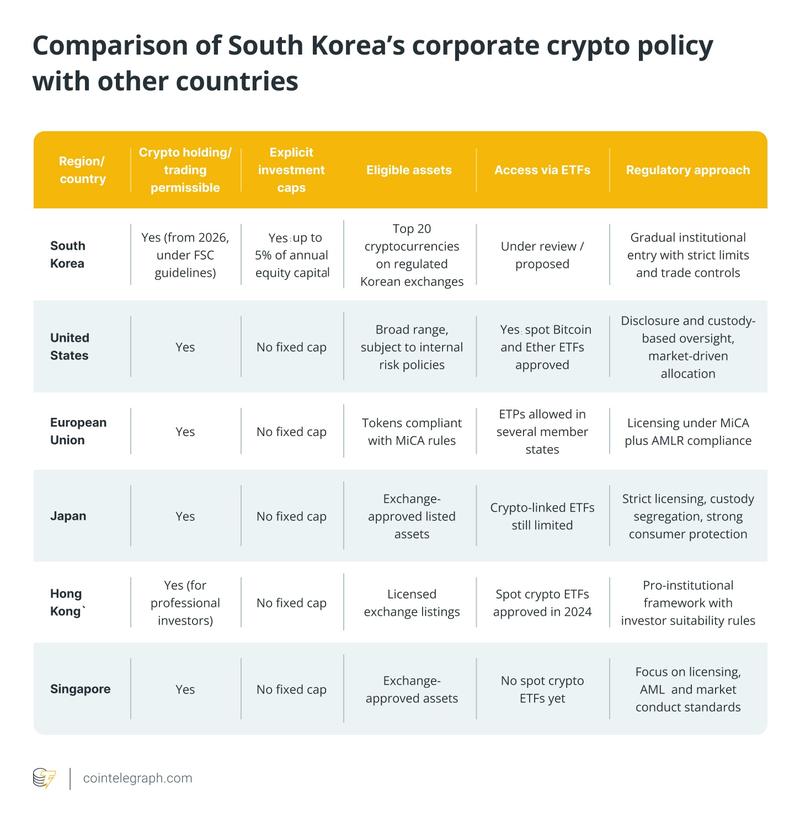
South Korea's prudent methodology for enabling corporate cryptocurrency participation diverges from dominant policy frameworks in leading financial markets. Within the US and certain European jurisdictions, no explicit percentage limitations exist on corporate digital asset holdings. Nevertheless, organizations must comply with accounting standards, disclosure obligations, and fiduciary duties.
Japan and Hong Kong similarly permit institutional cryptocurrency involvement without enforcing predetermined limits on balance sheet allocation. Instead, these jurisdictions depend on licensing structures, custody regulations, and market conduct standards.
South Korea's regulatory architecture demonstrates a more risk-averse supervisory posture. It creates opportunity for corporate cryptocurrency participation while constraining the magnitude of involvement until supervisors develop enhanced confidence in marketplace resilience.
Risks South Korean regulators are confronting
From the FSC's regulatory perspective, the newly established framework seeks to harmonize market expansion objectives with financial stability imperatives. The hazards that continue to occupy regulatory attention include:
- Volatility risk, which threatens to damage corporate financial positions and undermine investor trust
- Operational risk, encompassing potential custody infrastructure failures or cryptocurrency exchange operational disruptions
- Reputational risk, which emerges when corporations sustain material losses from speculative digital asset trading.
Through imposing constraints on permissible asset categories and investment magnitudes, regulatory authorities seek to limit systemic exposure while accumulating supervisory expertise with institutional cryptocurrency participation.
What happens next?
The FSC is anticipated to publish the finalized regulatory guidelines in January or February 2026. Implementation will be synchronized with the Digital Asset Basic Act rollout later during the year. Corporate cryptocurrency trading activity may commence prior to year-end, assuming the legislative timeline proceeds as scheduled.
Subsequent regulatory modifications may materialize should market conditions prove stable and compliance infrastructure demonstrate effectiveness. Trade associations are expected to advocate for elevated investment thresholds and expanded eligible asset categories following successful completion of this preliminary phase.
Balancing financial stability with institutional innovation
Eliminating the extended prohibition on corporate cryptocurrency trading participation constitutes a substantial evolution in South Korea's digital asset policy orientation. Following nearly ten years of retail-exclusive market participation, institutional entities are finally receiving authorization to enter the domestic South Korean marketplace, albeit under restrictive conditions.
Whether this measured regulatory opening matures into comprehensive institutional integration will depend on marketplace performance, corporate risk management capabilities, and regulatory enforcement effectiveness. What remains clear, however, is that South Korea no longer characterizes corporate cryptocurrency participation as fundamentally incompatible with financial system stability, but instead as an activity amenable to management within a structured regulatory environment.