
BIP-110 remedy potentially more dangerous than issue, warns Adam Back
Adam Back of Blockstream warns BIP-110 poses risks to user fund security, while the proposal's developer maintains protective measures exist.

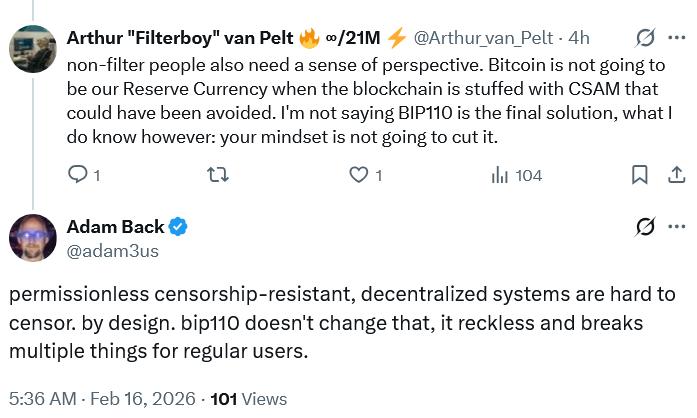
Adam Back, the chief executive of Blockstream, has voiced strong opposition to a proposed solution designed to combat Ordinals-related "spam" on the Bitcoin blockchain, cautioning that implementing the fix might inflict greater damage than benefit to the network's reputation and reliability.
The Bitcoin Improvement Proposal known as BIP-110 was put forward in December by Dathon Ohm, a Bitcoin developer operating under a pseudonym. Data indicates that approximately 7.5% of Bitcoin nodes have indicated their preparedness to implement BIP-110, with all of these nodes being Bitcoin Knots clients.
The core objective of this proposal is to implement a temporary reduction in the volume of data that can be embedded within Bitcoin transactions, aiming to curtail the influx of images, videos, audio files and other forms of "data abuse" that have been overwhelming the network infrastructure.
Although Back concurred with the principle that Bitcoin ought to function as "sound money," he expressed in a Sunday post on X that implementing a consensus-level modification was not justified, further characterizing BIP-110 as "an attack" on Bitcoin's reputation as both a store of value and a secure monetary system.
"It's a lynch mob attempt to push changes there is not consensus for," he said, adding that spam is "just an annoyance" that poses no real security threat to the network.
The nature of BIP-110 is that it represents merely a temporary measure designed to curtail arbitrary data storage, structured to provide the Bitcoin community with an opportunity to assess its effects over a 12-month period while developers concentrate their efforts on formulating a more permanent solution.
Support for BIP-110 has grown particularly among validators operating Bitcoin Knots, a client implementation that began capturing market share from Bitcoin Core during the latter half of 2025, following Bitcoin Core developers' decision to eliminate the 80-byte limitation on the OP_RETURN function in late October, which facilitated an increased volume of non-financial transactions entering the Bitcoin network.
The market share held by Bitcoin Core among Bitcoin nodes has declined from approximately 98% to 77.2% following the controversial modification to the OP_RETURN function that ignited substantial debate within the Bitcoin community regarding which types of transactions ought to be permitted on the network, while Bitcoin Knots' share has climbed to 22.7%.
Back numbers among the numerous individuals who stood against eliminating the 80-byte restriction on the OP_RETURN function, declaring in September that spam resembling Ordinals has "no place in the timechain."
Nevertheless, he raised concerns that a remedy such as BIP-110 carries the potential risk of freezing funds through rendering specific unspent transaction outputs (UTXOs) impossible to spend.
Ohm acknowledged that it is theoretically possible for funds to be frozen, but added: "This proposal goes to great pains to avoid affecting any known use cases."
Advocates for non-financial transactions, including Leonidas who leads the Bitcoin Ordinals movement, have pointed out that the Ordinals and Runes ecosystems have generated more than $500 million in transaction fees that have bolstered Bitcoin's security infrastructure — a consideration that has gained increasing importance as the mining block subsidy undergoes its scheduled halvings approximately every four years.
Bitcoin Ordinals activity has tanked
That said, data from Dune Analytics reveals that inscription fees from Ordinals were regularly generating less than $10,000 daily for Bitcoin miners by the conclusion of 2025, creating challenges for miners attempting to depend on non-financial transactions as a revenue stream.
The peak of Ordinal activity occurred more than two years in the past, when Bitcoin miners accumulated nearly $10 million in fees on Dec. 16, 2023.
Following that pinnacle, fees have maintained a downward trajectory with the exception of several brief upticks.