
Anthropic's Claude Mythos Launch Raises Security Concerns Among Cryptocurrency Community
According to venture capitalist Simon Dedic, Anthropic's newest AI models reduce both the expense and expertise required to discover cryptocurrency vulnerabilities to "basically zero."
On Tuesday, artificial intelligence firm Anthropic launched Fable 5, the first publicly available iteration of its advanced Claude Mythos model, triggering anxiety among cryptocurrency enthusiasts who fear potential malicious exploitation, notwithstanding the incorporated security measures.
Last month, Anthropic disclosed that its Mythos model identified over 10,000 vulnerabilities of high or critical severity within "systemically important software," prompting widespread debate about whether public release was advisable.
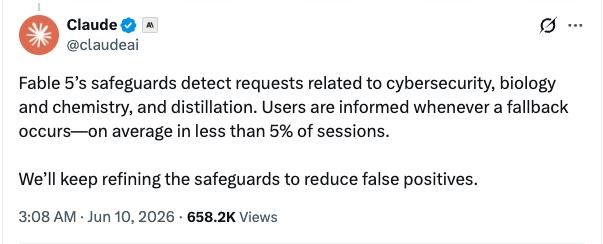
These concerns persisted even as the company stated on Tuesday that Fable 5 had been "made safe for general use," incorporating protective mechanisms that redirect certain subjects, including cybersecurity matters, to an alternative model known as Claude Opus 4.8
Releasing a model this capable comes with risks. Without safeguards, Fable 5's capabilities in areas like cybersecurity could be misused to cause serious damage.
These protective measures have provided minimal comfort to cryptocurrency participants, particularly as artificial intelligence continues to be leveraged in attacks targeting crypto platforms. Throughout April, the total value of cryptocurrency pilfered through hacking incidents reached $629.7 million, representing the highest figure since February 2025, a trend that analysts attribute to technological advancements in this domain.
Mythos release sparks warnings from crypto users
On Tuesday, Simon Dedic, who founded venture capital firm Moonrock Capital, shared on X that Fable 5 means the "cost and skill required to find exploitable flaws in smart contracts is about to drop to basically zero."
For DeFi, this should be a massive wake-up call. Unaudited protocols will become sitting ducks. Known exploits will get replayed on forks around the clock. Even small projects will get targeted simply because trying costs next to nothing now.
Dedic echoed widespread online recommendations, advising cryptocurrency participants to take defensive measures against the model's potential threats, such as revoking wallet approvals, withdrawing as much value from protocols as possible and transferring crypto to fresh hardware wallets.
However, Michael Egorov, co-founder of Curve Finance, suggested that the danger Claude Mythos presents to cryptocurrency may be exaggerated since its effectiveness in discovering bugs in other software might not necessarily carry over to funding smart contract vulnerabilities in DeFi.
During May, Anthropic announced that Claude Mythos discovered thousands of critical vulnerabilities in important software via Project Glasswing. Regarding open-source projects, which play a fundamental role in how crypto protocols are administered, Mythos identified approximately 6,200 high or critical-severity vulnerabilities across more than 1,000 projects under examination.
Egorov contended that the software where Mythos uncovered vulnerabilities contained millions of lines of code, whereas smart contracts typically have a few thousand, "and both humans and 'usual' AI perfectly fit that code in context and can reason well about it."
I suspect we might not be having a wave of DeFi code hacks, but we may see a lot of things in OpSec [operational security] getting hacked (looking like multisig keys compromises) and supply chain attacks on frontend dependencies, and those are way less dangerous in true DeFi.
In the meantime, Anthropic announced that a "small group" of cybersecurity and infrastructure providers would receive access to Claude Mythos 5, which is identical to Fable 5 but with safeguards removed in certain areas.