
Polymarket sees US traders dominate political betting markets despite geographic restrictions: Analysis
Fresh analysis from Allium reveals that traders from the United States are circumventing geographic restrictions to participate in betting markets on Polymarket's international platform.

Traders located in the United States represent the largest group of political bettors on Polymarket, notwithstanding the cryptocurrency-powered prediction platform's attempts to block American citizens from accessing the decentralized system, new research indicates.
In a report released on Thursday, blockchain analysis company Allium calculated that American-based traders constitute the single largest political betting market across all nations when measured by contracts traded and the number of wallets on Polymarket — a platform distinct from Polymarket US, which represents a regulated offering within the United States that debuted in December featuring a more limited selection of markets.
Blocking access did not end US participation; it made the US the largest single political market on Polymarket by volume. The demand is still there, now offshore and beyond US oversight.
The research indicates that Polymarket's attempts to prevent American users from accessing its international platform have proven largely ineffective, contributing to a growing series of challenges facing the company within the rapidly expanding predictions market industry, which finds itself under both legal and political examination.
The platform was compelled to terminate access for US users to its global service as part of a $1.4 million settlement agreement with the Commodity Futures Trading Commission in 2022.
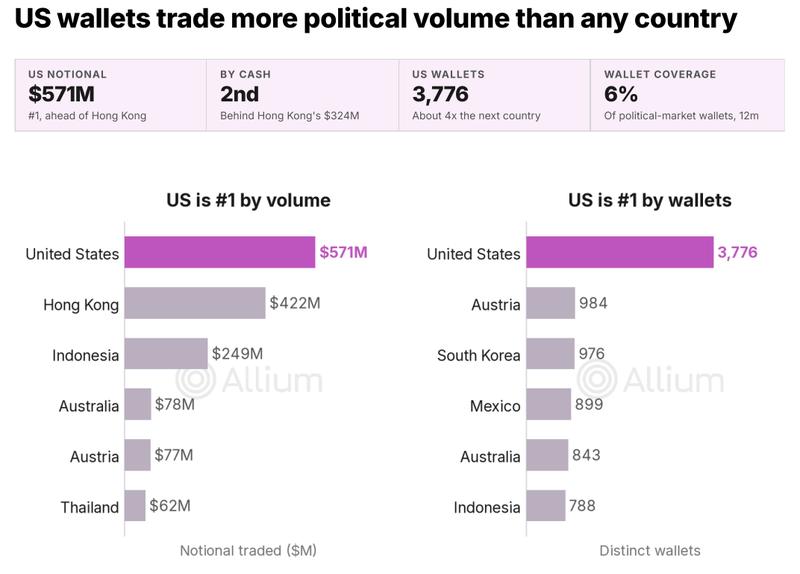
The analysis by Allium revealed that American users demonstrate a greater interest in markets related to international conflicts compared to other users on the platform, with five of the top 12 markets for the US group by notional volume connected to the Iran war.
The data also demonstrates reduced enthusiasm for election-related markets, which represents a category of prediction markets permitted on both Kalshi and Polymarket US.
US money pours into foreign wars, lately Iran, and largely skips the elections the global crowd trades.
Allium
Cointelegraph contacted Polymarket for comment.
Polymarket's effort to geoblock US users
The numbers published by Allium are consistent with a separate study released in June by Harry Crane, a statistician from Rutgers University, who calculated that 30% of trading volume on Polymarket originates from the US.
Crane's analysis estimated that individuals based in the US transmitted between $10.6 billion and $26.7 billion through Polymarket between May 2025 and April 2026, notwithstanding the platform's blocking of US-based IP addresses and VPNs, which could potentially be utilized to circumvent the restriction.
The academic examined the timing of trades throughout the day and the specific markets where trades occurred to establish connections between certain trading activity and US users.
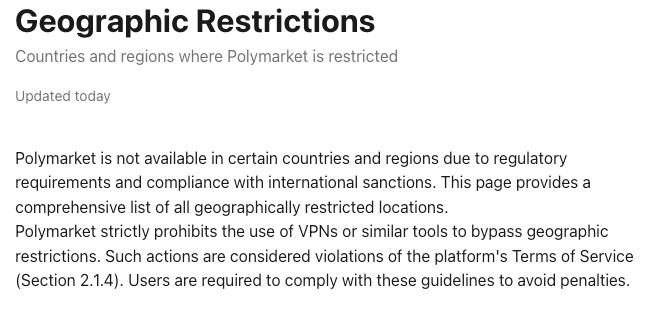
According to reporting from The Information in May, Polymarket has allegedly been intensifying efforts against users employing VPNs through the blocking of specific IP addresses associated with VPN services.
Where is Polymarket blocked?
More than 34 countries have implemented complete blocks on Polymarket, with Spain being the most recent addition, blocking access for local users to both Polymarket and Kalshi as a "precautionary measure" while authorities conduct an investigation into whether these companies are conducting operations without proper licensing.
An additional four countries, comprising Singapore, Thailand, Taiwan and Poland, have been placed in "close only" status, which permits users in these nations to close out existing positions while prohibiting the opening of new trades.
Additionally, there are four restricted regions, specifically Ontario in Canada, along with Crimea, Donetsk and Luhansk in Ukraine, where Polymarket faces blocks despite remaining accessible in other parts of those countries.