
Kalshi Faces Expanded Legal Challenge from Massachusetts Attorney General Following Judicial Decision
Massachusetts authorities proceed with their legal action against prediction market operator Kalshi in state court following a judge's approval of an expanded complaint containing additional accusations.

The ongoing legal dispute between prediction market operator Kalshi and the state of Massachusetts is set to move forward following a judicial decision permitting state officials to introduce additional accusations concerning sports wagering against the platform.
According to a Tuesday court document submitted to Suffolk County Superior Court, associate justice Peter Krupp granted permission for state officials to submit an expanded 71-page complaint, which builds upon the original filing that accused Kalshi of participating in sports gambling activities that violate Massachusetts state regulations.
The expanded legal complaint incorporated new accusations claiming that Kalshi "targets those under 21 years of age and does little to stop them from using its platform," referencing the platform's promotional activities on university campuses and featuring imagery in advertisements depicting individuals who "appear to be younger than 21 years old."
"Kalshi allows anyone who is at least 18 years old to create an account and wager on sports events by purchasing event contracts," alleged Massachusetts authorities.
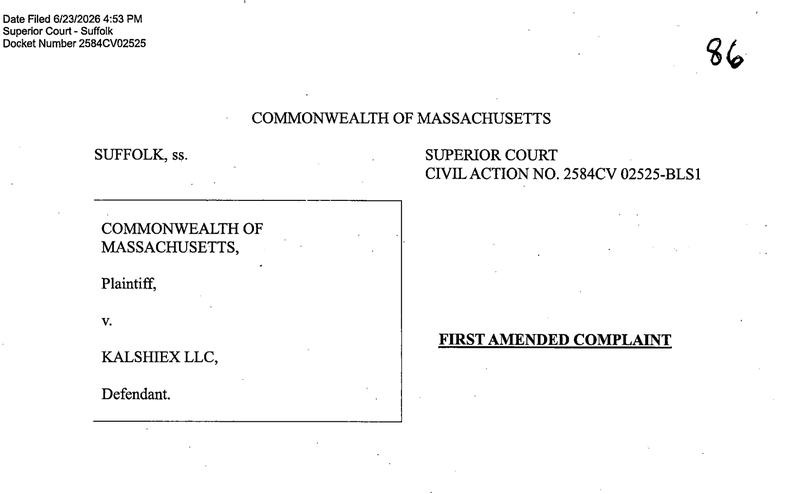
The initial lawsuit against Kalshi was filed by Massachusetts Attorney General Andrea Joy Campbell in September 2025, with allegations stating that the platform was required to obtain licensing from the Massachusetts Gaming Commission in order to operate in accordance with state regulations governing online sports gambling. A preliminary injunction was issued by a judge in January, preventing Kalshi from providing sports event contracts while the legal proceedings remained under judicial review.
The legal proceedings in Massachusetts represent merely one of numerous disputes involving state regulatory bodies and prediction market operators such as Kalshi and Polymarket, which provide users with the capability to engage in trading through event contracts covering a diverse range of outcomes spanning sports competitions, political events and current affairs.
Although Kalshi has faced restrictions from offering sports wagering services in certain jurisdictions, the platform also enjoys backing from the US Commodity Futures Trading Commission (CFTC), which submitted a brief in Massachusetts during April contending that the federal agency possessed "exclusive jurisdiction" over prediction market platforms. Under the leadership of Chair Michael Selig, the CFTC has maintained that event contracts available on these platforms constitute "swaps" regulated under the Commodity Exchange Act and therefore fall outside the scope of state-level regulatory oversight.
"Congress has entrusted the CFTC with the sole authority to regulate commodity derivatives markets, including prediction markets. To any state that seeks to nullify federal law and seize authority over these markets, I say again: we will see you in court."
Michael Selig, CFTC Chair
Cointelegraph reached out to Kalshi for comment but did not receive an immediate response. Following the initial complaint in September, a spokesperson said that the company was "ready to defend" itself in court.
Gaming organizations look to CLARITY Act for clarity on prediction markets
Although any one of the ongoing legal battles between prediction market platforms and state authorities in the United States could potentially advance to the US Supreme Court given the fundamental disagreements regarding federal versus state jurisdictional authority, certain organizations are instead seeking legislative solutions through Congress.
Earlier this month, national gaming and tribal organizations and labor groups called on US senators to add language "that explicitly prohibits event contracts tied to sports and casino-style gaming" to the Digital Asset Market Clarity (CLARITY) Act. The bill, under consideration in the Senate, is expected to give the CFTC more regulatory authority over digital assets.