
Federal financial regulators request public input on harmonizing portfolio margin frameworks for securities and derivatives
Both regulatory bodies are soliciting public commentary regarding cross-margining practices, collateral requirements and risk oversight as multi-asset trading and cryptocurrency derivatives markets experience continued growth.

Federal regulators overseeing the nation's financial markets—the Securities and Exchange Commission (SEC) and the Commodity Futures Trading Commission (CFTC)—have launched a collaborative public consultation process to explore whether portfolio margin frameworks should be better harmonized between securities and derivatives markets, requesting stakeholder input on strategies that might facilitate expanded cross-margining capabilities and diminish market fragmentation.
Both agencies are soliciting responses regarding cross-margining practices, how collateral should be treated, risk management protocols, protections for customers and the potential impact on market liquidity and competitive dynamics. The window for public commentary will extend for 60 days following publication of the request in the Federal Register.
"Cross-margining offers a clear opportunity to unlock liquidity that remains frozen in separate accounts," SEC Chair Paul Atkins said, adding that harmonizing the agencies' frameworks could help prevent jurisdictional overlap from limiting innovation and market efficiency.
The practice of cross-margining permits offsetting positions held across various products or markets to be evaluated collectively when determining margin requirements, as opposed to analyzing each position on a standalone basis. Through the recognition of such offsets, market participants can frequently pledge reduced collateral amounts against hedged positions due to margin calculations being grounded in the aggregate risk profile of the portfolio instead of evaluating each position independently.
Securities and security-based swaps fall under the SEC's regulatory jurisdiction, whereas the CFTC maintains authority over futures, swaps and commodity derivatives. Given that cryptocurrency exchanges and brokerage firms increasingly conduct business spanning both regulatory domains, the collaborative examination by both agencies mirrors the expanding requirement for synchronized regulatory oversight.
Cryptocurrency derivatives experience growth throughout regulated markets
The collaborative request for public feedback arrives following recent regulatory authorizations that established the foundation for a more extensive rollout of cryptocurrency derivatives products.
On May 29, the CFTC approved Bitcoin (BTC) perpetual futures for prediction market platform Kalshi and cleared Coinbase Financial Markets to offer eligible US institutional clients access to certain Deribit-listed crypto options and perpetual futures. Coinbase began offering that access the same day through its integration with Deribit.
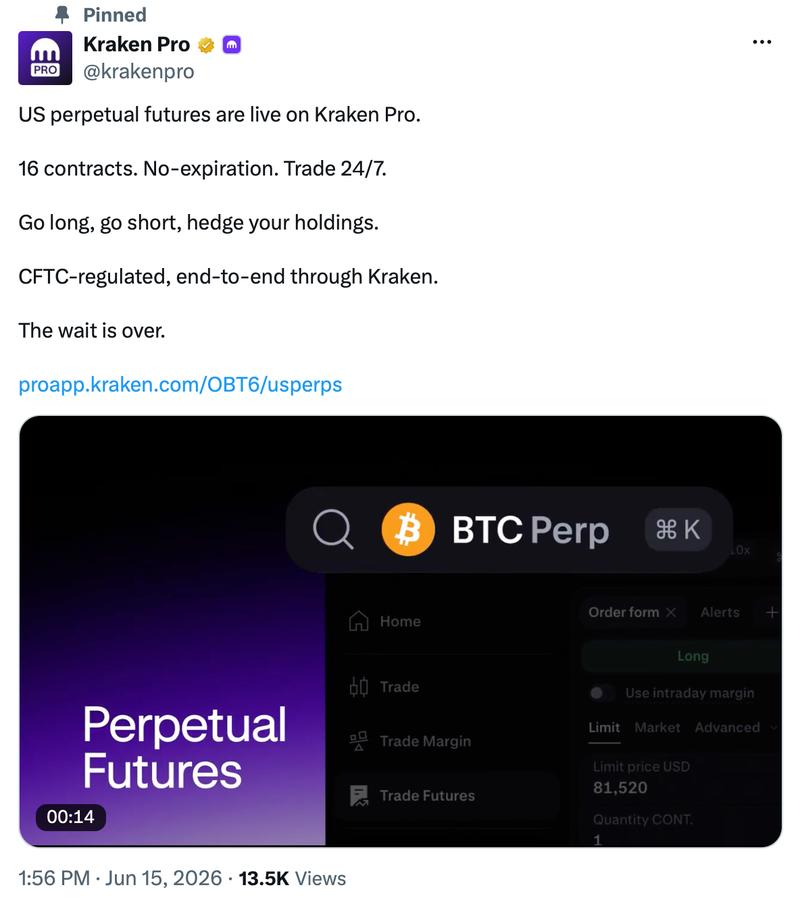
Several weeks thereafter, Kraken introduced CFTC-regulated perpetual futures contracts for qualifying US users via its recently acquired Bitnomial platform, broadening its domestic derivatives product lineup beyond crypto futures listed on CME.
The proliferation of cryptocurrency derivatives within United States markets has simultaneously sparked wider discussions regarding whether current regulatory structures continue to be suitable across varying market segments.
Earlier this week, CFTC Chair Mike Selig said cryptocurrency perpetual futures were not a "natural fit" for traditional commodity markets such as agriculture, highlighting the challenges regulators face in applying existing frameworks across increasingly diverse asset classes.