Custodia and Vantage Unveil Hybrid Token Design Switching Between Deposits and Stablecoins
The innovative framework seeks to bridge conventional banking systems with blockchain payment technology while keeping deposits within the banking sector.

A new token concept from Custodia and Vantage Bank features an automatic conversion mechanism that shifts the asset between functioning as a bank deposit and operating as a stablecoin, depending on whether it exists within participating financial institutions or moves to external holders.
Based on a white paper that was provided to Cointelegraph this Thursday, the digital token would function as a deposit instrument issued by member banks whenever it remains within the consortium of banking partners, while transforming into a stablecoin supported by cash reserves and short-term Treasury securities once it leaves what the companies call the Hazel network.
The two firms stated that the framework has been operational on the Ethereum (ETH) blockchain since March of this year and is currently undergoing evaluation by banks that are participating in the program, with plans for a more extensive deployment scheduled for the latter part of this year. The infrastructure has been engineered to accommodate tokenized deposits, stablecoins and additional blockchain-powered financial instruments through a collective banking framework.
The white paper indicates that financial institutions joining the network would have no requirement to dismantle or replace their current core banking technologies, as the platform is built to function in parallel with existing ledger systems and payment processing infrastructure.
The companies explained that the design was created to accommodate banks and credit unions regardless of their scale, encompassing community banks, and seeks to enable these institutions to engage in tokenized payment activities while ensuring customer deposits stay within the traditional banking ecosystem.
Custodia, which operates out of Wyoming, and Vantage, headquartered in Texas, announced their anticipation that the Hazel network will achieve widespread availability to banking institutions and their customer base during the fourth quarter of 2026.
Banks seek alternatives to stablecoins
This proposal emerges at a time when banking institutions are progressively searching for methods to provide blockchain-powered payment capabilities while avoiding the loss of customer deposits to entities that issue stablecoins.
At the beginning of this month, The Wall Street Journal published a report indicating that The Clearing House, an organization owned by major financial institutions including JPMorgan Chase, Bank of America and Citigroup, intends to introduce a tokenized deposit platform during the first half of 2027, which will enable banks to complete payment settlements utilizing blockchain-based digital representations of customer deposit balances.
Organizations representing the banking sector have additionally mounted resistance against proposed legislation that would potentially permit stablecoin issuers to provide products that generate yield returns.
Jamie Dimon, who serves as CEO of JPMorgan, made recent statements indicating that banks plan to maintain their opposition to specific provisions contained in the CLARITY Act, a piece of US legislation focused on crypto market structure, contending that these provisions would enable cryptocurrency firms to engage in competition for deposits while avoiding the requirement to secure bank charters. This legislation successfully moved forward from the Senate Banking Committee during May and continues to await approval from both the House and Senate.
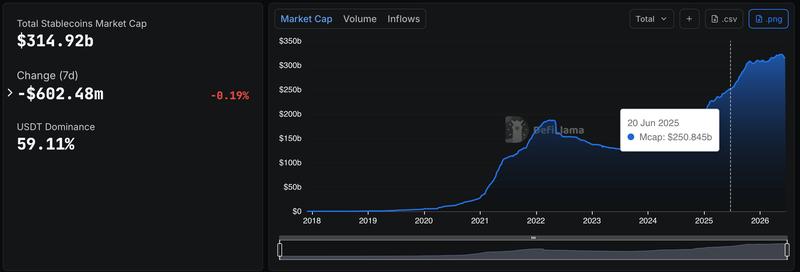
Data compiled by DefiLlama indicates that the overall market capitalization of stablecoins currently sits at approximately $315 billion, representing an increase from the roughly $251 billion figure recorded one year earlier.