
Controversial Ethereum Staking 'Tax' Proposal Faces Potential Irrelevance
A funding shortage at the Ethereum Foundation ignites controversy over implementing staking reward taxation, while EthLabs emerges as a superior solution.

According to former insiders, Ethereum faces a financial sustainability challenge.
This alert has ignited one of the most intense governance discussions within the Ethereum community in recent months: should the blockchain network finance its developers through taxation on staking rewards, or should it continue depending on affluent Ether holders to financially support the ecosystem?
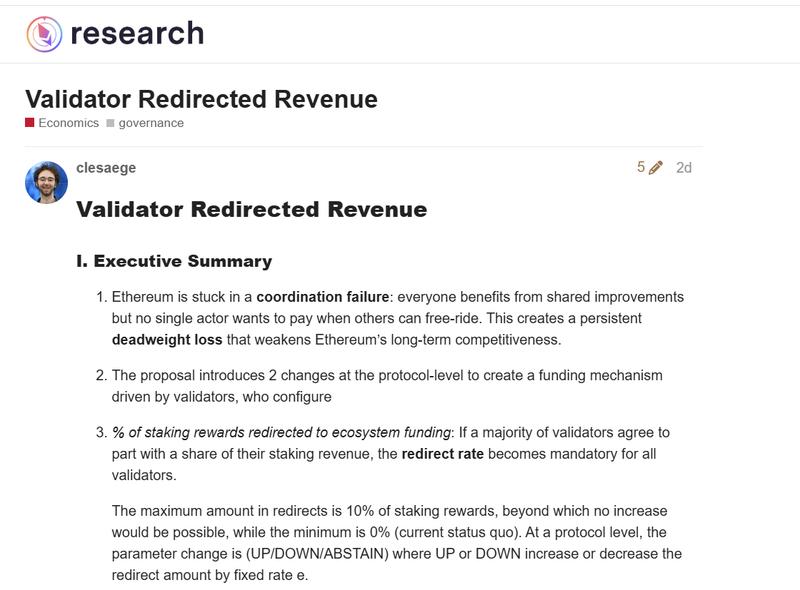
Central to this contentious discussion is a polarizing proposal put forward by Clément Lesaege, co-founder of Kleros. His suggestion involves channeling as much as 10% of validator earnings toward ecosystem development through a protocol-level system known as Validator Redirected Revenue.
According to Lesaege, this approach might be essential to address Ethereum's "coordination failure" and mitigate the chronic underfunding of collective ecosystem initiatives.
The concept encountered fierce opposition, with detractors raising concerns about cartel-style incentive structures and establishing a risky precedent for validator-controlled redistribution mechanisms.
However, precisely as the Ethereum community prepared for battle, a "credibly neutral" alternative was taking shape: Ethlabs.
Introduced on Monday by a team of five former researchers from the Ethereum Foundation, this newly established nonprofit Ethereum research and development laboratory has garnered support from the ecosystem's most significant backers, including BitMine, Sharplink and Joseph Lubin, who founded ConsenSys.
Given that major investors stand prepared to contribute financially, the fundamental question shifts from whether Ethereum possesses the capacity to fund itself to determining the preferred funding methodology.
Ethereum's 'slow-burning funding crisis'
The most recent controversy surrounding ETH commenced on Friday when Trenton Van Epps, a former contributor to the Ethereum Foundation, issued a warning that Ethereum's core development ecosystem might encounter a "slow-burning funding crisis" in a timeframe of three to nine months as legacy support initiatives expire and Foundation expenditures decline.
His calculations indicated that sustaining over 10 client, research and coordination teams requires approximately $30 million annually, and that the Client Incentive Program along with other support structures were insufficient to meet these financial obligations.
Van Epps contended that Ethereum is transitioning into an institutional "inheritance" stage where the Foundation will step back from its role as the primary custodian of protocol financing, necessitating new arrangements to succeed the expiring programs he previously helped oversee.
After dedicating much of the year to navigating leadership changes, facing public scrutiny regarding priorities, and engaging in an expanding discussion about core protocol financing, Van Epps' cautionary message struck a sensitive chord.
However, certain voices within the Ethereum community contested this view, maintaining that the EF possesses "enough funds to run for at least 30 years, so there is zero funding crisis." Tom Lee from Bitmine similarly dismissed the warning, declaring there was "zero chance" of Ethereum depleting its resources for protocol development.

The treasury policy of the Ethereum Foundation itself already indicates a multi-year operational reserve and a strategic plan for decreasing annual expenditures.
In June 2025, the EF announced its intention to preserve a 2.5-year operating expense reserve in cash and stablecoins, committed to limiting annual expenditures to 15% of total treasury holdings and progressively decreasing that expenditure rate to reach a 5% benchmark over a five-year period.
On Tuesday, Vitalik Buterin, founder of Ethereum, stated the Foundation is reducing its budget by approximately 40%, consistent with that strategy, as it moves from allocating around 15% of its resources annually prior to 2026 toward a long-term objective of about 5% per year following 2030. The organization eliminated 54 staff positions.
The proposal everyone hates
Therefore, while the Foundation may not exhaust its financial resources, it is implementing fiscal restraint and possesses considerably less capital to allocate toward research and development compared to its peak years. Lesaege contended that Ethereum experiences a coordination failure where all participants benefit from shared infrastructure — yet nobody wishes to bear the expense.
His proposed mechanism would mandate validators to indicate the portion of their staking earnings they are prepared to redirect, a percentage ranging from 0% to 10%. Should a majority of validators endorse a non-zero percentage, that redirection would become obligatory for all participants.
Based on current staking volumes, his calculations suggested that even a 5%-10% redirection could produce roughly 50,000 to 70,000 ETH annually for ecosystem initiatives, translating to approximately $82.5 million to $115.5 million at today's ETH valuation.
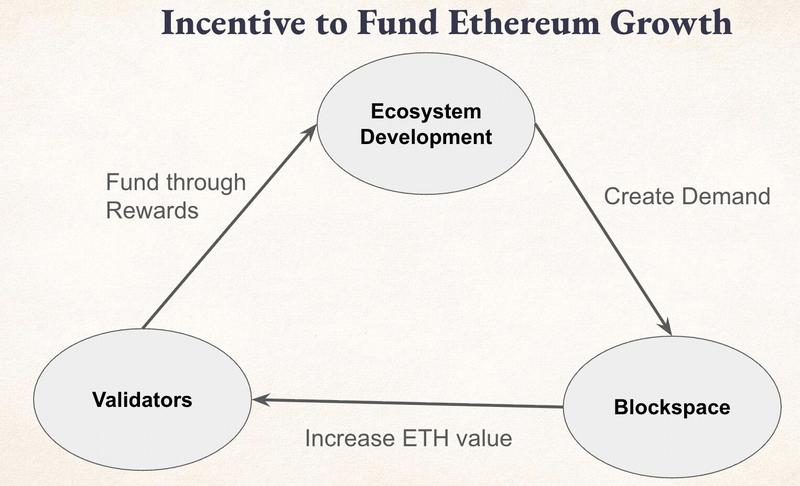
Opponents rapidly focused on the power dynamics inherent in this mechanism, cautioning that it could consolidate the position of large validators, obscure the distinction between operators and governance participants, and provide a stake-weighted majority with additional influence over ecosystem funding determinations.
What staking providers say
A representative from Figment informed Cointelegraph the proposal would reduce profit margins, which "tends to consolidate the validator set toward larger, more integrated operators" catering to institutional clients, such as Figment.
This consolidation would occur at the "cost of some operator diversity and potentially fewer net new ETH stakers," according to the spokesperson.
Andrew Gibb, chief executive and co-founder of Twinstake institutional staking, informed Cointelegraph that different investor categories would react in varying ways.
Though long-term ETH investors might appreciate the possibility of a better-financed ecosystem, shorter-duration capital, including retail investors, liquid multi-asset funds and return-oriented allocators may demonstrate less enthusiasm.
According to his assessment, the proposal would "narrow the addressable staking market at the margin," with the most price-conscious groups likely to "reduce or exit positions," and he anticipated some clients would reevaluate their staking commitments.
Max Shannon, senior research associate at Bitwise, informed Cointelegraph that Ethereum staking engagement has thus far demonstrated minimal sensitivity to reduced rewards.
He noted that the staking annual percentage rate (APR) has decreased from approximately 4.6% in June 2023 to around 2.7% currently, while staked supply and the staking ratio roughly doubled. Nevertheless, further reward reduction would render "slashing risk and exit-queue liquidity risk more material relative to the return."
He further noted that a diminished net consensus-layer yield might compel validators to depend more substantially on maximal extractable value (MEV) to compensate for lost APR, which could potentially impact censorship resistance negatively.
How large is the problem, really?
In theoretical terms the financing shortfall is not particularly substantial. Shannon observed that if the annual deficit amounts to around $30 million and annual staking rewards total about $1.9 billion, then the gap could be bridged with merely 1.6% of staking rewards.
This perspective makes Lesaege's proposal appear reasonable, despite its continued political toxicity. From an economic standpoint, a single-digit reduction on staking rewards is feasible. From a governance perspective, numerous Ethereum stakeholders perceive it as a boundary-crossing action that transforms validators into a taxation authority.
Shannon also maintained that networks with embedded development financing are not inherently more advantageous simply because they designate rewards. According to his assessment, protocol achievement is determined much more substantially by token value performance and contributor motivation than by any singular developer funding structure.
A new funding model emerges
Tom Lee's assertion there was "zero chance" of an Ethereum funding emergency and that resources were "secured" anticipated the introduction of the new non-profit EthLabs several days subsequently.
Instead of imposing taxation on rewards at the protocol tier, Ethlabs allows large ETH-aligned organizations such as BitMine and Sharplink to finance development directly.
It does not supplant the Ethereum Foundation, but rather augments it. EthLabs indicates that the smart contract platform's subsequent phase may incorporate a more decentralized funding structure, where the EF maintains its centrality to the protocol's foundation, while additional laboratories and treasury-rich institutions finance supplementary work.
In a post on X on Monday, Joe Lubin, Ethereum co-founder, stated there remains "an enormous amount of top tier talent" at the Ethereum Foundation that continues to concentrate on "the cypherpunk core components" of the protocol. However, he emphasized that numerous other Ethereum R&D teams will now investigate other dimensions.
Gibb stated that the obligation for financing ecosystem development belongs to foundations and protocol treasuries. There exist alternative mechanisms to consider, such as staking yield or priority fees, he noted, "before making changes to validator economics at the protocol level."
Whether Ethlabs demonstrates adequacy remains uncertain. However, its appearance has already transformed the discussion from how Ethereum should impose taxation on itself to whether such taxation is necessary whatsoever.