
Capital rotation signals emerge as Bitcoin ETF flows diverge from gold
Gold ETFs experience unprecedented outflows following historic gains, while Bitcoin ETF inflows return to positive territory. Could this mark the beginning of a capital shift from gold to Bitcoin?

Exchange-traded fund (ETF) flows for Bitcoin (BTC) have achieved net positive territory during the last 30 days, simultaneously as demand for gold ETFs has begun decelerating following a nine-month consecutive streak of positive inflows. This transition is occurring despite gold maintaining elevated price levels and Bitcoin experiencing cooling investor sentiment.
Given these opposing patterns in ETF flow dynamics and the recurring historical cycle of performance leadership between Bitcoin and gold, market analysts are currently scrutinizing data that could indicate an emerging gradual transition in investor preference between these two distinct assets.
Are ETF flows beginning to rotate?
Data from the Kobeissi Letter indicates that GLD, the most prominent US gold-backed ETF, experienced a $3 billion outflow on Wednesday, representing the largest single-day redemption in over two years. This significant withdrawal occurred in conjunction with a 4.4% price decline in gold, the most severe drop since the sell-off witnessed on Jan. 30.
Throughout January, gold ETFs accumulated $18.7 billion in inflows, followed by an additional $5.3 billion during February, establishing the most robust two-month opening period for any year on record while continuing a nine-month consecutive inflow pattern. This recent outflow suggests investors are realizing gains following gold's substantial rally throughout 2025.
During the preceding month, Bitcoin ETF flows demonstrated movement in the contrasting direction. The 30-day net flow reversed to a $273 million inflow position on March 6 from a $1.9 billion outflow recorded on Feb. 6
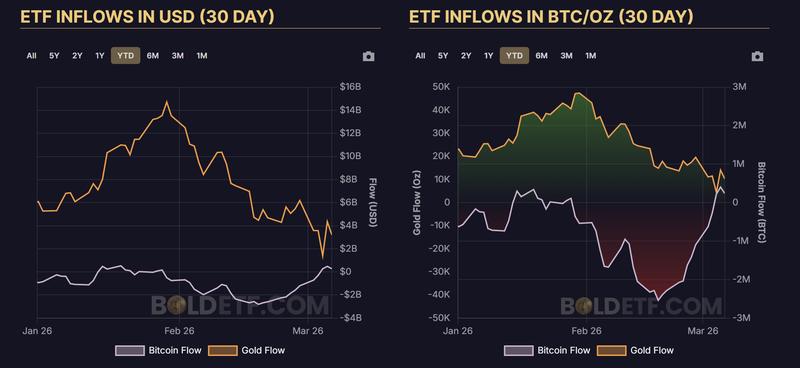
When examining holdings data denominated in native units, the divergence becomes even more apparent. Bitcoin ETF balances transitioned to a net gain of 4,021 BTC on March 6 compared to −42,275 BTC recorded on Feb. 6. During this identical timeframe, gold ETF holdings contracted from 1.4 million ounces down to 621,100 ounces.
Native unit measurements capture the genuine underlying asset quantities maintained by funds instead of the dollar-denominated value of these holdings. Monitoring BTC or ounces provides isolation of authentic accumulation or distribution patterns without interference from price movement distortions.
Joe Consorti, head of growth at Horizon, characterized the prevailing trend by stating,
"Gold is stalling out while bitcoin is soaring. BTC is set to overtake gold's % growth over the last month as the U.S. economy accelerates and risk sentiment improves. The anticipated risk-off → risk-on rotation could be underway."
Gold rallies precede Bitcoin recoveries
Within a "2026 Look Ahead" report published during late December 2025, Chris Kuiper, an analyst at Fidelity Digital Assets, observed that gold's 65% return throughout 2025 represented the fourth-largest annual performance increase since the conclusion of the gold standard. Examining previous rallies, Kuiper indicated that gold is potentially approaching the final phases of its leadership cycle in relation to these two assets. Kuiper stated,
"Historically, gold and bitcoin have taken turns outperforming. With gold shining in 2025, it would not be surprising if bitcoin takes the lead next."
Nevertheless, the rotation process may require considerable time before materializing in the marketplace.
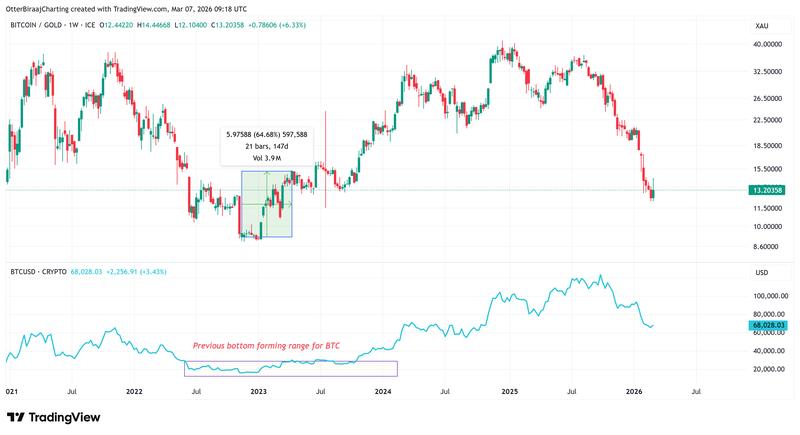
The chart demonstrates that BTC required approximately 147 days or 21 weeks to develop a sustained trend of outperformance relative to gold following Bitcoin's 2022 low point. This timeframe represented a consolidation phase occurring before the ratio initiated its upward trajectory.
Currently, the BTC-to-gold ratio is trading in proximity to the identical consolidation zone observed throughout the earlier rotation phases during 2022-2023.
Kuiper further noted that both assets stand to benefit from the ongoing fiscal deficits, escalating trade tensions, and geopolitical uncertainty as market participants pursue neutral stores of value positioned outside conventional monetary systems.
The continuing US-Israel and Iran conflict has strengthened demand for traditional safe-haven assets, which historically supported gold rallies throughout periods characterized by geopolitical stress.
Concurrently, Lyn Alden, a macroeconomic strategist, anticipates Bitcoin will outperform gold throughout the upcoming two to three years subsequent to gold's recent rally during the past several months.
This article does not contain investment advice or recommendations. Every investment and trading move involves risk, and readers should conduct their own research when making a decision. While we strive to provide accurate and timely information, Cointelegraph does not guarantee the accuracy, completeness, or reliability of any information in this article. This article may contain forward-looking statements that are subject to risks and uncertainties. Cointelegraph will not be liable for any loss or damage arising from your reliance on this information.