
BTC Surges Past $60K During Fed Inflation Discussion: Bull Trap or Path to $65K?
Despite concerns over Federal Reserve interest rate increases and continuous outflows from Bitcoin spot ETFs, BTC climbed above $60,000. Could this rally be a deceptive bull trap?

Key takeaways:
- Ongoing outflows from spot Bitcoin ETFs combined with US dollar resilience diminish the likelihood of a rapid climb to $65,000.
- Robust performance in the AI sector earnings and elevated fixed-income yields continue to draw capital away from both Bitcoin and gold.
Bitcoin (BTC) displayed a favorable response to comments made by US Federal Reserve Chair Kevin Warsh regarding persistent inflation challenges. In spite of Wednesday's price gains, market participants remain concerned that attractive fixed-income investment opportunities and the continued strength of technology stock earnings will maintain downward pressure on assets that don't generate yield, including cryptocurrencies.
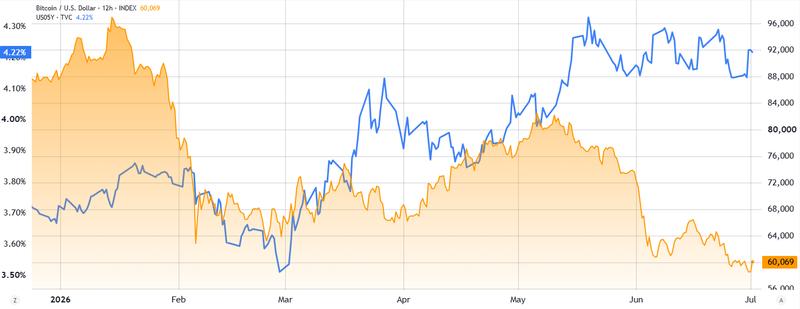
The yield on the US 5-year Treasury note surged to 4.22%, signaling that market participants are requiring greater compensation to maintain positions in government debt securities. Even with expectations of eventual inflation moderation and WTI crude oil prices dropping to their lowest point in 4 months, market participants are pricing in monetary expansion. Irrespective of the Federal Reserve's approach to managing interest rates and its balance sheet operations, the US Treasury maintains control over debt issuance patterns.
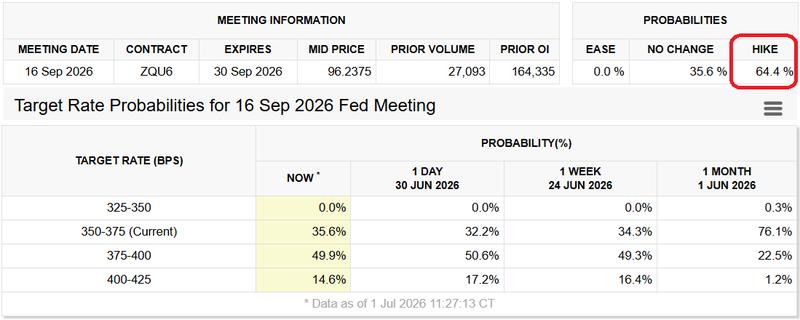
Based on US government bond futures pricing, the probability of interest rate increases by September reached 64%, a significant increase from the 23% probability recorded one month earlier. The elevated anticipated returns on fixed-income securities occurred alongside strengthening of the US dollar relative to other prominent global fiat currencies, creating particular challenges for alternative safe-haven assets including gold and Bitcoin.
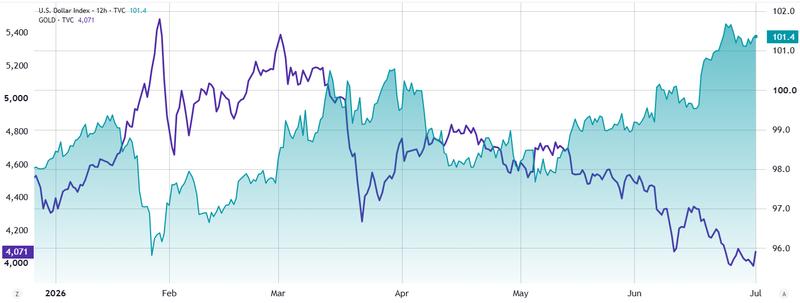
Notwithstanding Wednesday's positive price movement, gold has declined 12% over a two-month period, while the US dollar strength index (DXY) approaches its peak level over the past year. This demonstration of faith in the US economy is partially attributable to the AI sector's robustness, demonstrated by the Nasdaq 100 index's impressive 25% appreciation. Nevertheless, certain technology sub-sectors have exhibited recent signs of vulnerability, potentially serving as a trigger for Bitcoin and gold price movements.
Could the AI sector cool off act as a catalyst for Bitcoin?
Shares of Micron (MU US) and SanDisk (SNDK US) experienced intraday declines surpassing 9% on Wednesday following announcements from competitors SK Hynix (000660 KR) and Samsung (005930 KR) regarding their intentions to increase production capacity. Nonetheless, this price action can scarcely be characterized as a trend reversal considering the iShares SOX Semiconductor Index ETF (SOXX US) has appreciated 78% over a three-month timeframe.
Persistent outflows from US-listed spot Bitcoin exchange-traded funds (ETFs) have crushed the optimism of bullish investors, creating a downward price momentum where bearish developments receive amplification while favorable developments go largely unnoticed.
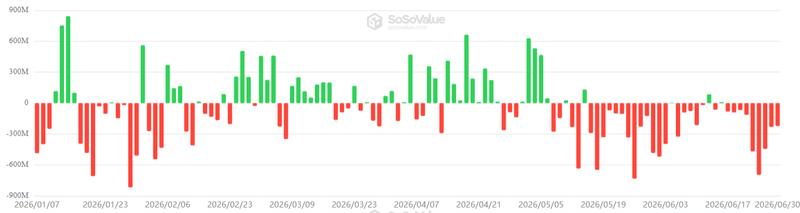
Irrespective of the underlying reasons driving the selloffs, Bitcoin's current weakness, positioned 53% beneath its all-time high, fails to generate investor confidence in the sustainability of the $60,000 support threshold.
Strategy (MSTR US) bolstered its cash reserves to achieve a sustainable 17 months of dividend coverage on Monday. Despite this move, Strategy's variable-rate Stretch preferred stock (STRC US) has remained substantially distant from the $100 price point necessary for executing additional stock issuances. The STRC dividend payment climbed to 12% from the previous 11.5%, yet this increase evidently proved insufficient to attract additional purchasing interest.
Bitcoin may have experienced short-term gains stemming from Fed Chair Warsh's commentary regarding stubborn inflation, however increasing market expectations for elevated interest rates combined with continued strong performance in the AI sector's earnings reports are likely to maintain downward pressure on Bitcoin. Consequently, achieving a durable rally toward $65,000 may require additional time to materialize.