
Blockchain Rule Enforcement Sparks Debate Between ZKsync and Canton
Divergent philosophies emerge as Canton and ZKsync pursue contrasting strategies for blockchain-based banking, revealing fundamental disagreements about network-wide rule enforcement versus trust-based systems.

Financial institutions are transitioning to blockchain technology through rival frameworks that diverge significantly in their approach to regulatory compliance and rule implementation.
One side features blockchain purists such as Matter Labs co-founder Alex Gluchowski, who contend that robust financial infrastructure demands universal rule enforcement affecting every network participant. Standing opposite are institution-focused platforms like Canton, which emphasize privacy considerations, administrative oversight and seamless connectivity above maintaining a unified global state.
Gluchowski ranks among the most outspoken detractors of the institution-first methodology, contending it simply replicates traditional financial system constraints in blockchain clothing. The fundamental question centers on whether regulations can be uniformly applied throughout an entire network. Such capabilities don't exist in architectures like Canton, according to his assessment.
But they are possible with blockchains — specifically with zero-knowledge systems anchored to public blockchains like Ethereum, which is an environment all parties can trust because it cannot be captured by any single corporate interest.
Alex Gluchowski told Cointelegraph
The cryptocurrency sector's embrace by mainstream institutions is ushering banks and financial service providers onto blockchain networks, though it's simultaneously dividing the ecosystem along philosophical lines that run deeper than jurisdictional boundaries or compliance frameworks.

What counts as a blockchain?
Canton has achieved market penetration by addressing privacy concerns and compliance obligations, linking financial institutions and investment firms through an infrastructure where transaction data is disclosed exclusively to directly involved counterparties instead of being disseminated network-wide. Major institutional players including JPMorgan and Goldman Sachs participate in the network.
The question of whether Canton qualifies as a legitimate blockchain hinges on definitional boundaries and which fundamental characteristics are considered non-negotiable for the classification.
From Gluchowski's perspective, a blockchain's defining characteristic is a unified, transparent ledger enabling simultaneous rule application across every network participant. Canton fails this test, he maintained. The platform facilitates connections between institutions via bilateral or trilateral arrangements, with each organization viewing and authenticating only those transactions in which it directly participates.
Before blockchains, banks had to enter bilateral relationships and define how they handle edge cases through contracts and API interactions. It's just taking these existing relationships and workflows and putting them into a tokenized form.
Gluchowski said
Gluchowski contended that Canton's architecture constrains what guarantees the platform can deliver. Though participants can authenticate transactions involving them directly, they lack the ability to independently confirm network-wide characteristics like aggregate asset circulation or universal rules governing all users. He emphasized that such assurances necessitate a common state accessible for verification by all parties.
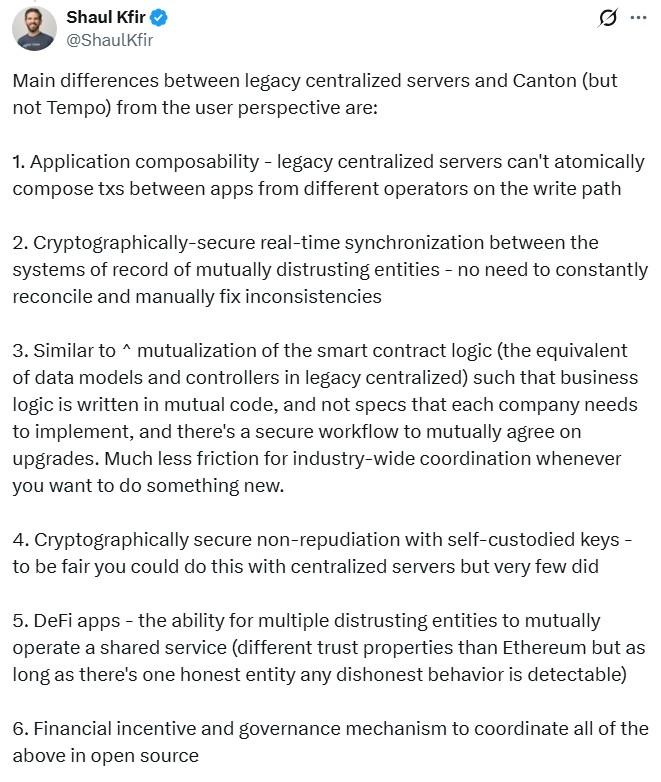
[Gluchowski] is correct that Canton does not have a global shared state, but he is incorrect in implying that this negatively affects Canton's trust model.
Shaul Kfir, co-founder of Digital Asset, responded through a statement shared with Cointelegraph
In Canton, as in all other blockchains, I only trust my own validator and assume anyone else can be malicious. This 'don't trust, verify' approach is very different from a distributed API system.
Kfir added
Within Canton's framework, trustworthiness stems not from a singular network-wide perspective, but rather from each participant autonomously verifying the transactions in which they engage.
Network rules clash with issuer control
After his initial conversation with Cointelegraph, Gluchowski engaged in a public debate with Yuval Rooz, another Digital Asset co-founder. He restated his position that financial regulations require network-wide enforcement mechanisms in blockchain systems.
Rooz challenged the notion that network-level enforcement removes dependence on trusted entities, noting that public blockchain participants remain reliant on token issuers. Rooz referenced security breaches involving assets like USDC to support his claim that issuers constitute the primary enforcement layer.
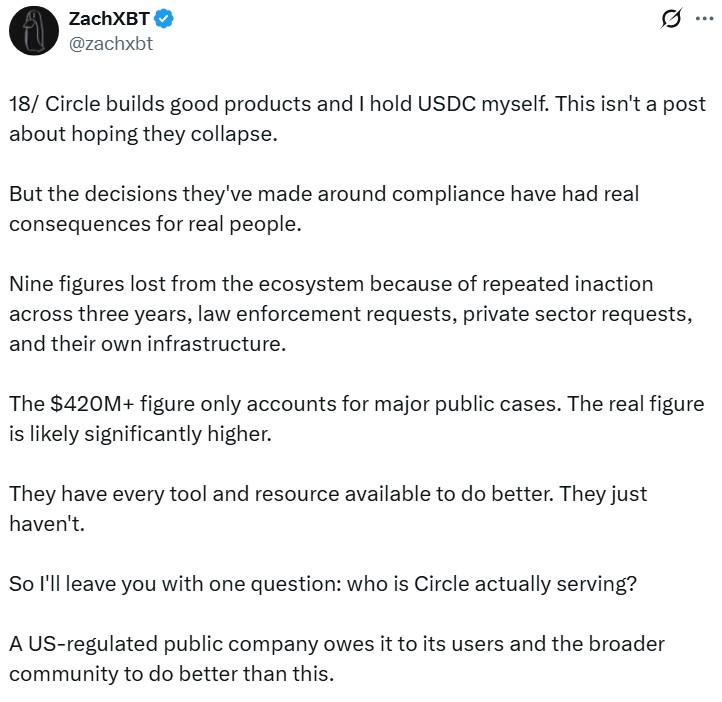
Actually, we would have been happier — as we've seen a lot of the crypto space saying if the centralized issuer were to intervene sooner rather than allowing these assets being traded and swapped into permissionless assets where then they can no longer interfere.
Rooz said
On Canton, no different than any other public chain, the issuer is centralized in real world assets, and they have different properties or similar properties to what they would have on public permissionless chains.
He added
Gluchowski countered that issuance restrictions can be programmed directly into smart contract code. He explained that on platforms like Ethereum, transactions exceeding predetermined thresholds can be blocked or flagged for additional authorization, eliminating sole reliance on issuer-controlled infrastructure.
On Canton, you rely solely on the multisig. On Ethereum, you rely on smart contracts that are enforced by the network.
Gluchowski said
"It's just absolutely not true," Rooz replied.
Kfir, whose written response was provided to Cointelegraph following the live debate, asserted that Gluchowski is "confusing the capabilities of Canton" with its implementation by centralized RWA issuers.
When there's a centralized RWA issuer, e.g. a stablecoin issuer, you're already trusting them with the 'mint' function, and you're trusting them and their auditors that the amount onchain is backed by reserves off-chain.
Kfir said
Competing visions for bringing banks onchain
Canton and Matter Labs represent competing approaches to the identical challenge of transitioning institutional finance onto blockchain infrastructure. Matter Labs, the organization behind ZKsync, is pursuing institutional applications through Prividium, an architecture that maintains transaction confidentiality while anchoring authentication to Ethereum via zero-knowledge proofs.
Kfir suggested that platforms like Prividium merely relocate trust concentration rather than eliminating it. From his standpoint, users forfeit independent validation of pertinent state information, compelling them to align their internal records with what an operator claims transpired onchain.
ZKsync relies on Prividium operators who create ZKPs, but ZKsync's own open source client doesn't verify these proofs. And even if a user does verify, it doesn't verify which smart contract logic is running. The user is completely at the mercy of the Prividium operator.
He said
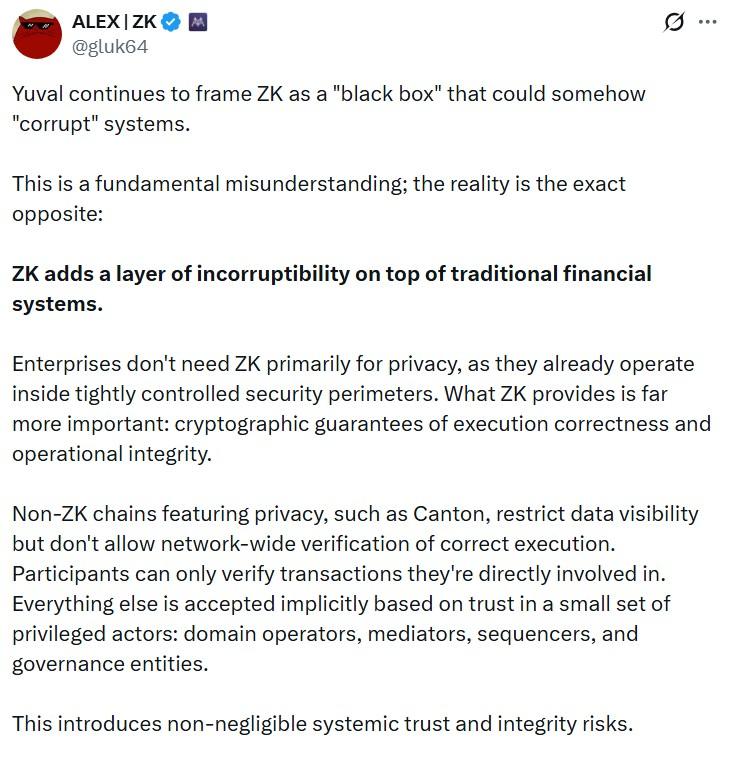
Rooz acknowledged one specific point throughout the debate, namely that Canton currently lacks public verifiability, though he noted that roadmap plans include adding this feature down the line.
At present, the philosophical divide persists without resolution. Canton's architecture centers on privacy preservation and institutional governance, whereas ZKsync's Prividium seeks to maintain these characteristics while securing verification to a public network. Both platforms assert they provide workable pathways for onboarding banks to blockchain technology, yet they rest on fundamentally incompatible premises regarding how financial infrastructure should operate.