
50,000 BTC Exchange Transfers Signal Potential Capitulation Event for Bitcoin
Approximately 50,000 BTC were transferred to exchanges by short-term Bitcoin investors at a loss as selling pressure from institutions dampened market sentiment.

Fresh indicators of capitulation among short-term Bitcoin (BTC) holders have emerged following the transfer of approximately 50,000 BTC to exchanges at a loss within the last 24 hours. Concurrently, the realized market capitalization attributed to short-term holders dropped to $237.7 billion, marking the lowest reading observed since October 2024.
This uptick in selling activity motivated by losses occurs against a backdrop of restrictive monetary conditions and diminishing institutional appetite for Bitcoin, which analysts describe as a "deeply unfavorable" climate for BTC performance.
Fresh indicators of stress emerge among short-term Bitcoin investors
According to CryptoQuant analyst Amr Taha, the short-term holder (STH) market capitalization for Bitcoin declined to $237.7 billion on June 26, representing the lowest point since Oct. 2, 2024, when the metric registered near $239.7 billion.
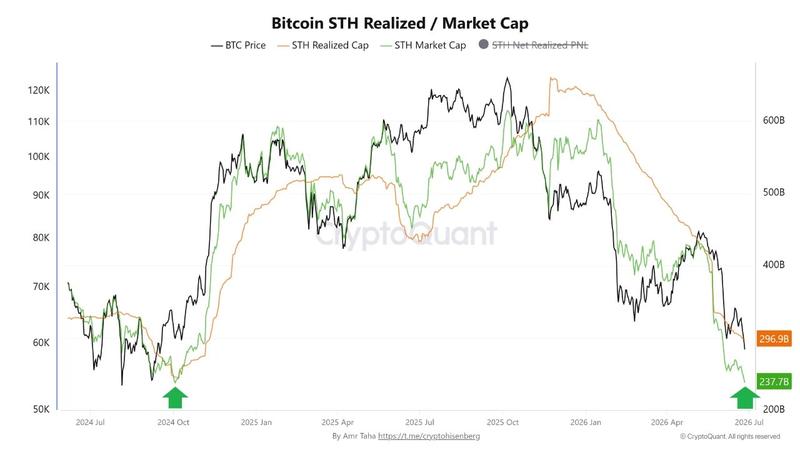
This particular metric monitors the aggregate market value of Bitcoin holdings belonging to investors who acquired their positions during the preceding 155 days. The current data point reveals that this cohort's market valuation has fallen beneath its realized value, suggesting that numerous recent purchasers are currently sitting on unrealized losses.
A comparable downward movement was observed during the correction phase in October 2024, which subsequently coincided with a significant bottom formation for Bitcoin. The current reading functions as an indicator of market stress but does not definitively confirm that a market floor has been established.
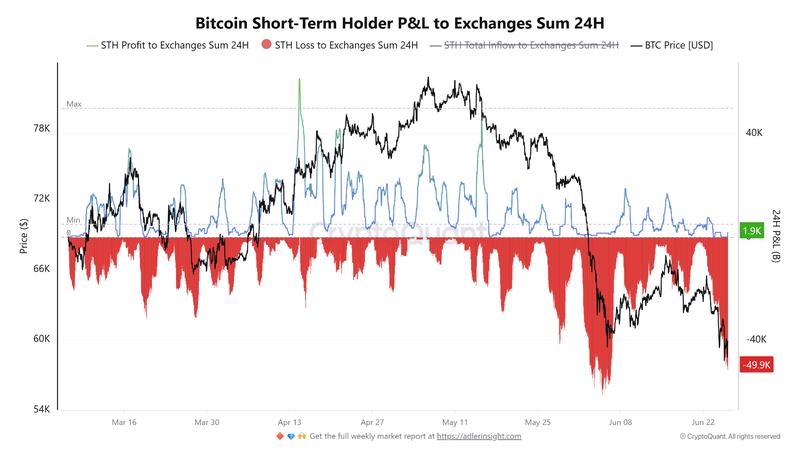
Data from exchange platforms provides an additional dimension to the overall situation. Approximately 50,000 BTC belonging to short-term holders were transferred to exchanges at a loss over the preceding 24 hours, representing the most substantial loss-driven exchange flow observed since June 4. Binance specifically received approximately 9,500 BTC under comparable circumstances, marking its highest inflow level since June 3.
These movements suggest that selling pressure from the buy-side has intensified as more recent market participants respond to declining prices.
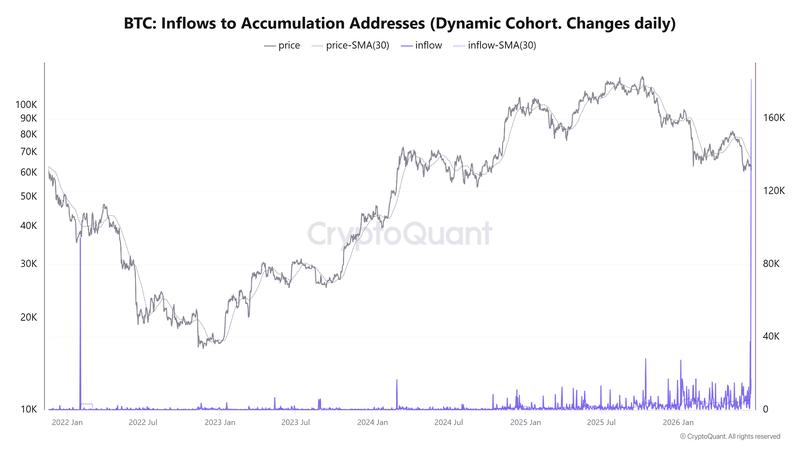
In contrast, the behavior of long-term holders presented a more encouraging development. Bitcoin deposits into accumulation addresses surged to an all-time high of 181,000 BTC on Thursday, nearly double the prior peak of 94,700 BTC that was documented in February 2022. These particular wallets characteristically receive coins with minimal transaction history, implying that this spike indicates long-term investors are absorbing available supply as short-term holders liquidate their positions.
Challenging macroeconomic environment pressures BTC purchasers
According to market analyst Darkfost, demand from institutional participants has persistently weakened, evidenced by the Coinbase Premium Index maintaining negative territory for 40 consecutive days beginning May 15.
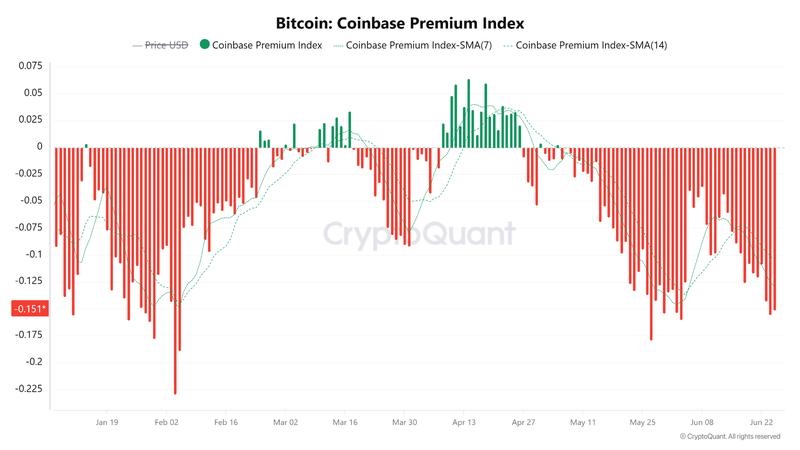
This particular indicator performs a comparison between Bitcoin valuations on Coinbase Advanced and Binance platforms. An ongoing discount on Coinbase suggests more aggressive selling activity from institutional investors compared to retail market participants.
Macroeconomic data releases from the United States further contributed to the prevailing cautious sentiment. Headline PCE inflation registered at 4.1% compared to market expectations of 4.0%, while Core PCE recorded 3.4% versus the anticipated 3.3% forecast. GDP figures also surpassed projections at 2.1%, maintaining subdued expectations regarding the implementation of more accommodative monetary policy. Offering commentary on the prevailing market conditions, the analyst stated,
This dynamic is a perfect reflection of the current macro backdrop, which remains deeply unfavorable for risk assets such as BTC.
Investment management company Bitwise indicated that the Federal Reserve meeting conducted last week intensified the hawkish pivot after central bank policymakers eliminated their accommodative bias and elevated the median 2026 Fed funds projection to 3.8% from the previous 3.4% forecast issued in March.
The company further noted that increasingly restrictive financial conditions have aligned with persistent outflows from cryptocurrency exchange-traded products including the spot ETFs.
Market focus has also gravitated toward Strategy, which has amassed 174,300 BTC throughout 2026. According to Bitwise estimates, approximately 96,000 BTC, representing 55% of total acquisitions, were financed via STRC preferred equity issuances, while an additional 77,500 BTC were funded through MSTR common stock offerings.
Currently, CryptoQuant has observed that STRC is trading at an unprecedented 17.5% discount relative to its $100 par value following a decline to $82.5 last week, before further deteriorating to approximately $73 during Friday's premarket trading session. Strategy's available cash reserves have contracted by 38% since the beginning of 2026, subsequent to the company's repurchase of a $1.5 billion convertible note.
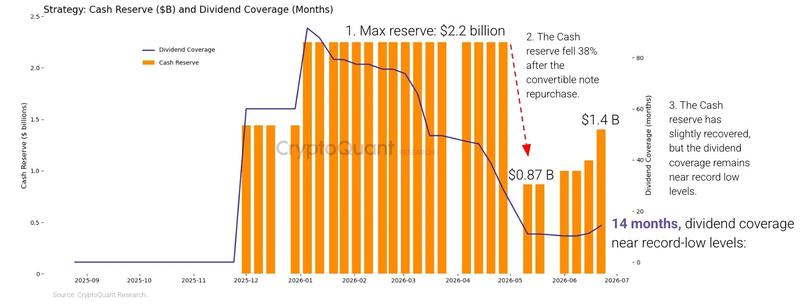
Annual dividend commitments associated with STRC have also escalated to $1.2 billion from the previous $300 million level, while dividend coverage capacity has been reduced to 14 months, declining from what was previously as extended as seven years.
These financial metrics indicate increasingly constrained funding conditions for one of the largest institutional accumulation entities in the Bitcoin market, introducing an additional layer of downward pressure occurring simultaneously with the rise in loss-motivated exchange deposit flows.