
Vitalik Buterin Unveils Four-Year Vision for Enhanced Speed and Quantum Security on Ethereum
The Ethereum network aims to reduce block time to just 2 seconds and achieve finality in 16 seconds, implementing quantum-resistant technology through seven planned forks by 2029.

Vitalik Buterin, the co-founder of Ethereum, has provided additional insights into a recently unveiled roadmap that details how the network intends to significantly accelerate both block production and transaction confirmation processes.
On Thursday, Vitalik elaborated on a visual public roadmap dubbed "Strawmap" that was published by the Ethereum Foundation's Protocol team.
"Fast slots are positioned in their own dedicated lane at the roadmap's top, and don't really appear to connect to other elements," Buterin remarked, observing that the remaining portions of the roadmap are "pretty independent of the slot time."
The term slot time refers to the duration Ethereum requires to generate new blocks, which currently stands at approximately 12 seconds. According to the roadmap, this timeframe is targeted to decrease to as little as 2 seconds, transforming the blockchain into something that feels more like a live, immediate system instead of one requiring waiting periods.
"I expect that we'll reduce slot time in an incremental fashion," Buterin stated, proposing reductions that follow a roughly square-root-of-two formula, progressing from 12 seconds downward through 8, 6, 4, and ultimately reaching as low as 2 seconds.
He further indicated that p2p improvements, or enhancements to the way Ethereum nodes interact with one another — including sharing new blocks and data while eliminating the need to download duplicate data — can substantially decrease block propagation time, "making shorter slots viable with no security tradeoffs."
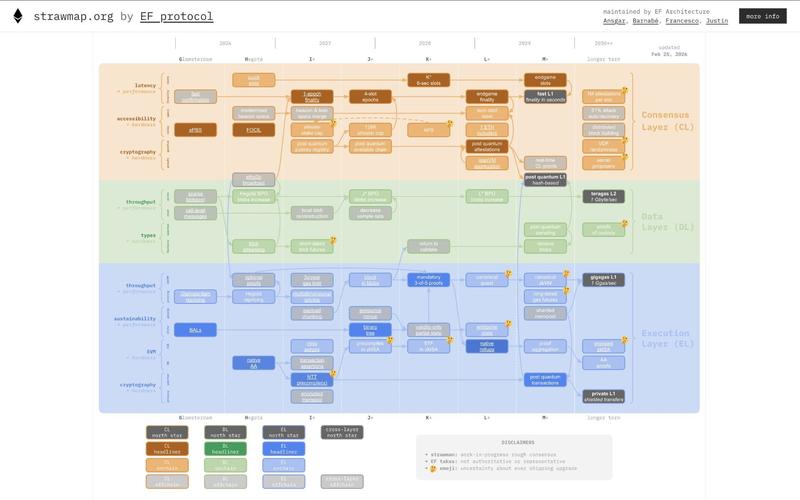
Finality from minutes to seconds
The roadmap's second significant enhancement concerns finality, which represents the stage at which a transaction becomes mathematically guaranteed to be irreversible, currently taking approximately 16 minutes.
The objective for the future is to achieve finality within a window of 6 to 16 seconds, accomplished by substituting the existing complex confirmation system with a more streamlined, simpler alternative that also incorporates quantum-resistant features.
"The goal is to decouple slots and finality, to allow us to reason about both separately," Buterin explained.
He characterized this as a "very invasive set of changes," leading to the decision to combine the most substantial step in each modification with a "switch of the cryptography, notably to post-quantum hash-based signatures."
Quantum resistance of slots before finality
According to Buterin, one result of this methodology would be the implementation of quantum-resistant slots ahead of finality.
"One interesting consequence of the incremental approach is that there is a pathway to making the slots quantum-resistant much sooner than making the finality quantum-resistant."
The network could "quite quickly" arrive at a state where, should quantum computers suddenly emerge, "we lose the finality guarantee, but the chain keeps chugging along," he explained.
"Expect to see progressive decreases of both slot time and finality time," Buterin concluded.
The "component-by-component replacement" of Ethereum's slot structure and consensus mechanisms will yield a "cleaner, simpler, quantum-resistant, prover-friendly, end-to-end formally-verified alternative."
The timeline for implementing these modifications spans the next four years, featuring seven forks scheduled at roughly six-month intervals. Glamsterdam and Hegotá have already been confirmed and are scheduled for deployment later this year.