USDb Stablecoin Debuts on Bitcoin Infrastructure for Corporate Payment Solutions via Paystand
Enterprise payment platform Paystand introduces USDb, a stablecoin pegged to the US dollar and operating on Bitcoin-connected infrastructure, designed for corporate finance operations including payroll, treasury management, and business transactions.

A new US dollar-pegged stablecoin called USDb has been introduced by Paystand, designed specifically for enterprise payment applications and built on Bitcoin-connected infrastructure. The digital asset will be deployed across various business payment functions, encompassing accounts receivable and payable operations, payroll processing, and corporate treasury management.
The announcement made on Tuesday revealed that USDb operates on Bitcoin-linked infrastructure, notably Rootstock, while maintaining interoperability with Blockstream's technology framework. Initial deployment will occur throughout Paystand's payment infrastructure, a network that has facilitated transaction volumes exceeding $20 billion across more than one million business entities, according to company statements.
Headquartered in Santa Cruz, California, Paystand operates as a blockchain-focused payments company delivering accounts receivable and payable solutions to commercial clients throughout North America and Latin America.
The USDb token maintains full backing through US dollar reserves on a 1:1 basis and will be integrated into Paystand's current product lineup, which includes international payroll services via its Bitwage division. The company has outlined plans to broaden availability to other partners and clientele throughout 2026.
Launch partners supporting the stablecoin include Rootstock, Blockstream and Ibex, with Ibex serving as the primary minting partner and provider of liquidity. The token architecture ensures compatibility with Bitcoin-based network protocols including the Lightning Network and Liquid.

USDb has been engineered to seamlessly connect with corporate financial management systems, featuring ERP-ledger integration capabilities, while facilitating automated settlement procedures across Paystand's operational network.
The Bitwage platform, which Paystand acquired during 2025, provides workforce payment services to over 90,000 individual workers and approximately 4,500 corporate clients spanning nearly 200 nations worldwide, company representatives stated.
Stablecoins push into payroll and payouts
The utilization of stablecoins for corporate payment functions continues to accelerate, with businesses deploying these digital assets for payouts, payroll disbursements, vendor payment settlements and international money transfers, representing expansion beyond their traditional applications in trading and remittance services.
In recent developments last week, DoorDash announced a collaboration with Tempo to facilitate stablecoin-based payment options for its driver workforce and merchant partners, enabling transaction settlements via digital assets throughout more than 40 nations globally. According to both organizations, primary motivations behind this integration include accelerated payout processing, reduced expenses for cross-border transactions, and enhanced operational flexibility.
Western Union has similarly revealed intentions to introduce USDPT, its own US dollar-backed stablecoin, with a scheduled launch in May, as disclosed by CEO Devin McGranahan during analyst discussions last week. The initial announcement came in October, confirming that Anchorage Digital would issue the token on the Solana blockchain platform, with integration planned for the company's digital asset payment infrastructure.
Also on Tuesday, Paxos revealed the integration of its Amplify platform with Toku, enabling users to generate yield on stablecoin-denominated salaries maintained within payroll wallet systems without requiring fund transfers to external platforms. This functionality accommodates USDC, USDT and USDG, with availability extending across Toku's complete payroll network infrastructure.
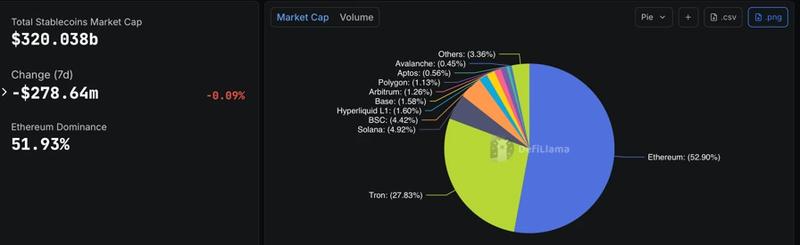
Current market valuation for stablecoins stands at approximately $320 billion, with market dominance concentrated among Tether's USDT (USDT) commanding roughly $189.7 billion and Circle's USDC (USDC) representing approximately $77.7 billion in market capitalization, based on data compiled by DeFiLlama.
Distribution of supply shows significant concentration across limited blockchain networks, with Ethereum (ETH) representing approximately 52% of total market share, while Tron (TRX) accounts for roughly 28% of the market. Remaining portions are spread among alternative networks including Solana, BNB Chain and various other blockchain platforms.