
US Senate Reconvenes to Continue CLARITY Act Deliberations This Week
As the US Senate resumes its legislative session, lawmakers prepare to advance discussions on a digital asset market structure bill while the GENIUS Act's public comment window reaches its conclusion.
The Digital Asset Clarity (CLARITY) Act is anticipated to return to the forefront of US Senate deliberations as legislators gather once again following the Memorial Day holiday recess.
Numerous members of Congress alongside prominent figures in the cryptocurrency sector are advocating for advancement of the CLARITY Act, a Republican-sponsored digital asset market structure measure that successfully cleared the House of Representatives in July 2025.
The proposed legislation, which is anticipated to grant expanded powers to the federal commodities oversight body regarding digital assets, successfully navigated two key committees prior to the week-long Congressional recess. Congressional debate on the measure has continued despite opposition from banking sector representatives and industry stakeholders concerning stablecoins, tokenized securities and related matters.
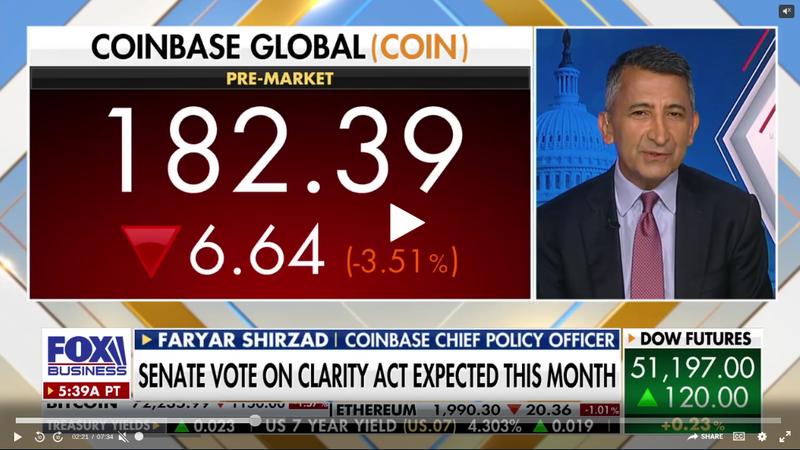
This will be actually the biggest financial regulatory bill that Congress has done in quite some time, certainly since Dodd-Frank.
Coinbase chief policy officer Faryar Shirzad in a Monday Fox Business interview, referring to a 2010 law in response to the 2008 financial crisis
Speaking on Friday, JPMorgan CEO Jamie Dimon stated that the financial services sector would oppose the CLARITY Act in its present form, contending that the proposed legislation permits cryptocurrency firms to offer interest payments on customer deposits and balances held in stablecoins.
During the coming week, Senate members will gain the chance to begin merging the distinct versions of market structure legislation that were approved by the agriculture committee in January and the banking committee in May, developing unified legislation that certain chamber members anticipate could face a floor vote as soon as August.
According to statements made in May by White House crypto adviser Patrick Witt, administration officials had established the US' Independence Day holiday as a target date, though uncertainty remained regarding whether the measure would be prepared for voting given ongoing concerns regarding ethics provisions.
In May, US Senator Kirsten Gillibrand stated that "there will be no one voting for this bill if we don't have an ethics provision." Members of the banking committee declined to consider amendments that would have addressed matters of ethics and conflicts of interest, with certain Republican lawmakers asserting that such concerns were appropriate for deliberation by the entire Senate body.
In the event that a unified bill reaches the Senate floor within the coming weeks, the Republican-controlled chamber would require support from some Democratic members to achieve the 60-vote threshold necessary to advance the legislation and send it back to the House and possibly to the president for signature. Certain legislators, including Senator Elizabeth Warren, have highlighted US President Donald Trump's connections to the cryptocurrency industry during CLARITY deliberations, pointing to his memecoin, his family's crypto venture World Liberty Financial and additional conflicts stemming from his position as an elected official.
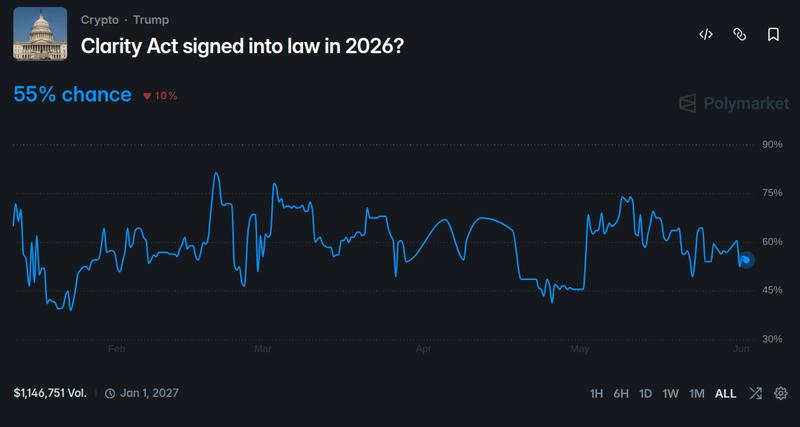
Betting activity exceeding $1.1 million has accumulated on Polymarket regarding the probability of the legislation's enactment during the current year, with the prediction market platform indicating a 55% likelihood of passage, according to Monday's latest data.
Public Comment Period for GENIUS Act Concludes
The public comment period for the GENIUS Act will close on Tuesday, as the US Treasury Department, Federal Deposit Insurance Corporation (FDIC), Financial Crimes Enforcement Network (FinCEN) and Treasury's Office of Foreign Assets Control cease accepting feedback on the stablecoin payments legislation that received presidential signature in July 2025.
Despite requests from at least one banking industry organization seeking an extension of the comment period, the Tuesday cutoff is anticipated to represent the subsequent phase in GENIUS' rollout. The legislation stipulates that it will become operational 18 months following enactment or 120 days after regulatory authorities publish final rules, whichever comes first.