
Treasury Department advances GENIUS Act implementation with anti-illicit finance measures
New regulatory framework would require stablecoin payment providers to implement comprehensive AML/CFT protocols and sanctions programs, granting authority to "block, freeze, and reject" specific transactions.

Under the proposed regulatory framework for the GENIUS Act, companies issuing payment stablecoins within the United States will face mandatory requirements to implement comprehensive systems designed to combat illicit financial activities.
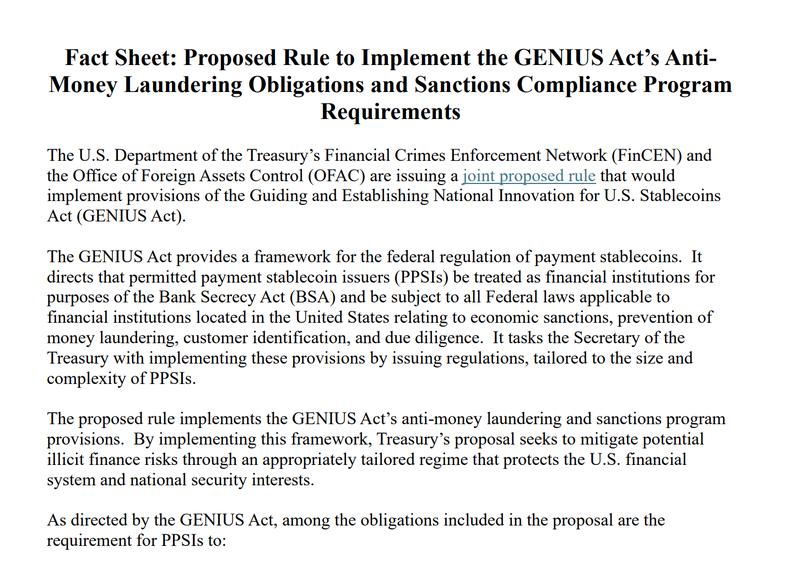
The US Treasury Department announced on Wednesday that its Financial Crimes Enforcement Network, working jointly with the Office of Foreign Assets Control (OFAC), had released a proposed rule aimed at implementing key provisions of the GENIUS Act, which became law following its signing in July 2025.
According to the proposal, payment stablecoin issuers would need to develop and maintain both an anti-money laundering (AML) program and a countering the financing of terrorism (CFT) program, establish a sanctions compliance program, and possess the capability to "block, freeze and reject" specific stablecoin transactions. Under this framework, issuers would be classified as financial institutions for Bank Secrecy Act (BSA) purposes.
"Bringing stablecoin issuers into full BSA/OFAC compliance effectively turns them into bank-like gatekeepers. That means significantly more wallet freezes, transaction blocking and asset seizures at scale."
Snir Levi, CEO of blockchain intelligence firm Nominis
The announcement from Treasury represents a component of the broader implementation strategy for the GENIUS Act, the legislation governing stablecoin payments that received US President Donald Trump's signature last year. This law establishes a comprehensive framework for entities issuing stablecoins and is anticipated to benefit cryptocurrency markets substantially. The act will become effective either 18 months following its July signing or 120 days after federal authorities publish associated regulations.
One day earlier on Tuesday, the US Federal Deposit Insurance Corporation (FDIC) released its own proposed regulatory rule as part of its contribution to GENIUS Act implementation. According to the FDIC's statement, individuals holding stablecoins would not qualify for insurance coverage under the legislation, although reserve deposits maintained by issuers would be eligible for protection.
Stablecoin yield fight rages between US lawmakers and banking and crypto industries
As federal agencies continue their work on implementing the GENIUS Act, Congress has found itself at an impasse regarding advancement of legislation designed to create a comprehensive digital asset market framework, known as the CLARITY Act following its passage through the House of Representatives last year.
Given that the Senate Banking Committee has not yet scheduled a markup session for the bill — an essential procedural step before a complete floor vote can occur in the chamber — representatives from the cryptocurrency and banking sectors have been conducting meetings with White House officials to address concerns surrounding stablecoin yield, tokenized equities and ethical considerations.
In a statement released Wednesday, the White House's Council of Economic Advisers indicated that prohibiting stablecoin yield in the legislation "would do very little to protect bank lending," asserting that such a ban would place financial burdens on users.
As of Wednesday, the banking committee had not announced a rescheduled date for a markup session on the CLARITY Act.