
Tokenized Financial Markets May Heighten Systemic Risks, IMF Cautions
Outstanding tokenized assets hit $65 billion by July, with credit instruments leading the way, while an IMF assessment underscores barriers to widespread use, settlement complications and expanding investor interest.
The practice of tokenization has the potential to revolutionize financial markets through enhanced trading and settlement efficiency, yet uncertainties in legal frameworks and threats to financial stability may impede broader implementation, the International Monetary Fund (IMF) has indicated.
In research published Thursday, the IMF noted that while tokenized financial markets are experiencing rapid expansion, they continue to represent a modest portion when measured against traditional markets, with limited interoperability and an absence of universally recognized settlement instruments serving as primary barriers to growth.
The disparity between what tokenization promises and its actual current footprint becomes clear when examining trading volumes. Daily transaction activity in tokenized repurchase agreements, commonly known as repos, ranges from $300 billion to $350 billion on average, a figure that pales in comparison to the approximately $13 trillion in daily trades within the wider US repo market.
Looking beyond repos and stablecoins, the value of outstanding tokenized assets is primarily concentrated within credit products and money market funds. As of July, tokenized real-world assets (RWAs) stood at roughly $65 billion in outstanding value, representing merely a tiny slice of the global capital-market assets totaling around $300 trillion. Credit products in tokenized form accounted for $30.4 billion, with money market funds following at $17.5 billion, and tokenized equities comprising approximately $2.3 billion.
Investors embrace 24/7 trading as risks persist
Notwithstanding their modest size, tokenized equity instruments are drawing investors who desire continuous trading capabilities and the ability to purchase fractional shares. The IMF's research revealed that over half of all tokenized equity transactions took place beyond standard US market operating hours, and approximately 80% of individual trades involved quantities of less than one full share.
The IMF's analysis additionally discovered that price fluctuations occurring overnight in tokenized equity markets appeared to be reflected in conventional stock prices soon after traditional markets commenced trading, indicating that tokenized platforms could offer valuable price discovery signals during off-market hours.
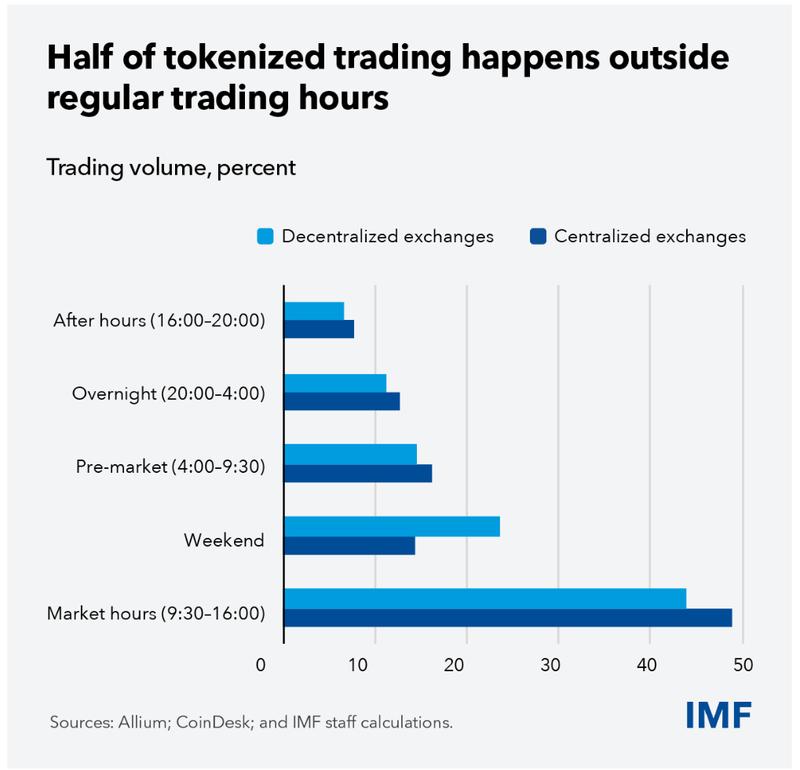
Nevertheless, the IMF reported that tokenized equity instruments demonstrated substantially lower liquidity levels and displayed approximately 1.5 times the realized volatility when compared to their conventional equivalents. The organization issued a warning that as tokenized markets continue expanding, increased interconnectedness combined with leverage could magnify established financial risks, encompassing fire sales, liquidity runs and contagion effects.
The IMF advocated for more transparent legal and regulatory structures, enhanced interoperability connecting tokenized and conventional financial infrastructures, and protective measures to mitigate emerging vulnerabilities as adoption continues to scale. In the present moment, though, the analysis observed that systemic risks remain constrained due to adoption levels still being comparatively modest.
IMF, European regulators raise tokenization concerns
This marks not the initial instance that the IMF has voiced apprehensions regarding tokenization. During November 2025, the organization issued warnings that automated trading mechanisms and interconnected smart contracts had the potential to magnify market volatility and contribute to flash crashes.
During April, the institution expressed caution that accelerated settlement processes could intensify financial stress conditions, and a July examination brought attention to systemic risks stemming from fragmented platform ecosystems and inadequate regulatory coordination efforts.
Regulatory authorities in Europe have articulated comparable concerns. During the previous month, the European Securities and Markets Authority (ESMA) issued warnings that strengthening connections between cryptocurrency and conventional finance, including those facilitated through tokenized equity products, could elevate the probability of financial disruptions propagating throughout markets.
"Tokenization may yet transform finance, but its future will be determined less by technological possibilities than by policies that ensure market depth, trust, and sound safeguards,"
IMF authors in Thursday's blog post