
National Football League Supports New Jersey's Supreme Court Challenge Against Kalshi
The National Football League has submitted an amicus brief backing New Jersey state officials in their Supreme Court petition challenging the prediction markets platform Kalshi.

The National Football League (NFL) has thrown its weight behind New Jersey state officials in their Supreme Court petition requesting consideration of a case involving sports betting through prediction markets platforms
Through an amicus brief submitted to the US Supreme Court this past Wednesday, the NFL urged the justices to approve a petition for a writ of certiorari from New Jersey Attorney General Jennifer Davenport alongside gaming enforcement interim director Mary Jo Flaherty. This submission came as a response to New Jersey officials seeking the court's review of their case against Kalshi, which could potentially determine whether prediction market companies fall under the jurisdiction of state authorities or federal regulatory agencies.
The professional football league endorsed numerous arguments advanced by New Jersey authorities, including concerns that the case raises significant questions about classifying sporting-event contracts on prediction market platforms as "swaps" and that judicial review is necessary to "preserve game integrity" while "protect customers." The organization referenced data indicating that during the opening Sunday of the football season, "more than half of all prediction-markets' trading volume," approximately $1.8 billion out of $3.3 billion, was connected to the NFL.
The NFL maintained that numerous sporting event contracts available on Kalshi and similar platforms were "highly susceptible to manipulation" or "otherwise inherently objectionable."
These bets, in the NFL's view, pose the greatest threats to game integrity, because many can be manipulated by a single person, especially if known in advance—for instance, a player can alter his performance, a coach can change his team's lineup, or an official can make (or not make) certain calls
NFL amicus brief
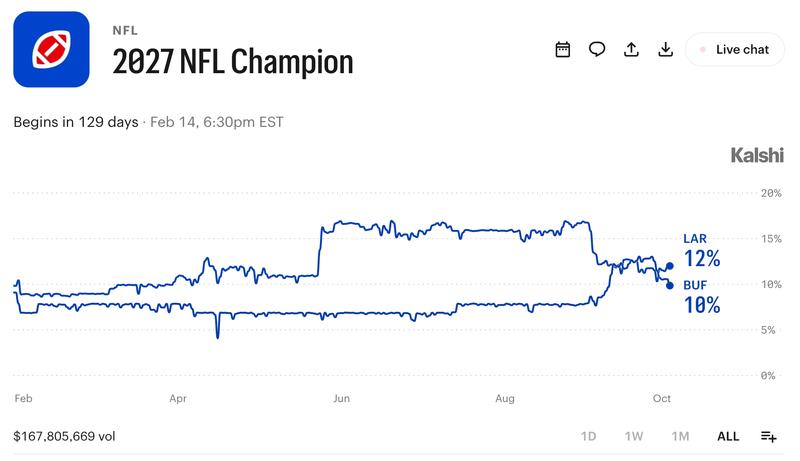
Another concern raised by the NFL involved the absence of what the organization described as "sensible safeguards" for event contracts from the Commodity Futures Trading Commission (CFTC). The question of federalizing sports betting regulation, as opposed to maintaining oversight at the individual US state level, represented a "major question" warranting Supreme Court consideration.
As of this Thursday, the Supreme Court has not made an announcement regarding whether it intends to grant review of this case. Kalshi has been granted an extension for responding to the New Jersey filing, providing the company with a deadline of Nov. 9 to address matters relating to jurisdiction, manipulable event contracts, and consumer protection.
States want clarification from SCOTUS on prediction markets
This past Wednesday, 39 US states along with the District of Columbia also submitted an amicus brief in support of New Jersey's position, asserting that the conflict between the CFTC and state authorities regarding prediction markets has created a "national turf war" that cannot be resolved absent a determination from the Supreme Court.
Waiting too long to address this issue will permit the federal-state regulatory dispute to escalate. The ongoing power struggle between the States and the CFTC highlights the unpredictability about what law applies—and to whom. Whether in this case, or in one of the many more cases sure to come, this Court should step in, resolve the circuit split, provide guidance to lower courts, clarify the CFTC's authority, and provide the badly needed answer to the Question Presented.
States' amicus brief
Kalshi spokesperson Dani Lever informed Cointelegraph following the September New Jersey filing that the company could not be "regulated by 50 different regulators."
Whether the Supreme Court justices will decide to take up the matter of prediction markets remains uncertain. Although New Jersey officials were the first to petition the high court for consideration of the Kalshi case, there were numerous examples of state-level enforcement actions against prediction market companies that could still face appellate review.