
Three-year growth streak for crypto-native yield stablecoins comes to a halt
The supply of yield-bearing stablecoins dropped 15% during Q2, with sUSDe and sUSDS experiencing declines, even as Treasury-backed alternatives like BUIDL, USYC and USDY posted gains.

The supply of yield-bearing stablecoins decreased by more than $3.5 billion during the second quarter of 2026, ending a nearly three-year streak of consecutive quarterly expansion as crypto-native offerings saw contractions while Treasury-backed alternatives experienced growth.
According to a Thursday report from crypto exchange CEX.IO, the sector saw a 15% drop throughout Q2. The supply of Ethena's sUSDe plummeted by 52%, losing close to $2 billion, while Sky's sUSDS experienced a 16% reduction.
Products backed by Treasury assets demonstrated the opposite trend. BlackRock's BUIDL expanded by 2%, Circle's USYC saw growth of nearly 16%, and Ondo Finance's USDY climbed by more than 66%, underscoring a growing gap between yield assets native to crypto and those supported by conventional financial instruments.
This divergence occurred as the overall stablecoin marketplace experienced its initial quarterly decline since the third quarter of 2023, CEX.io data shows. Overall supply dropped to $312 billion during Q2, while adjusted transaction volume saw a 5.5% decrease.
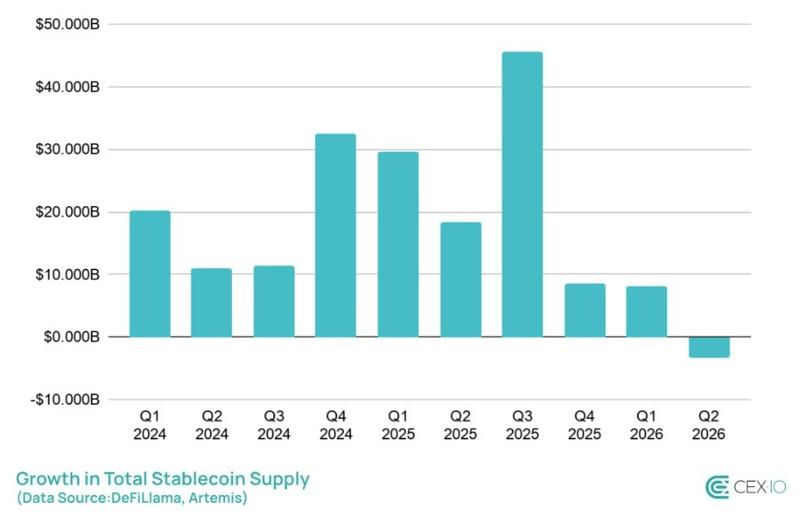
Stablecoin slowdown deepens after weaker Q1 signals
The second quarter downturn represents a dramatic turnaround from the beginning of 2026. During Q1, stablecoin supply grew by approximately $8 billion to reach an all-time high of $315 billion, with yield-bearing offerings serving as key contributors to this expansion.
Nevertheless, indicators of diminishing organic demand had begun to surface earlier in the year. Throughout the first quarter, retail-sized transactions decreased by 16%, while automated operations represented approximately 76% of stablecoin transaction volume.
The deceleration persisted into Q2. CEX.io data reveals that overall stablecoin transaction counts dropped by 530 million to reach 4.48 billion, representing the most significant quarterly reduction ever recorded. Nevertheless, transfers under $250 rose by 5% to reach $19.39 billion, indicating that smaller peer-to-peer transactions demonstrated greater resilience compared to larger automated operations and trading-related flows.
Contraction comes amid weaker crypto market activity
The decline in stablecoin supply also contributes to wider apprehensions about diminishing activity throughout cryptocurrency markets. On Wednesday, institutional data provider Talos highlighted declining stablecoin supply along with spot Bitcoin (BTC) exchange-traded fund (ETF) outflows and reduced Bitcoin acquisitions by Strategy as three critical demand channels that deteriorated during Q2.
Tanay Ved, senior research associate at Talos, told Cointelegraph that a rebound in stablecoin supply would indicate "fresh capital coming back into the ecosystem more broadly" and would help bolster onchain liquidity.
Ved noted that spot ETF flows continue to be the most critical demand channel to monitor because they typically reflect more sustainable changes in institutional interest. Nevertheless, he emphasized that ETF flows, corporate Bitcoin acquisitions and stablecoin supply frequently move in tandem when market momentum experiences shifts.