
Stock perpetual futures gain regulatory approval for US exchange trading
American financial regulators have granted approval for equity-based perpetual futures contracts, bringing a widely-used cryptocurrency trading instrument to conventional markets while legal challenges continue.

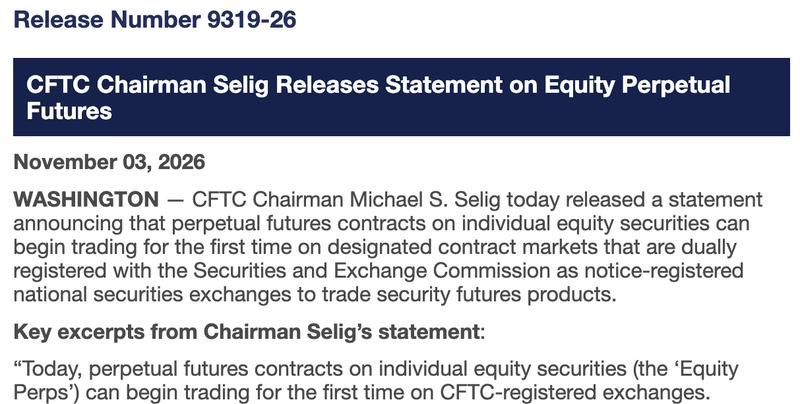
For the first time, perpetual futures contracts based on individual equity stocks have received authorization to trade on regulated exchanges in the United States, the Commodity Futures Trading Commission (CFTC) has announced, marking an expansion of a derivatives instrument that gained prominence in digital currency markets into conventional stock trading.
In a statement released Tuesday, CFTC Chairman Michael Selig indicated that these contracts received deemed approval status pursuant to CFTC Regulation 40.3, with availability on exchanges maintaining dual registration with the CFTC and the Securities and Exchange Commission (SEC) for security futures product trading.
According to Selig, introducing these products to regulated United States markets would provide American market participants with access to perpetual futures under domestic regulatory protections instead of compelling them to "forced to turn to offshore, and often unregulated, venues."
The perpetual futures mechanism enables market participants to establish positions on asset price movements without acquiring the underlying asset itself or confronting contract expiration dates. The cryptocurrency exchange BitMEX played a pivotal role in popularizing these instruments, frequently called perps, beginning in 2016.
This announcement arrives following a series of regulatory submissions filed in September, during which Coinbase, Kalshi and Kraken parent Payward, operating through its Bitnomial exchange, submitted requests for authorization to offer perpetual futures contracts linked to individual United States equities. OG.com entered the competition several days afterward, putting forward contracts designed for continuous weekday trading.
These submissions came on the heels of the CFTC's May decision approving Bitcoin perpetual futures contracts for Kalshi and distinct regulatory relief permitting Coinbase to facilitate access to specific cryptocurrency perpetual futures contracts listed on a related foreign trading platform.
Selig refrained from disclosing which specific exchanges would make the contracts available or establishing a timeframe indicating when trading operations would commence.
US push for perpetual futures faces legal challenge
This announcement also arrives nearly three months following President Donald Trump's statement that the CFTC was undertaking efforts to onboard Hyperliquid, a decentralized cryptocurrency exchange primarily recognized for perpetual futures trading, to the United States in a "fully compliant and legal fashion."
Trump delivered these remarks at an Aug. 19 White House event. During that period, neither the CFTC nor Hyperliquid had publicly disclosed a formalized strategy for establishing the platform's presence in US markets.
Nevertheless, the CFTC's methodology regarding perpetual futures has encountered legal resistance. During June, CME Group's Chicago Mercantile Exchange initiated legal action against the regulatory agency concerning its authorization of cryptocurrency perpetual futures, contending that these contracts warrant regulation as swaps instead of futures and that the agency had overstepped its regulatory authority. This classification carries significance because swaps face different regulatory obligations, potentially encompassing more stringent reporting, margin and registration requirements, whereas futures maintain the ability to trade within the established futures exchange regulatory structure.
The CFTC filed a motion to dismiss the lawsuit in September, maintaining that CME demonstrated insufficient standing due to its failure to establish financial injury and possessed the capability to list comparable contracts independently.