
Standard Chartered delays $2T stablecoin market projection to 2030 amid rising usage patterns
Analysis reveals four separate stablecoin sectors, with USDC dominating payment systems and AI-driven transactions while competition heats up around reserve yield distribution.

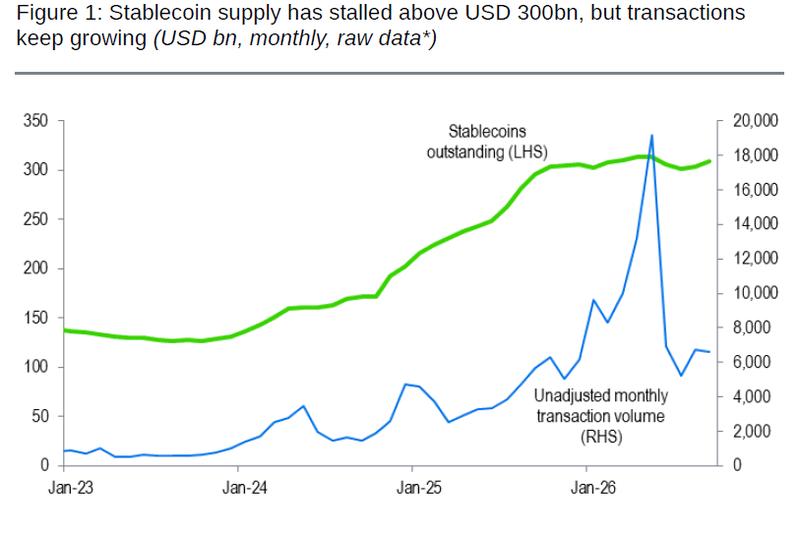
According to Standard Chartered, transaction activity in the stablecoin sector is experiencing sustained growth despite the market's total value remaining relatively stagnant, indicating that current stablecoins are being utilized with greater frequency instead of new issuance fueling expansion.
Through a report provided to Cointelegraph, the financial institution revealed it has adjusted its stablecoin market capitalization forecast to hit $2 trillion by 2030, representing a two-year delay from its original timeline, following the market's stabilization at approximately $309 billion throughout this year.
Geoffrey Kendrick, who serves as StanChart's head of digital assets research, explained that stablecoin adoption is experiencing continued expansion notwithstanding the deceleration in supply increases, with current stablecoins being exchanged with increased frequency as their applications become more varied.
Kendrick outlined four separate market segments, each characterized by unique competitive forces. Tether's USDt (USDT) maintains dominance in emerging-market savings applications, whereas Circle's USDC (USDC) commands developed-market payment systems. Both USDC and Ethena's USDe have secured dominant positions within crypto trading operations, while USDC additionally leads the considerably smaller sector of transactions conducted between AI agents.
The financial institution anticipates the fiercest competition will emerge in developed market payment systems, where new entrants including USDG, M^0 and multibank stablecoin networks are seeking alternatives to current payment infrastructure.
Based on Kendrick's analysis, the manner in which issuers and payment networks allocate the yield produced by stablecoin reserves may prove decisive in determining which competitors successfully capture market share.
US regulatory and accounting changes could shape stablecoin use
The updated projection from Standard Chartered emerges alongside regulatory and accounting changes in the United States that have the potential to impact corporate stablecoin adoption patterns.
Following the passage of the GENIUS Act in 2025, regulatory authorities in the US have put forward rules addressing stablecoin issuance, reserve requirements and consumer safeguards. Certain provisions have also delineated the boundaries of these protections, including a Federal Deposit Insurance Corporation (FDIC) proposal that would prevent stablecoin holders from receiving pass-through deposit insurance coverage.
The Treasury Department has simultaneously moved forward with implementing the legislation. During August, it introduced rules that would limit stablecoin issuance within the United States to entities authorized at the federal or state level, with these licensing requirements anticipated to become effective in January 2027.
In a separate development during August, the Financial Accounting Standards Board (FASB), the organization responsible for establishing US accounting standards, introduced a proposed update that may influence how corporations record specific stablecoins on their financial statements.
Tempo, a blockchain payments company, indicated the proposed modifications have the potential to simplify stablecoin usage by businesses for payment and settlement purposes while avoiding the introduction of additional accounting complexities.