
Stablecoin Market Split: USDT Dominates Payments While USDC Rules DeFi, Dune Analysis Reveals
Analysis from Dune reveals a clear market division as Tether's USDT emerges as the leading stablecoin for payments transactions, while Circle's USDC maintains dominance in decentralized finance applications, demonstrating how blockchain selection influences stablecoin functionality.

Rather than directly competing for the same market segments, the cryptocurrency industry's two largest stablecoins are evolving into specialized financial instruments tailored to different blockchain ecosystems, with Tether's USDt (USDT) and Circle's USDC (USDC) each fulfilling unique functions throughout the digital asset landscape.
According to Dune's Digital Asset Brief, USDT has established an overwhelming lead in the realm of onchain payment transactions. Throughout the initial six months of 2026, the market-leading stablecoin processed approximately $95 billion worth of documented commerce-related payments, significantly outpacing the $14 billion handled by its closest competitor, USDC. Additionally, USDT represented around 92% of the $48 billion in business-to-business transaction volume recorded during this period. Within the Tron network, which serves as USDT's primary blockchain platform, approximately 93% of the token's total supply resides in standard user wallets as opposed to exchange platforms, emphasizing its primary function as a tool for payments and cross-border remittances.
Conversely, USDC has solidified its position as the preeminent stablecoin within the decentralized finance sector. The USDC token operating on the Base blockchain facilitated approximately $2.6 trillion in transfer volume throughout June alone, representing the largest volume of any individual token-chain combination, whereas Ethereum-based USDC processed an additional $1.6 trillion during the same timeframe.
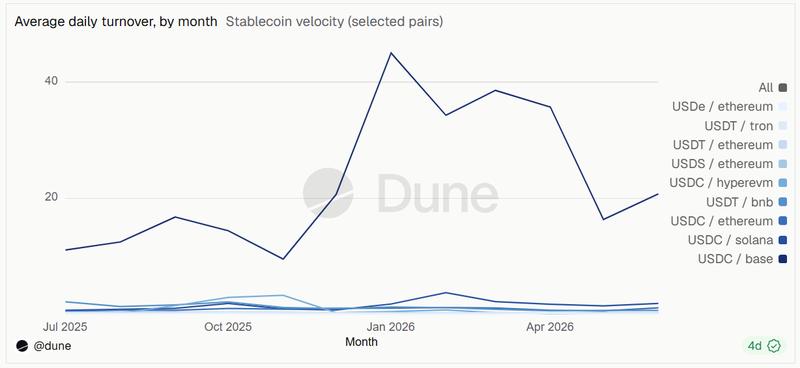
These data points indicate that the conventional head-to-head USDT-versus-USDC comparison framework is diminishing in relevance. Rather than direct competition, each stablecoin appears to be establishing its own specialized market segment, with USDT emerging as the leader in payment infrastructure while USDC serves as the foundation for a substantial portion of cryptocurrency trading and decentralized finance operations.
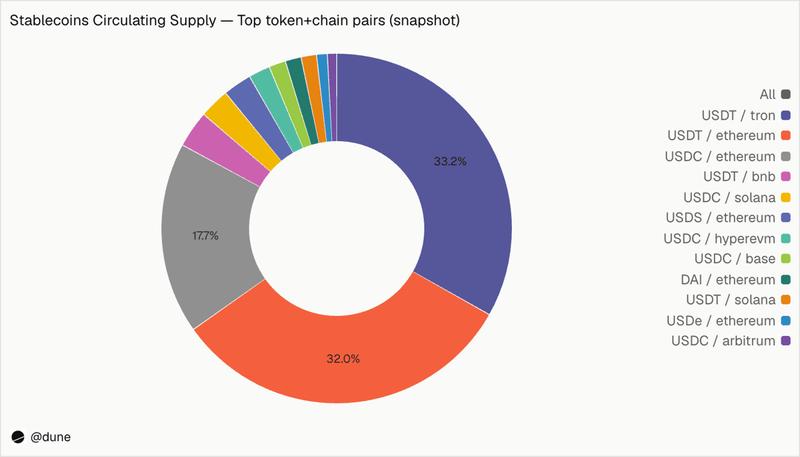
These observations emerge as both digital assets maintain their commanding presence within the stablecoin marketplace. Combined, the two tokens represent approximately 83% of the industry's total market capitalization, which stands at roughly $315 billion, based on data from Dune, which monitored over 200 distinct stablecoin tokens operating across numerous blockchain networks.
US lawmakers reshape stablecoin rules
Within the United States, the stablecoin industry has experienced accelerated development following the enactment of the GENIUS Act. After being signed into law during 2025, GENIUS created the nation's inaugural federal regulatory structure governing payment stablecoins, opening opportunities for banking institutions and additional organizations to create digital assets pegged to the US dollar.
Legislative bodies are currently examining the CLARITY Act, legislation that would create a comprehensive market framework for digital assets through establishing guidelines determining whether cryptocurrency assets are subject to oversight by the US Securities and Exchange Commission or fall under the authority of the US Commodity Futures Trading Commission. Although the legislation does not include direct regulation of stablecoins, it would influence the wider regulatory landscape affecting stablecoin issuers, cryptocurrency exchanges, and decentralized finance platforms throughout their operations.
The CLARITY Act successfully advanced through the Senate Banking Committee during May and may proceed to a complete Senate floor vote prior to the August recess, though Galaxy has recently reduced its probability estimate for passage before the break to 50% as available legislative time becomes increasingly limited.