
SoFi's blockchain settlement strategy demonstrates stablecoins as viable payment infrastructure alternative
Financial services firm SoFi advances its payment capabilities by transitioning its complete card program to settlement on blockchain infrastructure powered by SoFiUSD stablecoin, anticipating over $25 billion in annual transaction volume.

The role of stablecoins in facilitating payment settlement behind established card networks continues to expand, enabling continuous fund transfers while maintaining existing consumer payment experiences.
However, instead of displacing major players like Visa, Mastercard or financial institutions from the transaction ecosystem, this emerging technology is starting to substitute a more specific component of the payment infrastructure: the conventional banking channels traditionally employed for settling balances among network participants.
This transformation came into sharp focus recently as SoFi commenced settling both debit and credit card payments with Mastercard through the deployment of its SoFiUSD stablecoin. The financial institution announced its plan to transition its complete card portfolio, which is projected to handle over $25 billion in annualized transaction volume, to this new settlement framework.
The transition does not eliminate middlemen from the card settlement workflow, according to a SoFi spokesperson who spoke with Cointelegraph, but rather offers an alternative settlement infrastructure built on blockchain technology.
From the customer perspective, these modifications occur predominantly in the background. SoFi's card users will maintain their normal debit and credit card usage patterns, while the migration to onchain processing enables the financial institution to finalize transactions more rapidly, the spokesperson explained.
Visa is similarly pursuing onchain settlement capabilities. In April, the payment giant reported its stablecoin settlement experimental program had achieved a $7 billion annualized run rate while extending compatibility to nine blockchains, characterizing blockchain-based settlement as a "viable complement to traditional settlement rails."
Stablecoins don't eliminate payment intermediaries
In a March note, Federal Reserve researchers indicated that stablecoins have the potential to transform payment economics without necessarily removing banks from the equation.
Cointelegraph conducted interviews with payments and investment specialists to gain deeper insight into what aspects of card settlement actually change with the move to blockchain, and what elements remain essentially unchanged.
"I wouldn't call it disintermediation at this stage,"
Martins Benkitis, co-founder and CEO of emerging-markets liquidity provider Gravity Team
"Visa and Mastercard are still there. The banks are still there. The network is still calculating the obligations, managing the transaction and deciding how participants interact with it," he said.
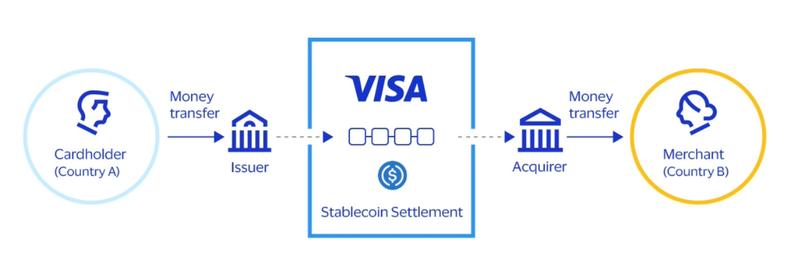
Consequently, stablecoins may occupy an increasingly significant position in the payments landscape without businesses or end consumers necessarily engaging with them in a direct manner.
"If stablecoins become a major part of payments, most businesses probably won't care that there is a stablecoin somewhere in the process. They'll care that settlement is available when they need it and that the money arrives."
Martins Benkitis
The economics of faster settlement
Varun Datta, venture capitalist and founder of Truth Ventures, concurred that real-time settlement capabilities could minimize processing delays and decrease the capital reserves companies must maintain across different geographical locations for payment operations, especially in cross-border transactions.
However, those advantages don't automatically result in reduced payment costs, he noted. Expenses related to currency conversion, regulatory compliance, system integration and stablecoin administration must still be factored into the equation.
"I don't think speed on a blockchain automatically means a cheaper end-to-end payment,"
Varun Datta
He further stated that he would require confirmation of reduced aggregate costs and improved liquidity management at scale before declaring the economic argument conclusively validated.
Stablecoins still need local liquidity
The financial calculations can grow increasingly complex when stablecoins must eventually be exchanged for local fiat currencies.
Benkitis explained that although stablecoins denominated in dollars can transfer between financial ledgers in a matter of minutes, finalizing payments in developing markets presents additional challenges. Liquidity in local currencies may be more limited, a smaller number of banking institutions may facilitate these flows, and integration with the domestic banking infrastructure remains necessary.
"The stablecoin gets the value there quickly. You still need the local liquidity to finish the payment."
Martins Benkitis