
Six major Canadian banks team up to develop tokenized deposit system
The nation's top financial institutions are moving forward with tokenized deposits for payments between banks, following recent regulatory guidance on their treatment.

A collaborative initiative among Canada's six biggest banks is underway to develop a framework for tokenized Canadian dollar deposits, enabling digital versions of bank deposits to transfer across financial institutions.
Bank of Montreal, CIBC, National Bank of Canada, Royal Bank of Canada, Scotiabank and TD Bank Group are participating in the initiative, as revealed in a collective announcement made by the banks on Tuesday. The initial stage will concentrate on transferring tokenized deposits among Canadian financial institutions, with plans to eventually integrate with additional digital asset platforms.
The initiative arrives just under two weeks following additional guidance from Canada's banking regulator regarding the legal status of tokenized deposits for banking institutions.
The Office of the Superintendent of Financial Institutions (OSFI) stated on Sept. 10 that tokenized deposits are "not legally distinct from traditional deposits," further noting that the technology underpinning a financial product does not alter its legal classification.
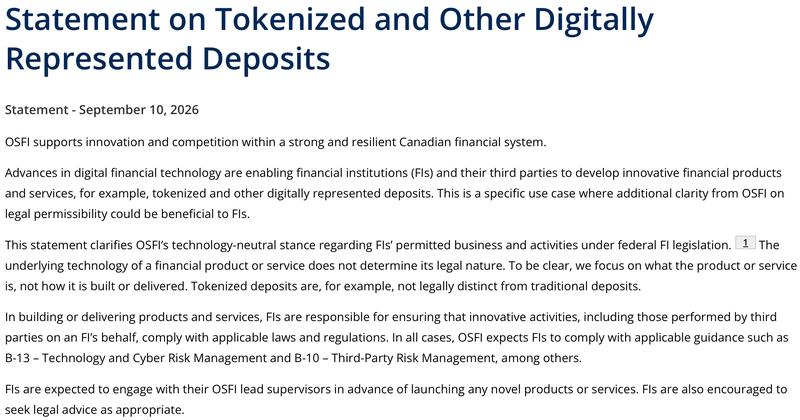
Money held at a regulated bank is what tokenized deposits represent, and they continue to be a liability of the issuing bank, which distinguishes them from fiat-backed stablecoins that function as independent digital assets supported by reserves maintained by their issuer.
According to the banks, the framework is designed to enable more rapid and programmable payments, with future objectives including expansion of the initiative to additional deposit-taking institutions. An immediate response was not received after Cointelegraph reached out to CIBC for further information.
Canada builds out stablecoin framework
As Canada develops a more comprehensive regulatory structure for digital money, the tokenized deposit initiative is taking shape.
Canada's Stablecoin Act became law in March as a component of Bill C-15, creating a federal regulatory structure for fiat-backed stablecoins. Non-financial institution issuers will need to register with the Bank of Canada under the regime, keep reserves at a minimum 1:1 ratio in high-quality liquid assets and provide par value redemption to holders. The framework's implementation is anticipated in 2027.
The framework, however, applies exclusively to fiat-backed stablecoins issued by entities that are not financial institutions. Banks and credit unions already under prudential regulation are excluded from its scope. Additionally, issuers subject to the framework will be barred from characterizing their stablecoins as deposits or as covered under a public deposit insurance program.