
Cross-border stablecoin transactions jump 78% amid broader cryptocurrency market decline
International stablecoin transactions experienced a dramatic surge even as the overall cryptocurrency market contracted by 37%, with Chainalysis identifying increased adoption for commercial transactions, international money transfers and wealth preservation.

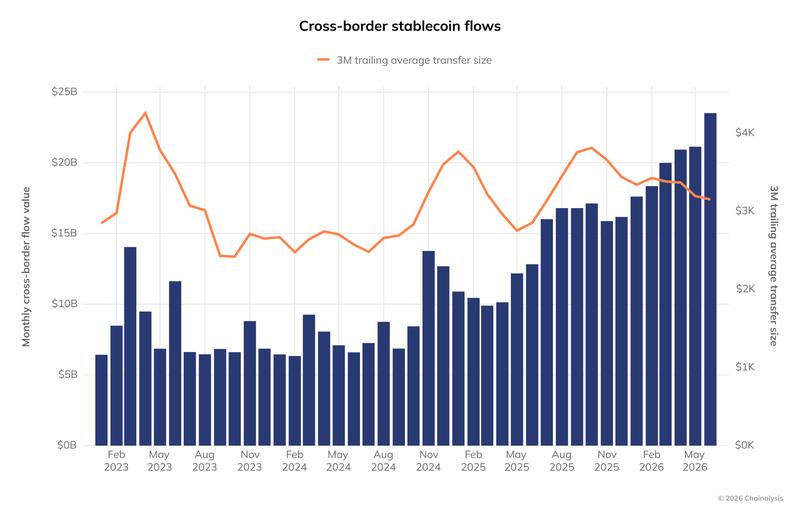
The cryptocurrency sector's declining fortunes throughout the past year have had minimal impact on international stablecoin activity, with transactions across borders climbing 77.5% during the year ending June 2026 even as the overall market witnessed a value decline exceeding one-third, new findings from Chainalysis reveal.
According to the blockchain analytics firm's freshly published 2026 Global Crypto Adoption Index, international stablecoin transaction volumes expanded 77.5% to reach $220.3 billion during the 12-month period concluding in June 2026, up from $124.2 billion recorded in the prior year-long timeframe, while the aggregate cryptocurrency market capitalization simultaneously contracted 37% to settle at $2.1 trillion throughout the identical interval.
The bear market hit the price-sensitive half of crypto and left the payments half alone.
Chainalysis
This expansion suggests rising cryptocurrency utilization extending beyond investment speculation. Digital currencies designed to preserve stable valuations, typically pegged to traditional fiat money, have established meaningful traction within conventional financial services. The GENIUS Act received presidential signature and became United States law in July 2025, meanwhile the European Union's Markets in Crypto-Assets framework and Hong Kong's stablecoin issuer licensing structure have drawn these digital assets increasingly under established financial regulation.
According to Chainalysis, the expansion originated from international transactions averaging approximately $3,000, which aligns with practical everyday applications including business vendor payments, international family remittances or transferring personal savings away from unstable national currencies.
Activity has become consistent, routed through wallets in a steady rhythm rather than in bursts. That is the signature of trade and business activity, not speculation.
Philip Gradwell, vice president of economics at Tether
In an interview with Cointelegraph, Tianwei Liu, co-founder and CEO of StraitsX, explained that throughout Asia, disparate national currencies and incompatible payment infrastructures have generated significant appetite for stablecoin-based transaction settlement.
That demand is also extending into everyday spending, with stablecoins sitting behind payment methods people already use.
Tianwei Liu, co-founder and CEO of StraitsX
Beyond the Asian continent, however, stablecoins fulfill distinct requirements, Liu noted, encompassing access to United States dollar exposure, international money transfer services and safeguards against currency devaluation or government-imposed financial restrictions, particularly throughout Latin American nations, African countries and Middle Eastern territories.
The blockchain analytics company identified 4,708 newly established international transaction corridors throughout the reporting timeframe, collectively processing a total of $2.64 billion. Individual corridors represent specific pathways connecting a sender country with a destination nation.
Transaction volumes continued showing substantial concentration within the highest-performing quarter of all corridors, which represented 96.1% of quantifiable international stablecoin transaction value. The bottom three quarters processed $8.66 billion collectively, representing substantial growth from $260 million during the preceding period.
Speaking to Cointelegraph, Vincent Chok, co-founder and CEO of First Digital, explained that although conventional payment infrastructure continues performing adequately for well-established transaction routes, it becomes increasingly fragmented when enterprises transfer capital between jurisdictions featuring divergent banking frameworks, different national currencies and varying settlement timeframes.
Stablecoins provide an alternative solution, Chok indicated, though adoption faces ongoing limitations including regulatory uncertainty, dependable redemption mechanisms, local currency access points and compatibility with established banking infrastructure.
Onchain settlement is fast, but it doesn't solve the off-chain parts: converting to local currency, meeting compliance requirements, and moving funds through existing banking rails.
Vincent Chok, co-founder and CEO of First Digital
At the same time, established international money transfer companies have broadened their stablecoin service portfolios throughout this year.
Western Union introduced a proprietary stablecoin wallet paired with a Visa-linked payment card spanning 37 jurisdictions in August, enabling customers to maintain balances and conduct purchases using its proprietary US dollar-backed stablecoin product.
MoneyGram unveiled a comparable card program in September, with initial availability in Colombia, alongside plans for expansion into additional geographic markets before year-end.