
SEC declares majority of cryptocurrency assets fall outside securities classification
The regulatory agency released guidance detailing token classification frameworks and establishing which digital assets would be treated as securities under federal regulations.

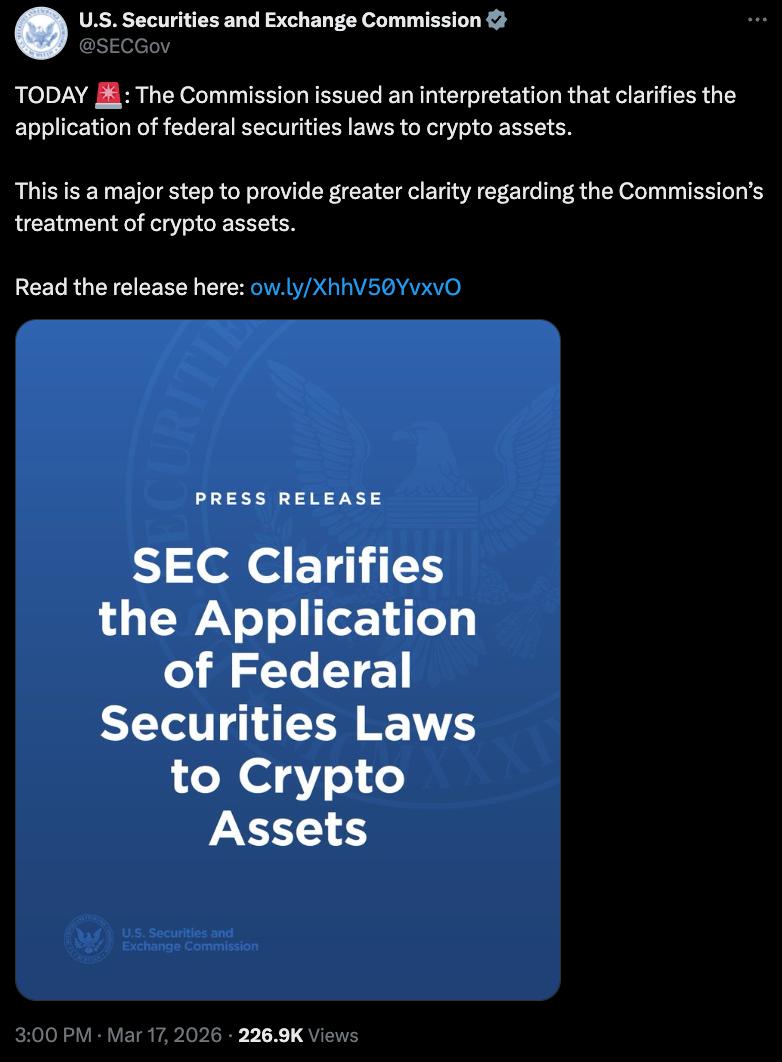
Among the initial measures taken following the execution of a memorandum of understanding with the Commodity Futures Trading Commission (CFTC), the US Securities and Exchange Commission (SEC) announced it would provide interpretative guidance on how "non-security crypto assets" are treated under federal securities regulations.
According to a notice released on Tuesday, the SEC indicated that its guidance regarding the treatment of crypto assets would function as a crucial "important bridge" while US Congress legislators deliberate on market structure legislation designed to establish regulatory frameworks for how financial authorities will supervise digital assets.
The regulatory body stated that the guidance would establish a "coherent token taxonomy for digital commodities, digital collectibles, digital tools, stablecoins, and digital securities," outline how a "non-security crypto asset" might or might not qualify as an investment contract falling within the SEC's jurisdiction, and provide clarity on federal securities regulations concerning "airdrops, protocol mining, protocol staking, and the wrapping of a non-security crypto asset."
"This is what regulatory agencies are supposed to do: draw clear lines in clear terms. It also acknowledges what the former administration refused to recognize -– that most crypto assets are not themselves securities. And it reflects the reality that investment contracts can come to an end."
SEC Chair Paul Atkins
Based on Atkins' prepared statement delivered at the DC Blockchain Summit on Tuesday, the interpretation leaves "only one crypto asset class remains subject to the securities laws," specifically "traditional securities that are tokenized." The regulatory commission urged industry participants to examine the interpretative guidance to "better understand the regulatory jurisdiction between the SEC and CFTC" regarding cryptocurrencies.
The interpretative notice from the SEC was released while US Senate legislators continue discussions over the conditions under which they could achieve consensus on a digital asset market structure bill. The proposed legislation is anticipated to grant the CFTC expanded authority over cryptocurrency oversight.
Shakeup in SEC enforcement leadership draws criticism
The SEC disclosed on Monday that Margaret Ryan, director of its enforcement division, has stepped down from her position at the agency. Sam Waldon, the principal deputy director, was designated as acting enforcement director.
Following Ryan's exit, John Reed Stark, a former SEC official, stated that "not a single person on this planet" accepts the commission's assertions that the enforcement director made investor protection a priority and brought "renewed focus on holding individual wrongdoers accountable" to the agency.
"The SEC has abandoned its identity. It has transformed from the cop on Wall Street's beat into something far more troubling, a regulatory body that functions less like a law enforcement agency and more like a concierge service for the largest financial players in the country."
John Reed Stark, former SEC official
Stark, who served at the regulator for 19 years, established and led the SEC's Office of Internet Enforcement, as indicated on his LinkedIn profile.
The agency's leadership currently consists of Atkins, alongside SEC Commissioners Mark Uyeda and Hester Peirce — all three being Republicans — who represent the only remaining leaders on a commission designed to include a bipartisan composition of five members. As of Tuesday, US President Donald Trump had made no announcements regarding nominations for additional commissioners to either the SEC or CFTC, the latter of which had just one Senate-confirmed member.