
Resource-Based Fee Reform on Solana to Boost Token Burns and Charge Heavy Users More
A new Solana improvement proposal seeks to restructure network fees based on computational demands, raising costs for resource-intensive operations while reducing prices for basic transactions and accelerating SOL token burning.

A significant restructuring of Solana's resource pricing mechanism is currently under consideration by the network.
The Solana Improvement Document known as SIMD-0553 aims to implement a system where the blockchain's heaviest computational users face higher charges, while those conducting basic transactions would benefit from reduced costs. Additionally, the proposal includes provisions to accelerate the rate at which SOL tokens are burned — potentially setting the stage for deflationary tokenomics in the future.
The proposal's author, Cavey, who works as a researcher at Solana infrastructure company Temporal, explains to Magazine that the existing fee structure fails to accurately represent actual computational expenses:
"If I submit a transaction that does nothing versus a transaction that burns 200 million CPU cycles, I'm charged the same amount."
The suggested changes would establish a direct correlation between fees and the computational resources that each individual transaction demands. Instead of compensating validators, these resource-based fees would undergo burning, effectively eliminating SOL tokens from the total supply.
However, the prospect of diminished validator compensation has generated pushback from certain quarters. On github, contributor bji voices opposition:
"I like the aspect of this proposal that gives tx submitters extra incentive to be accurate with CU limits. Everything else I'm meh to negative on. 'More burn' should not be a goal. Validator incomes should not be arbitrarily reduced."
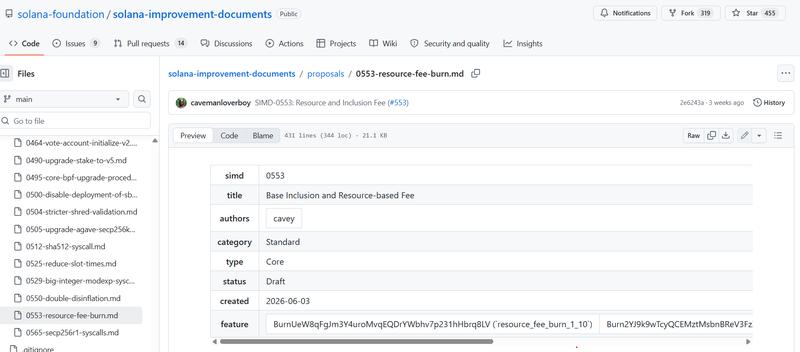
The SIMD-0553 proposal was introduced into Solana's newly established onchain governance framework during early August, successfully completing its preliminary support phase on August 4.
The proposal is presently navigating the support and discussion phase, which conventionally spans seven epochs, approximately equivalent to two weeks. Should it receive approval, the changes would fundamentally alter the economic incentives surrounding Solana's low-cost blockspace.
What are the potential downsides?
Resource Inefficiency Comes With a Price Tag
According to Cavey, the existing fee model on Solana presents challenges for application developers.
Despite years of optimization work by core Solana developers to enhance network performance, applications currently lack meaningful financial motivation to eliminate wasteful resource consumption — since inefficient and efficient transactions carry identical price tags.
"By installing this resource pricing right now, suddenly app developers have to optimize," Cavey says.
Should the proposal gain acceptance, developers who successfully minimize resource consumption could pass along savings to their users and enhance their applications' competitive positioning. Meanwhile, developers whose applications demand greater portions of Solana's computational bandwidth would face proportionally higher costs.
The proposal specifically targets computationally inefficient arbitrage operations, according to Cavey, where traders can flood the network with massive quantities of largely unsuccessful transactions while incurring minimal expenses.
During the previous 30-day period, he notes, the five traders exhibiting the highest transaction failure rates collectively submitted 11.5 million transactions, utilizing 929 million compute units across 2,477 successful trades that yielded $16,091 in profits, while their total fee expenditure amounted to merely 78 SOL.
Implementation of a resource-based fee structure would encourage arbitrage traders to adopt more strategic and responsive methodologies.
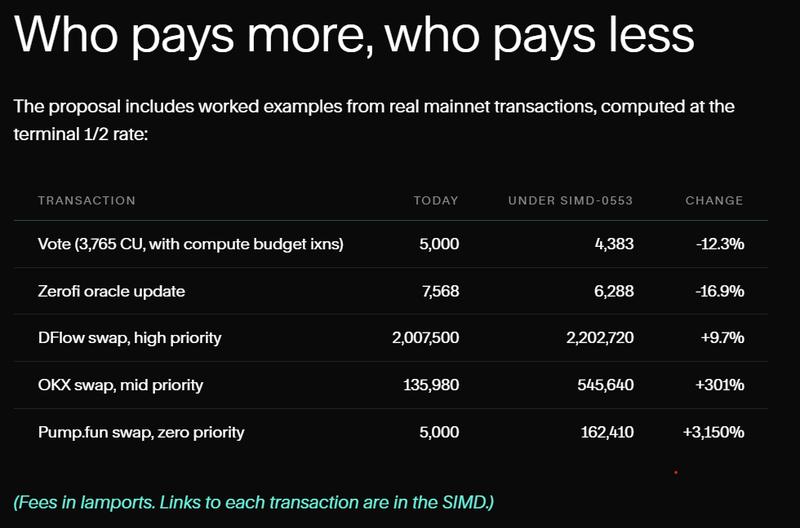
Simple stablecoin and token transfers could see approximately 20% cost reductions, Cavey notes. Modeling conducted by Temporal additionally indicates that vote transactions would experience around 12.3% lower costs and oracle updates would decrease by 16.9% under the proposed framework.
The Potential Drawback?
Certain categories of trading activity would experience substantially elevated costs.
According to Temporal's analysis, a high-priority swap executed through DFlow would incur 9.72% higher costs under the proposed terminal fee structure, whereas a mid-priority OKX swap would see costs rise by 301% and a pump.fun swap with zero priority would face a dramatic 3150% increase.
This indicates that some of the network's most intensive users could witness significant inflation in their transaction expenses, especially automated traders deploying bots that generate high transaction volumes.
Nevertheless, the increases originate from a minimal baseline, Cavey points out. He maintains that even the most computationally demanding transactions would cost approximately $0.05 under the proposed system, compared with the $2 to $5 fees a typical user might encounter when swapping $100 on a centralized exchange platform.
The current proposal explicitly rejects implementing a blanket increase to Solana's current 5,000-lamport fee, contending that such an approach would unfairly burden high-volume participants like market makers while continuing to inadequately price actual resource utilization.
Additional Considerations and Concerns
"There have been a few people that have raised concerns about the parameters, but overall, everyone's been very supportive," Cavey says, citing validator income, higher costs for high-frequency users and increased complexity among the core issues.
Contributor mschneider questions the rationale for basing fees on requested resources rather than actual consumption. "Units used seems more natural," he says.
Cavey explains that charging based on requested resources rather than actual usage serves important purposes: it provides users with transparent upfront cost information and enables validators to verify transaction affordability before commencing processing. However, this approach also means users may pay for unused resources, creating an incentive for developers to accurately estimate their computational requirements.
Validators might experience a modest decline in base-fee revenue, approximately 4% initially. Though Cavey indicates the parameters could be modified to neutralize this effect if necessary, certain contributors including bji maintain their skepticism and argue that protecting validator income should supersede additional token burning.
The proposal has also sparked discussions regarding added complexity, with several contributors expressing concerns that the revised fee model might complicate Solana's user experience. Cavey dismisses this worry, noting that most end users won't need to perform fee calculations themselves since applications and exchanges typically manage this automatically. Automated trading operations already possess the "sophisticated" infrastructure necessary to accommodate adjustments in Solana's fee architecture, he argues.
Implications for SOL Token Burning
Implementation of SIMD-0553 would substantially increase the quantity of SOL tokens removed from circulation through transaction fee burning, diverting more tokens away from validator compensation.
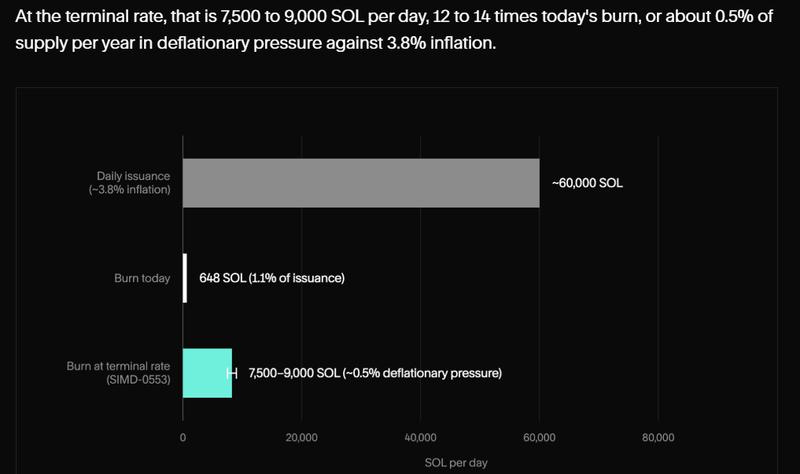
Based on the proposal's calculations, the current daily burn rate of approximately 648 SOL could climb to roughly 7,500 to 9,000 SOL under the proposed terminal fee rate, representing approximately a 12 to 14-fold multiplication assuming resource demand patterns remain constant.
Cavey suggests the enhanced burn rate could ultimately transition SOL into deflationary territory:
"If Solana wins, there's a chance that Solana could actually become a deflationary currency."
Directing the resource fee toward burning also diminishes incentives for validators to prioritize unnecessarily resource-heavy transactions.
Solana's current issuance stands at roughly 60,000 SOL daily, meaning even a 9,000-SOL daily burn rate would fall short of creating deflationary pressure independently (though a companion proposal designated SIMD-0550 would accelerate inflation reduction beyond the current schedule). Substantial growth in network activity would be required before burn rates could surpass new token issuance. According to Cavey, achieving deflationary status would represent "a nice secondary effect" rather than the proposal's central purpose.
"The primary goal is to align core devs, developers, and app developers to make Solana faster. That is objective number one, and that is enough of a reason for this proposal, in my opinion."