
Research from Stanford reveals Bitcoin prediction markets with 5-minute windows vulnerable to price manipulation
Academic study identifies how Polymarket's brief Bitcoin prediction market timeframes create opportunities for spot price manipulation during settlement periods, with researchers suggesting extended windows as solution.

An academic investigation conducted by researchers from Stanford University alongside Singapore Management University has revealed that Polymarket's brief five-minute Bitcoin prediction market contracts incentivize market participants to manipulate Bitcoin's spot price during settlement periods, enabling experienced traders to extract profits from less sophisticated retail market participants.
The research investigation analyzed market contracts where participants placed wagers on whether the price of Bitcoin would finish higher or lower than a specified threshold following five-minute intervals. Since these contracts reach settlement through Chainlink price feed data reflecting Bitcoin's valuation at the conclusion of trading windows, market participants face motivation to sway the underlying spot market in the moments preceding settlement time.
Through examination of trading patterns both prior to and following Polymarket's contract launch in July 2024, academic researchers discovered dramatic spikes in Bitcoin spot-market order activity immediately preceding settlement periods, which were then followed by swift price reversals, patterns that aligned with settlement-price manipulation tactics.
According to the study's calculations, such manipulative behavior resulted in approximately $1.28 million being transferred from regular traders into the pockets of those engaging in manipulation throughout the analyzed timeframe. The academic researchers determined that expanding contract time periods from five minutes to 15 minutes effectively eliminated the manipulative pattern.
The academic team emphasized that their findings should not be interpreted as evidence that prediction markets possess inherent susceptibility to manipulation, contending that thoughtful settlement architecture can meaningfully diminish such risks. They highlighted extended settlement timeframes and alternative pricing methodologies, including time-weighted average price calculations, as viable remedies.
The study's implications reach well beyond cryptocurrency markets. The research paper observes that conventional financial exchanges, such as Nasdaq and Cboe, have put forward event contract proposals linked to asset valuations, elevating contract architecture to an increasingly critical factor as prediction market platforms penetrate deeper into regulated traditional financial infrastructure.
World Cup fuels prediction market growth
The prediction market sector recorded unprecedented trading volumes throughout June as the enlarged 2026 FIFA World Cup tournament drove heightened activity throughout the industry. Based on DefiLlama statistics, Kalshi executed approximately $9.4 billion worth of trading volume throughout the month, whereas Polymarket International facilitated roughly $4.3 billion in transactions.
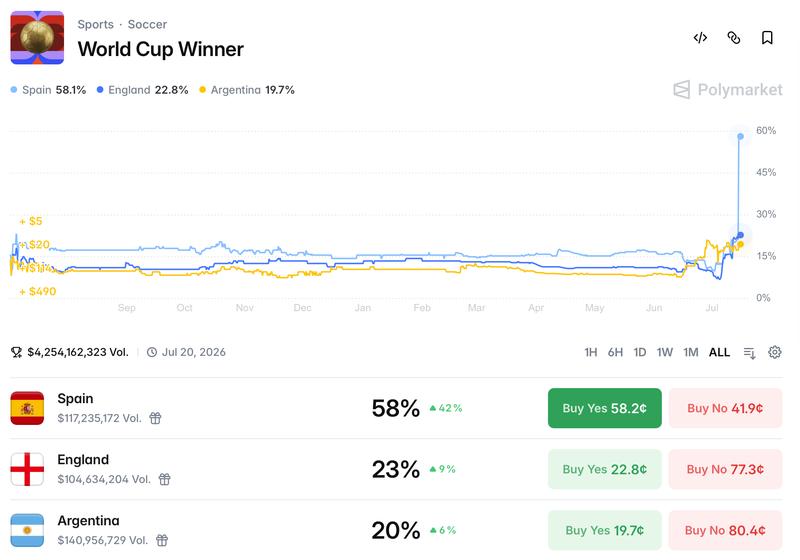
The World Cup winner prediction markets across both platforms have subsequently accumulated in excess of $5.4 billion in aggregate trading volume, with Polymarket accounting for approximately $4.25 billion and Kalshi representing about $1.2 billion, based on platform data available at the time of writing.
The industry's rapid expansion has occurred alongside escalating regulatory oversight. Multiple US state governments have initiated legal challenges against companies such as Kalshi and Polymarket throughout this year, as the Commodity Futures Trading Commission has maintained its position that federally supervised event contracts are subject to its "exclusive jurisdiction" instead of state-level gambling regulations.
The jurisdictional conflict is currently advancing through the federal court system, and legal experts have indicated that contradictory decisions from appellate courts could ultimately lead the US Supreme Court to determine whether state authorities or the CFTC possess primary regulatory authority governing prediction market platforms.