
Polymarket wallets earn $1M betting on Iran military action, raising insider trading concerns
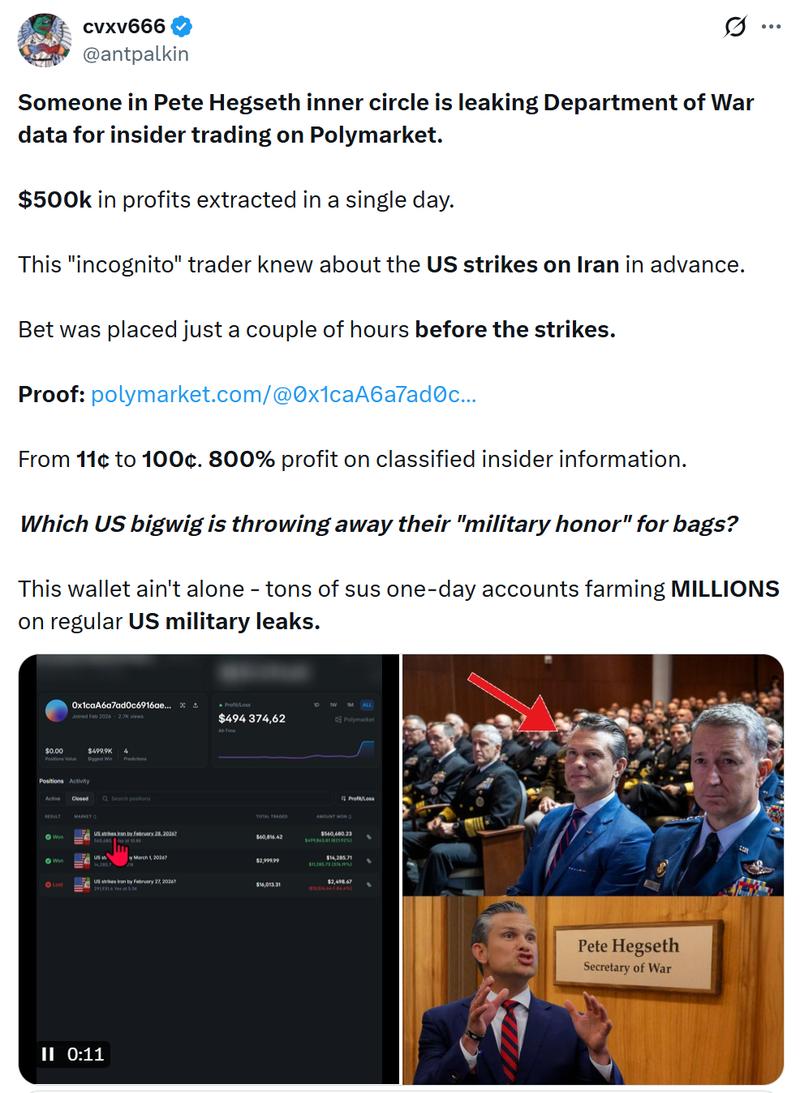
A group of recently established Polymarket wallets wagered on when the United States would conduct military strikes against Iran, purchasing shares mere hours before initial reports of explosions emerged from Tehran.
A group of six Polymarket participants generated approximately $1 million in profits following successful wagers that predicted United States military action against Iran would occur prior to February's conclusion, raising red flags regarding potential insider trading.
All six wallet addresses were established during February and concentrated virtually their entire trading activity on prediction contracts focused on the potential timing of a US military assault, according to a Bloomberg report citing information provided by Bubblemaps SA, an analytics company. Multiple instances showed shares being bought just hours ahead of the first explosion reports emerging from Tehran, with certain contracts being purchased at approximately $0.10, the report indicated.
The suspicious timing captured the attention of blockchain investigators, who noted that the trading patterns bear resemblance to previous behaviors associated with suspected insider activity occurring on prediction market platforms.
"In cases involving war or conflict, information can circulate within a broader circle before becoming public. Combined with the fact that Polymarket generally only requires a wallet to trade, which allows for a high level of anonymity, this can create incentives for informed participants to act early."
Nicolas Vaiman, chief executive of Bubblemaps
Cointelegraph reached out to Polymarket for comment, but had not received a response by publication.
Polymarket Iran strike bets draw $529 million in volume
It's worth noting that one of the identified accounts had suffered losses on a previous prediction before making a substantially larger bet that ultimately yielded more than $170,000 in returns, indicating that the trading activity alone does not conclusively establish misconduct. Additionally, Washington had openly signaled the possibility of military intervention for several weeks, which attracted numerous speculators to the prediction platform.
This is not the first occurrence of insider-trading accusations directed at Polymarket. Earlier this week, a limited group of cryptocurrency wallets generated over $1.2 million through wagers on a contract connected to an onchain investigation concerning DeFi platform Axiom, just before investigator ZachXBT released allegations that an Axiom employee and their associates had participated in insider trading activities beginning in early 2025.
During the previous month, a Polymarket account generated approximately $400,000 from a strategically timed bet regarding the apprehension of Venezuelan President Nicolás Maduro. The wallet had wagered roughly $32,000 on Maduro's ouster shortly before public news disclosure, triggering concerns about insider trading.
US lawmaker moves to ban insider trading on prediction markets
As Cointelegraph reported, US Representative Ritchie Torres is preparing legislation called the Public Integrity in Financial Prediction Markets Act of 2026 to limit insider trading on prediction platforms. The proposal would bar elected officials, political appointees and executive-branch employees from trading contracts tied to government policy or political outcomes when they possess nonpublic information.
Meanwhile, Polymarket has faced a wave of regulatory actions worldwide, with several countries, including the Netherlands, Hungary, Belgium, France, Italy, Romania, Poland, Singapore and Portugal, blocking or banning the platform after classifying its event-based contracts as unlicensed online gambling rather than financial trading.